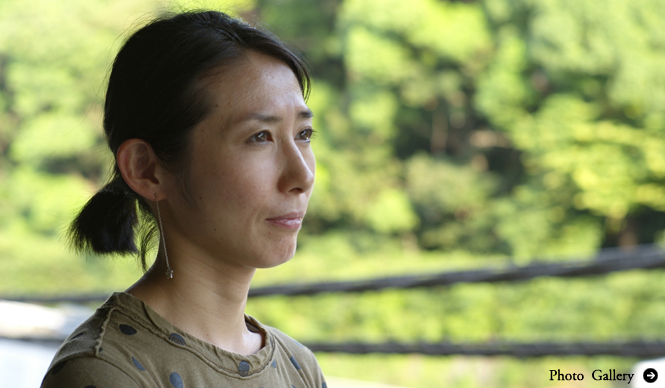
Feature: OPENERS' Picks of Japan's Women Architects Vol. 1: Kumiko Inui Interview
Vol. 1: Kumiko Inui Interview (1)
Affirming the Landscape
In 2008, OPENERS featured a special series titled "Japanese Young Architects Gaining Global Attention," introducing five architects from Japan. This was an attempt to embody the state of Tokyo in the 2000s, a city where the internet and personal computers had become commonplace and information technology had advanced significantly, by borrowing the words of these professionals who shape the city's form. It was also an endeavor to describe Tokyo not as a place rooted in the unreal and virtual, but through the reality that emanates from human activity.
Entering the 2010s, the economy and politics have become increasingly turbulent, and people's tastes and fashion trends have diversified, making it seem like we've entered an era where the future is hard to foresee. Precisely because of this, could we not say that we are now at a new, favorable turning point towards the next era, if we think positively?
This architectural feature introduces five Japanese women architects. Each of them, while observing the current state of Tokyo, broadens their perspective to regional and global scales, engaging in global activities through methods unique to architects. It is our hope that through the words of these five architects, we can illuminate, even in a small way, the future form of Tokyo (the city) and the ideal future for our OPENERS readers.
Interviewer and Editor: Takashi Kato
Architecture Gently Connecting City and Landscape
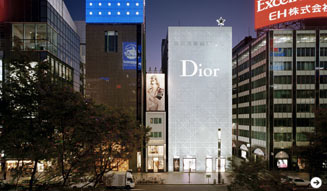
Her impressive designs, such as the residential complex 'Apartment I' and the 'Dior Ginza' and 'Louis Vuitton Taipei Building,' seem to integrate landscape and architecture. Kumiko Inui's architecture gently connects the city and landscape by exploring the invisible elements of a place and giving them form. In this interview, we had an in-depth conversation with her, covering everything from the facade designs for international luxury brand stores to her perspective on the current state of Japanese cities and her latest works.
—Please tell us about your encounter with architecture.
When I was a child, my parents used to read a magazine called Shukan Shincho. It no longer exists, but at the time, there was a long-running series called 'My Privacy.' It featured small floor plans of houses, which I loved and looked forward to every week. While looking at 'My Privacy,' I started to find floor plans interesting. The pages also included exterior and interior photos, so I naturally began to understand the meaning of floor plans, realizing that a building would take on a certain shape based on its layout. I sometimes imitated them and drew floor plans.
I am the youngest child, and perhaps because of that, I never had my own room. My older sister and brother each had their own rooms, but I was sort of staying in a corner of my sister's room, which I felt was unfair even as a child. Perhaps as an expression of that feeling, I would fantasize about rebuilding the house and creating my own room. Even though it was a fantasy, the plan was quite detailed, as if I were measuring the dimensions of the site before drawing.
While refining these plans many times, I asked my parents if they could rebuild the house, but naturally, they refused, saying it was impossible. So, I examined the existing floor plan and proved that by rearranging furniture, a storage room could be freed up, and I managed to get a small room that was being used as a storage space at the time.
—How big was that room?
It was a 4-tatami mat room. Small. Once you put in a bed and a desk, that was it. Even so, to create a comfortable room, I was influenced by Kappa Senno's 'Kappa ga Nozonda Toilet Mandara,' which was popular at the time. I kept drawing bird's-eye views of the room and thinking about its usability. In other words, I've loved thinking about houses since I was a child. However, I didn't know that the profession of architect existed when I was a child. So, I didn't want to become an architect back then.
In junior high and high school, I was good at drawing and belonged to the art club. Prematurely, in my first year of high school, I decided I wanted to go to an art university and started attending a preparatory school for art. I wasn't sure which department I would enter, but I decided in my heart that I would go to an art university. However, around my second year of high school, I suddenly realized I didn't have a talent for drawing. Around that age, you can distinguish between people who are technically good at drawing and those who draw pictures that people find appealing. I realized I was the former. Technically skilled, but I understood that drawing isn't just about that. I despaired, thinking I wouldn't amount to anything even if I went to art school.
Around that time, I learned that art universities had architecture departments, and that they even had drawing exams. So, I thought I could utilize the drawing skills I had honed. And that's how I came to apply for the architecture department.
Vol. 1: Kumiko Inui Interview (2)
The Emergence of Rem Koolhaas
—Was your high school a general academic track?
It was a general academic track with a science focus. My scores were good only in math and physics, so when I consulted with my teacher, they agreed that architecture might be a good fit.
—Did you have anyone working in architecture around you at the time?
I have an uncle who is an architect, but he wasn't that close to me.
—Did you ever show your childhood floor plan drawings to your uncle or consult with him?
No, I didn't.
—Were you never praised for the drawings you made back then?
No. I would just give myself high marks, thinking, 'Wow, that's really good,' or 'What a great floor plan,' and be impressed by myself (laughs). I was a rather introverted child, so I never really showed them to anyone. Even now, I can recall the floor plans I drew.
—Did those connect to your current design work?
No, they didn't. What I was thinking about then were orthodox courtyard types and simple plans that anyone could come up with, so even looking back, they aren't particularly interesting.
—A child's dream house, or rather, a dream floor plan.
No, it wasn't fantasy in the usual sense. While not an interesting proposal, it was quite realistic. In other words, I was engrossed in things that weren't childish.
—Yes, the very concept was practical, starting with the existing site.
Exactly. And there were scales involved too.
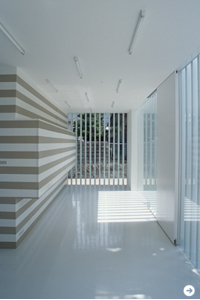
'Renovation of Kataokadai Kindergarten' (2001)
Photo by Ken Takahashi
—So, you began to study architecture professionally at university. What did you do there?
I was fortunate to get into the architecture department at the University of the Arts. As expected, having drawn floor plans since elementary school, my design skills were fairly good within the class. I was the type of student who was good at organizing things, meticulous. However, just like the limit I hit in high school, there was a moment when I suddenly realized that perhaps I was just 'good' at it. For example, the plans were well-organized, but was it truly good architecture? Or, was it interesting as architecture? I started to worry around my third year, when I began to grasp architecture somewhat.
There is interesting architecture and uninteresting architecture in the world, and I thought that if I continued to design only skillfully, I would inevitably end up creating only uninteresting architecture. So, I reflected on myself, thinking I had to change. I made an effort to look at various things, determined to break out of my shell.
—Looking at things is indeed important. During that time, did you encounter anything or anyone that influenced you and continues to do so?
I spent my undergraduate years in the early to mid-1990s. The mainstream architecture at the time was in the final phase of buildings influenced by the bubble economy, and it was around this time that Kazuyo Sejima began to present her work. Because of the era, there were many decorative buildings, and ideologically, superficiality was rather celebrated. Of course, looking back, those were interesting buildings in their own right, but from a student's perspective, I felt I couldn't quite keep up, or rather, that imitating them wouldn't lead anywhere. It felt like there was a lack of things that truly captured my heart during that period.
The era one experiences as a student is a matter of life and death. I was struggling, but there was no architecture that offered suggestions to save me, and at worst, I could have come to dislike design itself. I managed to maintain my interest in design, but I spent the rest of my undergraduate days in a state of constant turmoil, eventually deciding to study abroad and went to Yale University on the East Coast of the United States. I was at Yale from 1992 to 1996. By the mid-1990s, the activities of OMA, led by Dutch architect Rem Koolhaas, were becoming increasingly active. As I looked at and researched their work, I finally began to find contemporary architecture interesting. It was precisely around that time that OMA's approach was pioneering the next era of architecture.
—You were passionately following that as a contemporary event in America.
That excitement wasn't limited to America; it was a global phenomenon centered in the Netherlands, including Japan. I happened to be observing it from America. During this period, any student aspiring to be an architect was likely influenced by OMA, and I was one of them.
Vol. 1: Kumiko Inui Interview (3)
The Relationship Between Planning and Program, Structure and Surface
—Then, as you learned about OMA's work and global contemporary architectural trends, you began to think about and construct your own architectural methods. How did you approach that?
That was quite difficult. During my student days, discovering OMA was enough to realize the fascination of architecture; I was far from developing my own architectural methods. After returning to Japan, I joined Jun Aoki's office in 1996. Aoki and his staff at the time were also influenced by OMA's ideas, so I gained practical experience while engaging in interesting discussions. What I appreciated at Aoki's office was that he taught me a great deal about the breadth of architecture, not limited to OMA.
I then went independent and started my own firm in 2000. The projects I received were for interiors and exteriors, programs unrelated to architectural planning. However, the prevailing approach at the time was to construct architecture based on program considerations. This approach isn't very useful for things less than architecture, like interiors and exteriors, which don't fully address architectural functions. In other words, I lacked the tools to solve these problems. I found myself thinking, 'Interiors all of a sudden...' and felt like everything I had diligently learned up to that point was wiped clean.
So, I decided to reset my thinking to a blank slate and began to consider what I could do with interiors and exteriors, and how I could construct that within my own limited thought process. From there, I feel that a certain tendency, though not strongly original, began to emerge.
To be more specific, I think there are several points. With interiors and exteriors, there's often little room for planning. Especially in commercial interiors, decisions about placement are entirely driven by economic logic. In such situations, architects often end up dealing only with the superficial aspects, like cosmetic treatments. When told to 'just handle the surface,' I decided to seriously engage with manipulating the surface. This led me to consider whether such superficial manipulation could, in fact, alter the deeper aspects of the space. That's what I explored.
Learning Architecture
The 'Jürgen Lehl Marunouchi' store is an example of what emerged from this approach. In that project, planning wasn't the primary focus. Instead, by concentrating on the surface and applying a special technique, I aimed to create a space that would offer visitors a new sense of comfort.
In the case of exteriors, there is no inherent function; the only issue is how to present the surface. What needs to be avoided here is simply creating something beautiful and finishing it. If the goal is just to create something beautiful, there's no need for an architect. Learning architecture means being drilled in considering architecture in relation to various issues, such as history, urban problems, and community issues. This leads one to wonder if it's possible to find ways to approach urban problems even through surface manipulation. I feel it would be embarrassing to create something without such a perspective.
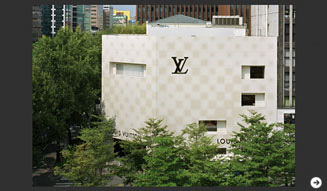
'Louis Vuitton Taipei Building' (2006)
For example, take the facade of the 'Louis Vuitton Taipei Building' in Taipei. Taipei is a pleasant city with abundant greenery. In contrast, Louis Vuitton is a symbolic entity that evokes specific images upon hearing its name, with no connection to the vibrant cityscape of Taipei. Therefore, if we were to express this symbolic entity directly as the facade, it would be too overpowering for the history and physical nuances of the city where it is built. I thought that wouldn't be right. Even for a store with a strong image like Louis Vuitton, I wondered if it was possible to create something that responded more subtly to the existing cityscape.
What I did here was to vary the size of the damier checkerboard squares to create a large checkerboard pattern that becomes visible from a distance. Furthermore, by varying the size of these large checkerboard squares and creating a soft, mottled pattern, I made it resemble the silhouettes of the surrounding trees. This allows the building's facade to blend in without overwhelming the environment, appearing softly like the surrounding greenery.
Although it uses the checkerboard pattern that Louis Vuitton possesses, I thought that if it could echo the silhouettes of trees, it would become continuous with the cityscape. In this way, I was earnestly trying to create a logical connection, even if just at one point, between what is newly created and the existing environment.
—This is akin to the struggle you felt in the early 1990s, when the city was filled with superficial elements. After ten years of various experiences, you once again confronted the issue of surfaces as an independent architect.
I don't think the meaning of 'surface' is the same in both periods, so I haven't consciously connected them, but perhaps the result is similar. In any case, I began to make an effort to incorporate architectural themes, even when dealing with surface issues.
—This must be the awareness you gained from encountering OMA in the mid-1990s, meeting Jun Aoki, and grappling with urban issues as an architect for ten years.
Perhaps so.
—So, you became able to proceed not just by manipulating surfaces, but by taking into account the history of the city and architecture.
Looking back, I question whether this was the best answer, but at the time, I thought it was important to establish some connection with the city. And I believed that the closer that connection, the better. That's how I was thinking and working back then.
Vol. 1: Kumiko Inui Interview (4)
On Order in Architecture
—In your book ('Sotto Kenchiku wo Oite Miru' - Placing Architecture Gently, INAX Publishing), I read that you wanted to express the order of richness unconsciously integrated into everyday life through the generosity of architecture, and I found that insightful. Could you tell us about the order you envision?
Order can be found everywhere. In the case of 'Louis Vuitton Taipei Building,' the buildings in Taipei are clustered in a chaotic manner. Amidst this, the dense trees provide a sense of order to the cityscape. I felt that the landscape is established by the presence of trees, and that's where I should focus.
In the 'Renovation of Kataokadai Kindergarten' project, mentioned in 'Placing Architecture Gently,' when I first visited the office that requested the renovation, I was dismayed by the lack of order, with various things piled up haphazardly. From a typical architectural perspective, this disarray is unacceptable, yet the teachers who lived there didn't seem to find it problematic. Moreover, they were able to operate a social institution like a kindergarten without issue. I was initially surprised by the gap between this lack of order and the functioning of their social activities. However, I realized there is visible order and invisible order, and that they likely shared this invisible order, which somehow enabled things to run smoothly. As a symbol of this, there was a rabbit hutch for the kindergarten's pets under a tall stack of documents.
—What is this order, seemingly random to an outsider, within a cluttered space that even accommodates the presence of a rabbit?
In a word, it's likely the accumulation of shared experiences. These experiences are shared among the teachers as an invisible order. Traces of this shared understanding are scattered throughout the space. Seeing the rabbit hutch beneath the documents made me feel that perhaps I needed to look at it more closely.
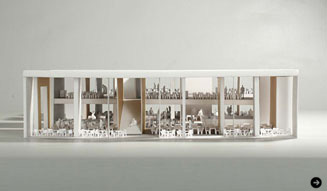
'(Tentative) Kyoei Gakuen Maebashi University of International Studies Building No. 4' (2010)
I realized that architecture had perhaps been too focused on a singular, visually apparent order. For instance, landscape theory is a good example. Although no longer popular, it once targeted utility poles and billboards. That's precisely what I call superficial, focusing only on visuals to categorize things as good or bad. However, the order of a city is not determined solely by such elements. While Japan's cities may appear messy and lacking in principles at first glance, they are, contrary to appearances, operated with considerable order. This must be properly evaluated.
—Human rules also often maintain a sense of order.
Yes. I believe that because such things exist firmly in the background, it is important for those who design to recognize that order exists in various layers. That's what I think.
—However, as designers, you must also have a strong desire to leave your mark or express your vision. Considering that, where does your strength, gentleness, or perhaps vulnerability in affirming the existing landscape come from?
My trip to America greatly influenced my affirmation of the landscape. The city of New Haven, where Yale University is located, was a truly tragic place. While university faculty and students, being part of a private institution, lived comfortably, stepping outside the university area revealed streets lined with abandoned buildings, a city plagued by frequent murders. The campus blended into the city without any fences separating it from the surroundings, making the boundaries between safety and danger extremely ambiguous. I don't know if it's changed now, but at the time, even when I visited other states, there were always neighborhoods that looked run-down. Witnessing such tragedy made me think that Japan was still doing quite well, and there was no reason to deny that.
—Through those experiences, you began to view the existing landscape positively.
Yes. This might be a bit of a leap, but I once read a book by someone who traveled the world and experienced farming in places like Africa. During their travels, they realized that Japan has incredibly fertile land. In Japan, you can plant anything anywhere, which is something we take for granted. The previous point is quite similar to this; there's no need to deny Japan's natural environment. That's how I feel.
Vol. 1: Kumiko Inui Interview (5)
How Architects Engage with the Landscape
—Perhaps we, the writers, accumulate small daily experiences and connect them to our lives when we talk about cities and architecture. Yet, recently, cities and architecture seem to have become distant from us who live in them. I was born in 1965, and I used to have an image of the city as a place where meaning would expand the more I approached it. But nowadays, I don't feel that way so much. I used to think of architecture as an extension of my daily life, but seeing good old things being demolished for redevelopment, I've been constantly pondering what that means, even if it's not an issue with individual buildings.
Cities and architecture have become distant images. That might be true. Seeing places that were not problematic being altered, not through slum clearance but through other means, it's not surprising to feel that the city is being ravaged by someone. The situation where the economy takes precedence over the city's history and depth is unfortunate for everyone.
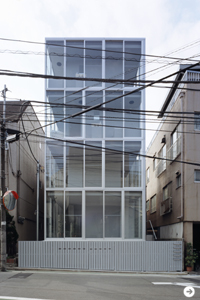
'Apartment I' (2007)
—Given this situation, do you consider ways to address it as an architect?
Real estate development, as an economic activity, is so immense that I had resigned myself to the fact that it was a problem that a single architect couldn't tackle. In other words, I felt it was unrealistic for an individual architect to do anything about it. Therefore, I had half-abandoned the idea of thinking about that issue myself. However, in the last two to three years, Japanese corporate activities have been weakening.
—The economy and population are both shrinking.
While we shouldn't celebrate this, I believe it's an opportunity for a fundamental change in the social structure, a time to consider the next step. I don't know specifically what I will do now, but I think it's a good time to reclaim what we lost during Japan's post-war economic growth.
Vol. 1: Kumiko Inui Interview (6)
The Relationship Between Architecture and Media
—I believe it's also our responsibility as writers, but for some time now, the decline of media has been discussed alongside the decline of Japanese cities and the economy. Looking back at the post-war architectural world, architecture and media, or rather architecture and criticism, had a mutually stimulating relationship. What are your thoughts on this?
I think that's very important. Criticism still holds a certain validity in architecture, and through criticism, communication across generations is established. For example, people from their 20s to their 80s can react to Toyo Ito's work with excitement or opposition, sparking discussion. In contrast, to make a comparison, I've heard that in contemporary art, such intergenerational communication is almost non-existent. Perhaps it's because the genre of contemporary art has become too diffuse, or the market is too strong, making criticism difficult to establish.
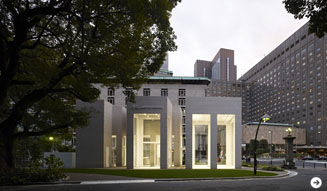
'Flower Shop H' (2009)
Architecture is still a relatively orthodox field, and there are common tasks that must be performed for any building. In that sense, architecture can maintain its critical platform strongly. In other words, it's still doing relatively well. However, architecture is becoming increasingly diffuse in its directions, which might make it difficult for criticism to be established.
—I believe that on one hand, there is what is called architectural studies. Of course, we should learn it, and it's important knowledge to have when living in a city or urban environment. However, I sometimes think that the landscape where architecture exists could be something closer to us, something that arises from the accumulation of people's daily lives.
Yes. Both are important. Balancing the two is crucial and difficult. Like all academic fields, I think various disciplines have rapidly advanced over the past 20 years. In this context, I believe ordinary citizens, outside of specialists, feel left behind. This is likely true for medicine, economics, and everything else.
In architecture, I think it has become so advanced that the general user cannot understand it. In the pursuit of safety and comfort, buildings have become so high-performance that they are impossible to comprehend with simple explanations. From a specialist's perspective, it's 'There are no problems, so please use it with peace of mind.' But from the user's perspective, doubts arise, like 'Is that really true?' The same thing happens in medicine. If these doubts are left unaddressed, dissatisfaction will eventually erupt. What becomes important then is, naturally, the time and effort required for clear communication. Workshops, for example, could be one such method.
—If there's a reason for that, it's that architecture has become so high-tech in its function and appearance that it has surpassed our understanding. While there's a lack of explanation from designers and developers, I believe the media, which should convey this information, also has a role to play, and I say this with self-reflection. Since architecture can be beneficial to everyone's lives if we engage with it properly, I want to focus on conveying its value.
It's truly difficult. As the terms 'construction state' and 'building-centric administration' suggest, construction is directly linked to politics. From that perspective, there are people who view the act of building itself as inherently bad, or are simply tired of new construction, and that's my personal observation. Within this context, creating and conveying the pure joy and wonder of architecture is a challenge for architects.
Vol. 1: Kumiko Inui Interview (7)
Tokyo and Other Cities
—Let's move on to a slightly brighter topic...
No, this isn't necessarily a dark topic. While it may seem dark at first glance, the essence is that architecture is currently in a somewhat unfavorable position, but perhaps it can't get any worse (laughs), offering a sense of brightness because we've reached rock bottom. We can no longer rely on the same level of consideration as before; we need further innovative ideas, stamina, and courage to move forward. That's all that has become clear. We can feel cheerful because things have become clearer.
—Then, (laughs) could you tell us about the No. 4 Building at Kyoei Gakuen Maebashi University of International Studies, for which you recently won a proposal competition?
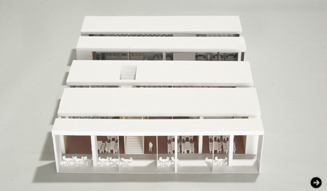
'(Tentative) Kyoei Gakuen Maebashi University of International Studies Building No. 4' (2010)
It's a building of about 2,000 square meters, with two main functions: a communication space centered around a student cafeteria, and learning spaces such as a media center and study areas. From above, it appears as if it's divided into five buildings. Each building is strip-like, with only walls erected inside. These are gathered together. By gathering them, the accidental placement of walls and columns, determined by the required area, creates a layout like an 'Amida lottery' on the plan, diversifying the relationships between opposite rooms.
This creates several options for how opposite rooms connect, allowing them to become larger or smaller rooms. Even within the same space, new spatial configurations emerge each time depending on the relationship between the rooms. This is the plan.
The university calls this flexible use of a single space 'layered usage' (kasanetsukai), a unique term they came up with during the competition. The university faculty devised this idea, and it's quite fascinating. Although the budget is not abundant, the university has many programs they want to implement. As a solution, they are pursuing this 'layered usage.' Our proposal aimed to give form to this concept of 'layered usage,' which was initially just an idea, creating a unique kind of flexibility throughout the entire building.
Also, as it is a Christian institution, we aimed for elements that would naturally express Christian spirit, such as light pouring from the skylight, a grand staircase, and the overlapping of walls and floors to evoke the motif of a cross.
—Are there any challenges you would like to take on in the future?
My mind is completely occupied with architecture. While my goal isn't to significantly expand the size of my firm, I do feel a desire to consider projects of a certain scale, as a larger scale inevitably provides new perspectives.
—Finally, could you share your view on Tokyo? In a large city like Tokyo, there are arguably enough buildings already. However, 65 years after the war, a generation has passed, and buildings, such as school facilities, are reaching the age for physical replacement. This involves many delicate issues, including the preservation of historical buildings. What are your thoughts on this?
What I like about Tokyo is that the cityscape is highly fragmented into small segments, scattered like historical records. I am always surprised by the scenery where clusters of wooden houses stand next to massive buildings. Tokyo's cityscape is not a grid, so I imagine the experience of encountering unexpected views from unexpected angles continues eternally. Osaka, where I was born, has a grid layout, so it's more orderly.
—Indeed, the vision of the 21st-century city we imagined a while ago was one of rows of skyscrapers and people moving through the air in capsules. However, the actual cityscape of the 21st century, as you mentioned, is a landscape where the envisioned skyscrapers coexist with Showa-era wooden buildings and chaotic billboards.
I don't really find much meaning in considering 'Tokyo' in isolation. Conversely, I believe we are at a time when we need to discuss the relationship between regions and cities, not just among architecture and urban planning experts, but on a broader scale. Regions are struggling now. I believe they are in a dire situation. Tokyo will likely continue to be a place where wealth accumulates for decades to come, regardless of what happens, so in that sense, I think Tokyo will manage on its own. However, I am more concerned about other places right now.
—So, the issue is how to connect Tokyo with other cities in practical terms.
I believe it's about time that I, too, start thinking about such matters.
—Thank you for your time today.
(September 11, 2010, Yoyogi)
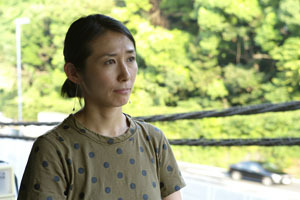
Photo by Takashi Kato
Kumiko Inui | INUI Kumiko
Born in Osaka in 1969. Graduated from the Department of Fine Arts, Tokyo University of the Arts in 1992. Completed graduate studies at the School of Architecture, Yale University in 1995. Joined Jun Aoki & Associates in the same year. Established Kumiko Inui Architect & Associates in 2000. Major works include 'Jürgen Lehl Marunouchi' (2003), 'Dior Ginza' (2004), 'Louis Vuitton Taipei Building' (2006), 'Apartment I' (2007), and 'Flower Shop H' (2009). Also 'Small House H' (2009) and 'TASAKI Ginza Main Store' (2010). Received the Shinkenchiku Award in 2008.
http://www.inuiuni.com
'Renovation of Kataokadai Kindergarten' (2001)
Photo by Ken Takahashi
—So, you began to study architecture professionally at university. What did you do there?
I was fortunate to get into the architecture department at the University of the Arts. As expected, having drawn floor plans since elementary school, my design skills were fairly good within the class. I was the type of student who was good at organizing things, meticulous. However, just like the limit I hit in high school, there was a moment when I suddenly realized that perhaps I was just 'good' at it. For example, the plans were well-organized, but was it truly good architecture? Or, was it interesting as architecture? I started to worry around my third year, when I began to grasp architecture somewhat.
There is interesting architecture and uninteresting architecture in the world, and I thought that if I continued to design only skillfully, I would inevitably end up creating only uninteresting architecture. So, I reflected on myself, thinking I had to change. I made an effort to look at various things, determined to break out of my shell.
'Louis Vuitton Taipei Building' (2006)
For example, take the facade of the 'Louis Vuitton Taipei Building' in Taipei. Taipei is a pleasant city with abundant greenery. In contrast, Louis Vuitton is a symbolic entity that evokes specific images upon hearing its name, with no connection to the vibrant cityscape of Taipei. Therefore, if we were to express this symbolic entity directly as the facade, it would be too overpowering for the history and physical nuances of the city where it is built. I thought that wouldn't be right. Even for a store with a strong image like Louis Vuitton, I wondered if it was possible to create something that responded more subtly to the existing cityscape.
'(Tentative) Kyoei Gakuen Maebashi University of International Studies Building No. 4' (2010)
I realized that architecture had perhaps been too focused on a singular, visually apparent order. For instance, landscape theory is a good example. Although no longer popular, it once targeted utility poles and billboards. That's precisely what I call superficial, focusing only on visuals to categorize things as good or bad. However, the order of a city is not determined solely by such elements. While Japan's cities may appear messy and lacking in principles at first glance, they are, contrary to appearances, operated with considerable order. This must be properly evaluated.
'Apartment I' (2007)
—Given this situation, do you consider ways to address it as an architect?
Real estate development, as an economic activity, is so immense that I had resigned myself to the fact that it was a problem that a single architect couldn't tackle. In other words, I felt it was unrealistic for an individual architect to do anything about it. Therefore, I had half-abandoned the idea of thinking about that issue myself. However, in the last two to three years, Japanese corporate activities have been weakening.
—The economy and population are both shrinking.
While we shouldn't celebrate this, I believe it's an opportunity for a fundamental change in the social structure, a time to consider the next step. I don't know specifically what I will do now, but I think it's a good time to reclaim what we lost during Japan's post-war economic growth.
'Flower Shop H' (2009)
Architecture is still a relatively orthodox field, and there are common tasks that must be performed for any building. In that sense, architecture can maintain its critical platform strongly. In other words, it's still doing relatively well. However, architecture is becoming increasingly diffuse in its directions, which might make it difficult for criticism to be established.
'(Tentative) Kyoei Gakuen Maebashi University of International Studies Building No. 4' (2010)
It's a building of about 2,000 square meters, with two main functions: a communication space centered around a student cafeteria, and learning spaces such as a media center and study areas. From above, it appears as if it's divided into five buildings. Each building is strip-like, with only walls erected inside. These are gathered together. By gathering them, the accidental placement of walls and columns, determined by the required area, creates a layout like an 'Amida lottery' on the plan, diversifying the relationships between opposite rooms.
Photo by Takashi Kato
Kumiko Inui | INUI Kumiko
Born in Osaka in 1969. Graduated from the Department of Fine Arts, Tokyo University of the Arts in 1992. Completed graduate studies at the School of Architecture, Yale University in 1995. Joined Jun Aoki & Associates in the same year. Established Kumiko Inui Architect & Associates in 2000. Major works include 'Jürgen Lehl Marunouchi' (2003), 'Dior Ginza' (2004), 'Louis Vuitton Taipei Building' (2006), 'Apartment I' (2007), and 'Flower Shop H' (2009). Also 'Small House H' (2009) and 'TASAKI Ginza Main Store' (2010). Received the Shinkenchiku Award in 2008.
http://www.inuiuni.com