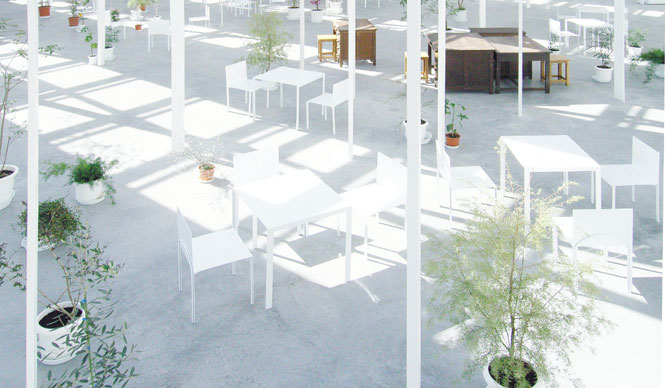
Japan's Young Architects Captivating the World: Vol. 6 Junya Ishigami
Vol. 6: Junya Ishigami Interview
Architecture: A Force Above All Else
Junya Ishigami shapes the inherent power of architecture through his own vision and firm principles. His seemingly ephemeral yet beautiful designs resonate with Japanese aesthetics and position him at the forefront of globally recognized Japanese architecture.
His recent work at the Venice Biennale International Architecture Exhibition in Italy garnered significant praise from various international media. In this interview, he speaks candidly about the concepts of 'space' and 'architectural reality,' his current thoughts, and the essential nature of the architecture that emerges from them.
Interviewer and Summary: Takashi Kato
—What does 'reality' mean to you, Mr. Ishigami?
It is the phenomenon itself, where various things intermingle.
I believe nothing in this world exists in complete isolation. Of course, one might conceive of isolated things in imagination, but ultimately, when we bring them into the world we inhabit, I feel they tend to break down at some point.
Various things exist through their mutual influence in different states, and their conditions constantly change due to these influences.
In that sense, I believe that if one cannot think with a certain breadth when considering something, the contemplation itself loses its meaning.
—Is this related to how becoming rigid in a single ideology can lead to contradictions in order to uphold that idea?
In some ways, it might be related, but I don't see reality and ideology as opposing forces, as ideology itself can shape reality.
However, as an ideology spreads into real society, I feel it often changes or dilutes through its interactions with various elements. Therefore, a rigid stance aimed at maintaining a certain ideology, I believe, distances one from reality. Especially in today's era, I don't think a single concept can explain everything. Take cars, for example: some people prioritize speed, while others advocate for environmental protection. I believe both find value in cars, but the crucial point is that neither aligns in the same direction. It's certainly not an era where we can simply set a single goal and have everyone march towards it in unison. Within this context, I am deeply contemplating how we can discover new values.
For me, I believe that finding new balances is what leads to the creation of something fresh and unseen. Conversely, no matter how significant a new discovery, if it cannot be connected to something else to create a new relationship, would we truly perceive it as fresh? By making new discoveries and finding them within new relationships, the balance of various things seems to be updated. In this way, I am thinking about how we can create something new that imbues strength within the balance itself.
—When you speak of space, does the 'reality' you refer to connect with the reality that guides your architectural practice?
Of course, it is connected. I believe architecture cannot exist without reality.
—Naturally, then, reality arises from the act of creating architecture?
However, I don't believe the act of creating architecture is merely about constructing a building.
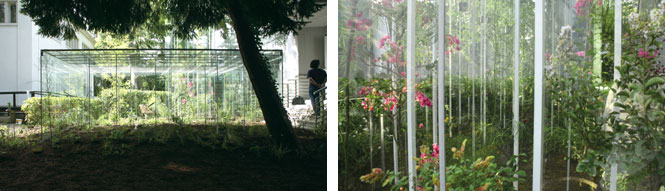
I think this is related to the abstraction inherent in architecture. For instance, with products, I feel we can often examine many aspects at full scale, whether in drawings or models. With architecture, however, considering it at full scale is rarely possible, and we cannot grasp the overall picture without first going through an abstract level, such as scaled drawings or models. In that sense, drawings and models are also significant elements that shape architecture. From this perspective, for a long time, drawings and the like have been subjected to various innovations as forms of architectural expression. Looking at church drawings, for example, they are as beautiful as if adorned with floral patterns. It's immediately clear that a drawing is not merely an instruction sheet. It feels as though a world is being represented. I believe architecture exists within the relationship between the concreteness of actual space and the abstraction of drawings and models. I aim to find new balances (or relationships) within this.
—Indeed, there were times when architecture was expressed solely through ideology, and that had its own historical context. Do you feel that the current era is one where things are outwardly expressed? How do you perceive the present time?
Certainly, I believe the nature of reality differs in each era, and there were times when ideology held a stronger significance within the whole than the actual building.
For example, the modernist era seems to have been a time when reality was 'proposed' through a certain ideology. The present era, I believe, is one where these proposed realities have been implemented, giving rise to various complex phenomena. These are artificial phenomena that are akin to, or even involve, natural phenomena. Within them, numerous contradictions coexist. Many problems that were unimaginable during the modernist era have emerged. In that sense, I feel we are still in a phase of navigating within the sea of the previous era, which has expanded enormously. Within this vast sea of reality, I believe we are being tested on how we can navigate it, connect global contradictions that have surfaced in new ways, and create a world of new dimensions.
Society and Architecture in Gentle Transition
There may have been times when revolutions could be carried out by rewriting societal systems. However, considering the present era, it seems we have lost clarity on how societal systems themselves function within this vast sea of reality. Amidst intricately intertwined realities, no one can definitively state where to change or how things will alter. Imagining how new things emerge in such a state, strong ideas or concepts seem less effective. I believe the key lies in how to soften strong ideas, how to diffuse them broadly, and, on top of that, how to maintain the intensity of the proposal without diminishing it. Rather than 'destroying' (negating) something to create the new, I believe strength comes from the broadest possible 'permeation' based on the current situation. Therefore, I suspect the method of transformation will differ from a revolution, where one day the old societal system is discarded, replaced by a new one, and the world changes from that day forward. It might be more like realizing, one day, that the world has gradually changed without us noticing. A change akin to the shift of seasons.
—Changing the subject, I've heard you're interested in old things. From what perspective is this interest?
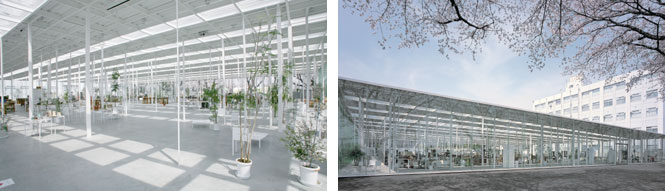
I have a desire to create something fresh by discarding the perspective that separates the new from the old. It may sound contradictory, but I want to create new things without negating old ones. The very act of distinguishing between new and old carries a certain critical nature, and it's a distinction that relies on a premise of something as a base. In today's world, where values and realities are infinite, such distinctions seem to hold little meaning. I believe that what is needed is something fresh, beyond concepts like new or old. Old things possess inherent value, which I see as akin to the 'environment' that surrounds us. Within it lies a very natural world, built upon an immense volume of information that we alone cannot create. Simply discarding that vast information seems somewhat wasteful. Furthermore, when considering architecture, I believe we must also contemplate where to draw the line between architecture and its surrounding environment. Designing by considering the position of that borderline itself means we must first think without the states of new or old.
—So, in terms of environment, are plants and old things the same to you?
Yes. To me, they are equally important parts of the environment.
—You mentioned that when you consider plants and architecture similarly, developing them within the same scale, you call it creating a small environment. I also sense a fantasy element in this, yet paradoxically, I feel it holds immense reality in today's world.
I believe it is important that the proposal itself can be imagined and understood by anyone. Even if the proposal is highly specialized and the method of realization is complex, I feel it's crucial that it can be perceived as something familiar to everyone. It might be perceived as fantasy in that regard, but I don't consciously aim for anything like fantasy.
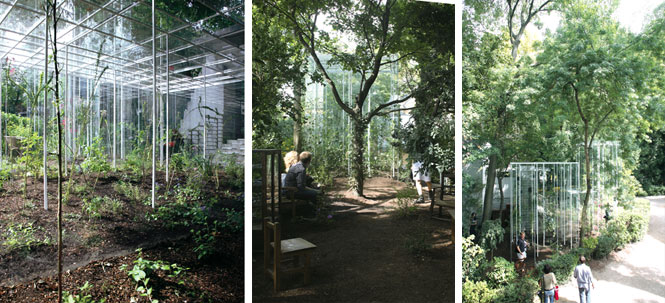
The word 'environment' I use encompasses not only its meaning in environmental issues but also a desire to treat old things, artificial environments, and everything else that surrounds us without distinction. From that perspective, I consider how to think about things like being a plant or being architecture on the same level. This is because I believe it leads to pursuing the fundamental aspects of architecture.
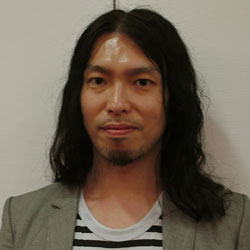
Junya Ishigami
Born 1974
2000: Completed graduate studies at Tokyo University of the Arts
2000–2004: Worked at SANAA (Kazuyo Sejima & Associates)
2004: Established Junya Ishigami+Associates