Vol. 5: Makoto Yamaguchi Interview
Vol.5 Makoto Yamaguchi Interview
Architecture in Pursuit of the Best
Makoto Yamaguchi, highly acclaimed internationally for works such as "Villa in Karuizawa" and "House in Komae," often finds subtle design diversity in seemingly ordinary, everyday architectural details that might otherwise be overlooked.
The spaces created by architect Makoto Yamaguchi can be described as architecture that fosters awareness, allowing daily life to gain depth over time. He designs architecture and products with the same approach. Richness and design, moving in the same direction, continue to shape the future of architecture.
Interviewer and Summary: Koji Kato
When did you first become aware of architecture, and what was that experience like?
My father was a craftsman, a carpenter. Because of that, I had opportunities to visit construction sites from a young age. The first time I went to a construction site was when I was in kindergarten. They were building the swimming pool for the elementary school I was supposed to attend.
It was still in the early stages, with the concrete freshly poured and pipes still in place. Concrete is alkaline, and I still remember that alkaline smell vividly. Even now, when I visit a site, those nostalgic memories come flooding back.
The smell there was incredibly intense. The rough, raw atmosphere of the construction site, so different from my everyday surroundings, left a powerful impression. It felt overflowing with texture, and I was struck by the realization that such places existed.
I believe that was the first time I experienced space, even if unconsciously.
When I consider architecture, while rational thought is certainly important, this experience likely instilled in me a deep sense of architecture possessing a raw materiality and a tangible presence as a physical entity. The origin of this awareness might lie in that childhood experience.
How does that raw, exposed aspect of construction influence your architectural design process?
For me, the materiality—what something is specifically made of—and the impression one gets from experiencing the space are crucial. How the space functions as a physical experience is very important. I suspect that the experience from my childhood forms the basis of my current approach to architecture.
Construction sites, in progress, have a more energetic and powerful impression than finished buildings. Once completed, buildings can appear composed, as if they had always been there. In contrast, a site under construction, perhaps due to its exposed materials, conveys a strong sense of dynamism.
During construction, things are constantly progressing and changing, yet on weekends, all activity halts abruptly. The contrast between these states of change is palpable within the space itself. Yesterday, it was bustling with activity; today, everything is still and silent, which can evoke a sense of awe, almost bordering on the sublime. Many of my current projects feature a lot of white surfaces, often painted. While this might seem to disregard materiality, I believe it's about achieving an abstract texture. Unless there's a specific intention, I've found that an abstracted surface is more suitable than readily choosing materials that overtly express their inherent texture, at least in my past projects.
When these architectural elements—walls, floors, ceilings with their abstracted surfaces—come together, it's crucial that the space itself doesn't become abstract and expressionless in a negative way. I always consider whether a captivating experience can be had from any point within that space.
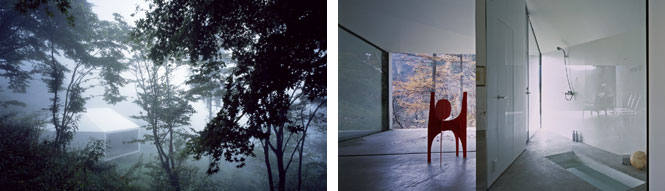
Villa in Karuizawa
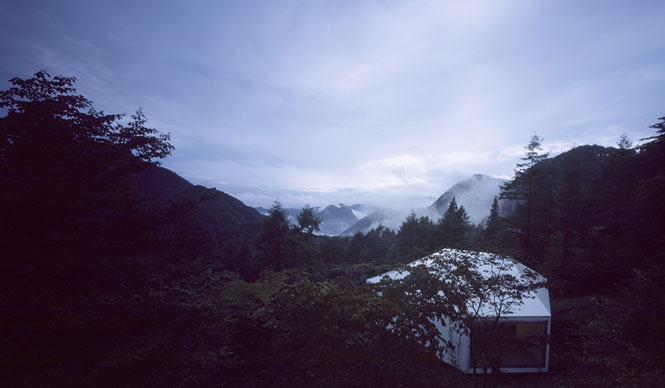
The Villa in Karuizawa (2003) felt like a very abstract structure within nature. Was there a conscious consideration of such symbolic elements when designing it to be situated in the forest?
I think it depends on what one chooses to abstract, but in the case of Karuizawa, I felt it would be better to abstract the sense of scale.
For example, when building in Tokyo, there are already various scales present, such as the adjacent houses, their windows, and roof shapes. In nature, like in Karuizawa, this is less common. While there is a sense of scale in the forest, it's not about individual elements like the size of leaves or the thickness of tree trunks. Instead, it's perceived as a landscape of continuously extending mountains, valleys, and open vistas. The site was in an environment where the vastness made it difficult to gauge distances. The scale of the surroundings was immense.
In such an environment, with a scale different from everyday life, I felt that building a conventional structure would create a sense of dissonance. It wouldn't be appropriate for the location.
Therefore, I sought to abstract the act of building itself, which I termed "bleaching." It wasn't about eliminating presence, but rather about diluting it. What I was aiming for with the Villa in Karuizawa was not to eliminate the building itself, but to soften its sense of scale.
Regarding the House in Komae
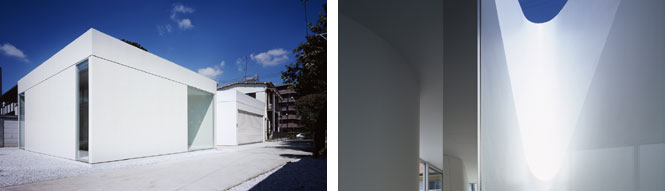
The House in Komae (2007) is quite the opposite of Karuizawa, built in a suburban residential area where similar detached houses stand side-by-side. How did you approach that project?
A residential area, as the name suggests, is a place where houses stand together, filled with a similar sense of scale for dwellings. In that sense, it's the complete opposite of Karuizawa.
The site is in Komae City, but looking at the surrounding neighborhood, individual houses are not very large, and while most have gardens, the plots themselves are generally small, making it a compact area overall. Even within residential areas, there are places like those in the city center with large plots and grand houses, so 'residential area' can mean many different things.
When building on a site, I conduct volume studies in the initial design phase. For the Komae site, placing a mass representing the estimated required area resulted in a volume that felt disproportionately large compared to the surroundings, partly because the plot was larger than neighboring ones. I felt it didn't harmonize well with the neighborhood or the site itself.
To address this, instead of exposing the entire large volume above ground, I adjusted it by burying a significant portion underground.
When I first surveyed the site and its surroundings, I noticed that each house seemed to stand modestly, which I found to be a unique charm of the area. I thought that by incorporating this sense of modesty into the new building, the landscape would flow better and the overall scene would be more harmonious.
In the actual building, I created a slight gap in the center of the entire frontage, making it appear as if two small, single-story houses were standing there. This made the presence even more modest than the surroundings. I believe this also allowed for a greater expanse of sky to be visible for the local residents. Of course, for the inhabitants of this house, the fact that their home creates such a sense of open sky contributes to their comfort.
These decisions were based on my interpretation and organization of the existing conditions of the surrounding environment. Ultimately, I believe this design is my answer to how to create the best possible state for this house, considering the context of its surroundings.
The "Frame" of Solid Material and "Architecture"
Was the theme of "solid material" something you had considered for a long time?
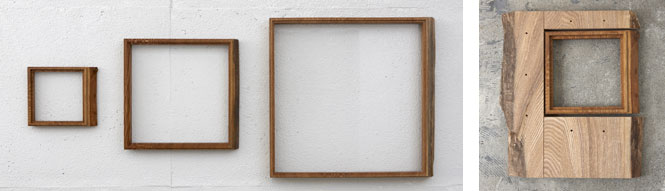
"Solid material" is a theme I discovered while creating the photo frame. I believe it's possible to connect this to the architecture and products I design. However, I don't feel I've fully organized my thoughts on how to interpret my past architectural works through the lens of "solid material" yet. That said, while it might differ significantly from "solid material," I definitely have a tendency to minimize the number of materials used in buildings.
Also, this overlaps with the photo frame, but I have a desire to create things that are as simple and straightforward as possible. I've recently come to feel that this way of making things and the concept of "solid material" hold similar meanings for me.
Thinking about it this way, my previous works can also be connected to the idea of "solid material." For me, "solid material" evokes a sense of extreme simplicity. Just by being made of solid material, one can feel a sense of understanding the object itself. It doesn't convey the convoluted procedures or logic behind its creation. I aspire to create architecture in this manner.
Although actually creating something in this way is far more challenging than ordinary methods, I want the final result to avoid appearing complex.
So, your architecture possesses a simple quality that connects to this sense of "solid material."
Yes. However, I believe it's more about the method of creation than the resulting space being simple.
For instance, the concept for the Villa in Karuizawa's plan involved creating an irregular hexagon, punching holes in three sides, and connecting the vertices, with little further elaboration. The House in Komae, appearing as a single-story structure with curved surfaces internally, has a rough simplicity that resonates with me. I've consistently been interested in exploring how far one can go in creating complex and diverse spaces through such methods.
Therefore, if the architectural concept is straightforward, but the building uses a multitude of materials or exhibits intricate details in their assembly, it contradicts the initial straightforwardness.
If a building is conceived with a simple approach, then the details should appear extremely natural, with no trace of the struggle involved in their creation; otherwise, it would be disingenuous.
With the solid frame, I want it to look as if it were simply made from a thick wooden board that was then shaped. I'm not trying to express the specific machinery or methods used to shape that board. For me, a satisfactory method of creation is one that conveys the simple act of 'having been shaped' concisely. I hope to create architecture in this manner as well.
LOHAS Architecture (as much as possible)
I dislike things that seem harmful to the body.
For example, even with something as simple as paint in architecture, there are significant differences between products. When using white paint, I naturally want to use products that are as harmless as possible.
When designing, the value for the client is paramount, and my personal feelings are often less important. However, when considering what is appropriate for the client, if I experience headaches on-site, it becomes a problem for me. And if I get a headache, others might too. It would be fundamentally disheartening if, after creating something intended to be beneficial for the client, they were to say, 'It gives me a headache.'
Regarding electromagnetic waves, electric floor heating systems generate them. There are floor heating systems designed to minimize electromagnetic wave emission, of course. But ideally, zero emission is best. I am always looking for such options. Rather than something that's almost zero but still emits a little, I'd prefer to use something that emits absolutely nothing.
These are aspects that aren't visible and are unrelated to the 'artistry' of the work. However, for the user, being good for both the environment and the body is truly important in the long run. I believe these considerations are necessary to support the design itself.
So, while surfaces like concrete floors or white-painted walls might not appear to prioritize health, my fundamental stance is to use carefully selected materials and products that are harmless. On the other hand, I also believe it's not ideal if this consideration becomes overtly apparent.
This is the first time I've heard you speak about this.
People haven't asked me about these things much, and I haven't had many opportunities to write about them until now.
Did you have this perspective from the beginning when you decided to pursue architecture?
When I first started practicing architecture, my focus was inevitably drawn to how to realize the designs I envisioned. Now, however, I feel I have a little more capacity to look beyond that.
What I consider most crucial now is how to create architecture and objects that are harmless to the body, in parallel with design. Therefore, for me, the value of a photo frame lies in its being made of solid material, which, simply put, eliminates the need for adhesives to join multiple parts.
Relatedly, I've recently become interested in traditional Japanese architecture and its construction methods.
Naturally, traditional construction methods do not use chemical adhesives, and I find Japanese architecture, which utilizes materials in their natural state, very compelling.
What direction do you see your architecture heading in the future?
I aspire to create works that value materiality, are built using traditional Japanese techniques, and, while clearly Japanese, possess a quality that makes their origin ambiguous.
I'd like to design using traditional Japanese wooden construction methods, or perhaps create a tiled roof design that deviates from traditional contexts.
On the other hand, I also have a desire to control tangible outcomes and integrate them into my designs.
Specifically, when considering how to improve indoor air quality in Tokyo, is natural ventilation truly the best approach? Is it suitable for people with allergies? Rather than simply implementing it because it's 'LOHAS,' I want to carefully consider whether it will produce genuinely positive effects for each project's specific circumstances.
I hope to create architecture and products with that kind of direction.
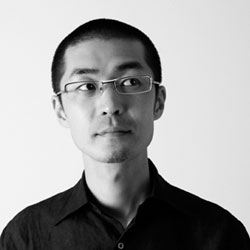
Makoto Yamaguchi
Born in Chiba Prefecture in 1972
Graduated from Aoyama Gakuin University, Faculty of Economics, Department of Economics in 1994
Graduated from Tokyo University of the Arts, Faculty of Fine Arts, Department of Architecture in 1999
Completed Master's program at Tokyo University of the Arts, Graduate School of Fine Arts, Department of Architecture in 2001
Established Makoto Yamaguchi Architects in 2001
Established Makoto Yamaguchi Design Inc. in 2007
Part-time lecturer at Shibaura Institute of Technology
Part-time lecturer at Tokyo University of the Arts