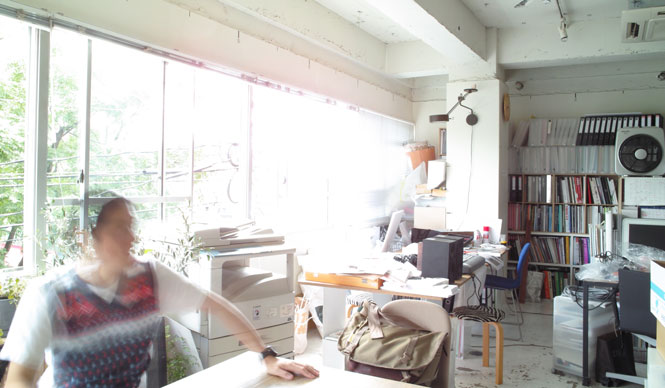
Vol. 4: Makoto Tanijiri Interview
Vol. 4: Makoto Tanijiri Interview
Architecture of Picking Up, Architecture of Noticing
Architecture is also a problem-solving method that responds with concrete actions to the questions and insights that arise in everyday life. Looking at Makoto Tanijiri's work, one sometimes feels that architecture is not a special entity that can only be created from architectural thought, but something much more familiar. We explore the background of the thinking that gives rise to such architecture.
Interviewer and Summary: Takashi Kato
—You became independent in 2000. How did you perceive architecture before that?
I suppose I just liked cool buildings. But I thought it was a world that had little to do with me. I used to look at buildings in magazines and think, 'this is good,' or 'this isn't good.' I wasn't an expert, but I habitually looked at them with a deep, intuitive sense. But I thought that was the world of the people featured in magazines, and that I wasn't part of it.
However, after becoming independent, various things happened, and architecture became very interesting.
At first, I was happy to do subcontracting work. But while doing subcontracting, I started making proposals. That was terrible (laughs). And I started missing deadlines and not following instructions, so I lost more and more work. I even worked part-time at yakitori restaurants (laughs).
—About how old were you then?
Around 26, when I had just become independent. I was working part-time, but acquaintances started asking me if I wanted to try this or that, and gradually my work began to pick up.
I had a lot of friends because I used to hang out in town a lot. So everyone encouraged me to try things.
Initially, I learned everything on-site. I had never done interior design for shops, but once I did one, I learned how to do it on the job. If I did a restaurant, I learned how restaurants work; if I did a hair salon, I learned how hair salons work.
But then I realized that architecture is something you continuously learn like that. That's what I understood at the time.
As I continued to work this way, I always wanted to design houses. Then, a friend of my wife's wanted to build a log house. When I asked more about it, she said she wanted to build an unusual house and asked for my consultation. As I came up with various ideas, she liked my proposal, and we ended up building my first house. That was in 2001.
Then, I wanted to widely communicate to the world what could be done, not just by building it. In reality, looking at the world of architecture, I feel like architects are creating buildings by looking only within the narrow confines of the architectural community. While calling it a social job, only a very small number of people are interested in architecture, so I thought we needed to increase the number of interested people.
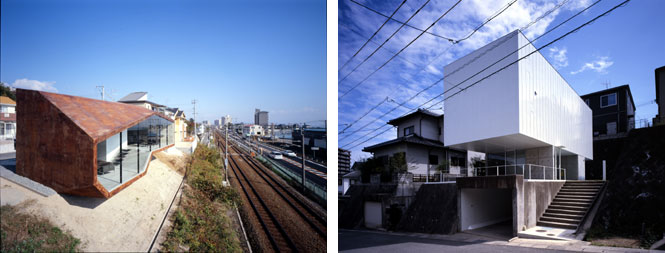
So, since we had built a house, I thought, why not hold an event? Separately from an open house, we collaborated with a furniture shop acquaintance and held a furniture sale in that house for two days.
That was the Kai House. For the year prior, I had been doing nothing but shop design, but thanks to placing event flyers in those shops, we had a considerable number of visitors. At that time, I realized that there were many people in Hiroshima interested in architecture and interiors. I thought that if I could create movements that would increase the number of interested people like this, I could continue to devise ways to attract people to open houses.
The Story of Fallen Apples and Architecture That Picks Them Up
There are many things that are not really considered architecture but are actually architectural. For example, stacking playing cards in the shape of a house is something everyone has experienced, a fundamental aspect of architecture, yet no one thinks card stacking and architecture are the same. I want to say that architectural ideas are abundant everywhere.
I quite like picking up things that have fallen, so if I communicate that to society, more people will open up to architecture, and naturally, if more people become interested in architecture, work will increase. Instead of everyone fighting over a small sandcastle, we should just make the sandcastle bigger. I intend to keep doing things like that.
—I actually think that's a very important point. Realizing that it was this simple...
Yes. People tend to eagerly pick new apples, calling them new varieties, but what I consider new is the novelty of picking them up. Fallen apples are generally thought to be inedible, so people don't even look at them. But if you look closely at things lying around, they can be very delicious or have some charm. That's all there is to it, but the world doesn't do that. I'm working hard to do these things, picking them up, and if I can create something like, 'Isn't this great?', then perhaps architecture can become a closer presence to society.
Deconstruction, Not Construction
This was a proposal I submitted for a competition. Instead of building more and more, it's about reducing. Regulations are strict for new construction and extensions, but what I proposed was deconstruction.
Currently, cities have many buildings, and due to environmental issues, the problem of urban heat and heat from air conditioning is making cities progressively hotter. Despite the reality of a declining population, buildings continue to increase, which is a strange situation. Instead, let's remove floors from existing buildings. If you remove floors and sashes, external spaces are created within the buildings. It's a dream-like idea, but that external space could become a zoo, a rock-climbing area, or even a residence with a ceiling height of three stories. Instead of demolishing buildings, I thought that a way of thinking about architecture that creates new environments by reducing them might be good for the future.
—If that were realized, it would be incredibly interesting. But it's strange that no one else is thinking like this.
Everyone is fixated on demolishing and rebuilding. I like subtraction, so I hope something like that can be done. Wouldn't a living room with a ceiling height of two or three stories be incredibly appealing? While the structural strength wouldn't increase, making the building lighter is extremely advantageous for seismic resistance. Essentially, the dead load is reduced, so the building is clearly at an advantage in terms of earthquakes. Instead of demolishing and discarding, leading to environmental destruction, I think creating a new, rich environment by reducing is a very good approach.
I always like to think about the thinking process, the presentation of the presentation, or what comes one step before. For example, if someone says they want a spacious living room, I ask, 'How many tatami mats?' What I want to know is, what does a spacious living room mean to you? Some people want actual space, while others might just want a large window. Some need ceiling height, and the sense of space is actually quite diverse.
But somehow, society has reduced it to 'How many tatami mats?' Instead, we should think about what a spacious living room means. Everyone follows an equation to find an answer, so there isn't much variation, but I think it's better to think about the equation itself.
—Indeed, Japanese housing often follows an equation like 'X LDK,' which leads to uniform floor plans.
I enjoy thinking about such things. Then, new things naturally emerge. So, I don't have a strong intention to create something new from the outset. I think, 'What is this person thinking when they say this?' or 'Why is this problem arising here?' Rather, it's a repetition of 'Why, why?' That's all I do. So, rather than me coming up with ideas, there's a problem, and I'm just thinking of ways to solve it.
—So, architecture as a solution to problems?
That happens quite often.
—On the other hand, there is also architecture that is like art today. What do you think about that?
Isn't it fascinating? We think it's wonderful too. But since there's a client, if their values align, I think that's perfectly fine.
A building isn't a product or a commodity. I believe that things are often overcome through affection rather than just convenience, ease of movement, proximity to water facilities, and good design. Humans are not truly satisfied by these alone.
You might think, 'This outfit is uncomfortable, but I like this part, so I'll wear it,' or 'This car breaks down often, but it's cute, so I'll drive it.' I think that for housing, the level at which one can develop affection is the most important. Therefore, for residential projects, I believe it's best to propose something concrete that the client can say, 'I really like this.' We find that aspect that fosters affection through communication with the client.
House on a Hill, Cafe Float
—So, it's clear that for your architecture, communication with the people who will live there is important, rather than constraints. When did you first realize that architecture could arise from such diverse insights?
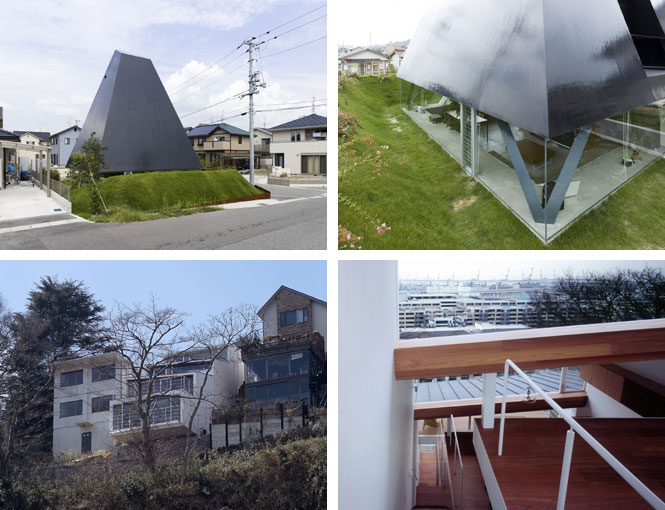
Things started to shift around the time I built Cafe Float in 2002. It's a house on a hill, and after building it, I received many calls from people with sloped properties (laughs). They'd say, 'You're good with slopes, aren't you?'
—You tend to take on projects with distinctive sites, don't you?
I didn't attend university or an atelier, so personality-wise, I lean towards the 'cliffside' (laughs). I didn't have a perfectly flat and ideal condition myself, so to showcase my strengths, I have to do what only I can do.
It's the same with steep sites. In such disadvantageous conditions, we must provide solutions where those disadvantages become strengths. The more the world sees the site negatively, the more simply creating something can be highly evaluated. It's truly challenging, but if done well, it can change the world's perspective on slopes, can't it?
So, I like being able to do things like that. It's like discovering the charm of something that's been left out.
I want to judge with my own eyes, rather than just going by what others say.
—Your work seems to be increasingly characterized by distinct forms. What do you think?
I don't really have a desire to create something specific like that. Rather, all the forms that exist now are dictated by budget and conditions. Usually, the budget is quite limited, so I think about what can be done precisely because the budget is limited. Anyone can build a low-cost wooden house because the budget is limited, but I find it enjoyable to think about what the appeal of having a limited budget might be.
In the 'Saijo House,' we used surplus soil, which would normally be discarded, as a screen for the building. When people realize that something they consider waste can become appealing, they understand that discarded things can have charm. That's what I want to do. It's just a slight change in perspective.
There are many things you can do with ample space, and many things you can do with limited space. My starting point is always like that. When jumping over a vaulting horse, if you immediately think, 'Wow, that's high,' you can't jump it. Conversely, if you think you can clear it, you can. It's like deceiving yourself first. I make myself think, 'This is exciting,' or 'This looks interesting.' It's close to rousing yourself up.
—So, if you reset your way of thinking, you can design?
Yes. Once the way of thinking is established, I can design quickly. Until then, it can be quite a long process (laughs). Until then, I might browse the internet or go out into the city.
—It seems many Japanese people tend to think while sitting at their desks. In Europe, however, theater directors, for example, have long said they think while walking through the city.
When I'm stuck, I wash my hands or walk around the city. When my body engages in a different action than usual, new ways of thinking emerge.
—So, what is important to you in architecture?
I want to create opportunities. I question what is currently decided. Is it really okay?
I want to cherish a basic principle that hasn't been encountered yet. For example, in the Saijo House, we used surplus soil. If everyone says, 'That's great,' and starts using it, it can become a basic principle. When people hear 'basic,' they think of what already exists, but I always build with the idea of expressing, through architecture, something that is basic but that we haven't encountered yet but can encounter in the future.
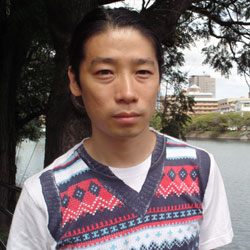
Makoto Tanijiri
Born 1974
1994 Graduated from Anabuki Design College
1994–1999 Worked at Honkane Architects
1990–2000 Worked at HAL Architects
2000 Established Suppose Design Office
Currently Part-time lecturer at Anabuki Design College
