Vol. 3: Eizo Okada Interview
Vol.3 Eizo Okada Interview
Connecting Architecture and Art Through Design: A Key Figure in Contemporary Architecture
Eizo Okada, who presides over dezain.net, a bilingual website that updates daily with the latest information on architecture, design, and art. He also directs the ribbon product line, the Ribbon Project.
Last year, his "DEROLL Commissions Series 1:box," which he personally funded and directed, garnered attention for its presentation of products designed by young architects. We spoke with Eizo Okada, an associate professor who teaches design processes at university and is a key figure connecting contemporary architecture, art, and design.
Interviewer and Summary: Koji Kato
— Please tell us about your current work at the university.
My doctoral research was originally on Japanese chairs. The reason I pursued this was that, until not so long ago, Japanese people didn't use chairs, did they? And now, it's commonplace to live our lives sitting on chairs. I thought that was quite remarkable. The extent to which lifestyles can change.
How did that change come about? What causes lifestyles to change so drastically, rather than just design changing? And what is the relationship with designers? My research began out of interest in these questions.
Before that, I had a period where I was doing something like journalism, and I felt a lot of frustration. This was because there was too much trivial design in the world, and too many people uninterested in design.
It was clearly an arrogant sentiment born of youth (laughs), but at one point, I felt I had to appeal to society and change design. That's why I decided to research social processes and how design integrates into society.
Ribbon = Product
— Please tell us about the background of the Ribbon Project's creation.
The manufacturing for the Ribbon Project is handled by Inoue Ribbon Kogyo, which is my wife's family's company. Because of my involvement in design work, I was often consulted about what could be done with ribbons. At first, I wasn't convinced, thinking, 'It's just ribbon, what can be done?' Then, at one point, I thought it would be interesting if ribbons became products. So, I asked five young designers to create designs.
When we exhibited in London, it was quite well-received. After that, we started expanding in Japan as well.
— Several young architects have participated in the Ribbon Project in the past, and I thought perhaps the "DEROLL Commissions Series 1:box" announced last November was a development of this Ribbon Project.
That's right. DEROLL was originally created as a separate brand from the Ribbon Project. For example, with products like the spoon designed by Makoto Yamaguchi for the Ribbon Project, we started seeing products that didn't use ribbons. So, I thought it wouldn't make sense to keep calling it a 'project' indefinitely, and that's how DEROLL came about.
With last year's DEROLL commissions, we planned it as a limited edition line, rather than a standard offering. So, fundamentally, the Ribbon Project is the origin.
— In that sense, Commissions 1 was a limited edition, but does that mean DEROLL could also produce standard products?
While they are limited editions, I do think it's possible to create products based on them. Separately, I'm also planning new projects.
— Is Inoue Ribbon Kogyo also funding the Commissions, similar to the Ribbon Project?
For the Commissions, I am handling everything myself.
What is DEROLL Commissions?
— How were the five architects for the Commissions selected?
For me, they were all individuals beyond question, so rather than selecting them, it might be more accurate to say it was a project initiated out of a desire to collaborate with them. I was already friends with Hideyuki Nakayama, and he introduced me to some architects. First, he introduced me to Makoto Yamaguchi, and we worked on the Ribbon Project together.
Most of them, except for Yuko Nagayama, are graduates of Tokyo University of the Arts. We are mostly of the same generation and have known each other since our student days. That era at Geidai had an incredible concentration of talent. That itself was strange and something I had been curious about for a long time. Moreover, they all create designs that are not the rigid style typically associated with architects, so I thought I'd like to ask them to design something.
So, I had the idea of an exhibition of products by architects, and that's why I decided to ask these five individuals.
— As you mentioned earlier, four of them are graduates of Geidai, and the only other woman, Ms. Nagayama, is also a graduate of Showa Women's University. None of them are from traditional engineering backgrounds. Did this influence the concept of the Commissions, which aims for designs not typically made by architects?
That might be part of their background. Perhaps that's why these five were chosen. They are all very interested in art.
— Around last year, the world started talking about design and art, and I've also come to think that architecture is close to art.
I completely agree. In the sense of being unique pieces, architecture might be closer to art than design.
— In the sense that both architecture and design enrich human life, I believe they are the same. And in terms of problem-solving methods, I think they are also the same. What are your thoughts on this?
I certainly hope that's the case.
It allows for a connection with nature, yet possesses architectural originality.
Japanese architecture today is incredibly interesting.
— The theme for Commissions 1 was "box," and "box" can be interpreted both abstractly and concretely. I think the way the theme was presented is also art-like. I have a premonition that DEROLL's projects will give rise to things that link architecture, design, and art.
What I admire about them is that in what is typically considered "architectural design," there's often a hierarchy between architecture and design. For example, when designing what to place within a building they've designed, or furniture they want to include, the architecture holds the totality, and the furniture is designed merely as an accessory. Or perhaps architects engage in product design as a hobby, not necessarily with the intention of conveying something to society through it.
However, for them, there is no such distinction.
I think it's wonderful that they feel the same weight of creation in building architecture as they do in creating a "box."
That's why I don't want each box to be called "small architecture." It should be called "architecture," not small architecture.
— I tend to think of architecture as being created within a scale that considers its relationship with its surroundings. I believe that's a matter of process, and size isn't really relevant.
For instance, Ryue Nishizawa's "Little Garden" also looked like a piece of architecture.
I'm amazed by the profound ideas they come up with, but I'm also reminded that each of them has a clear vision of what they want to achieve.
While I had anticipated certain outcomes, things emerged that I hadn't expected at all.
— How long did it take to complete them?
Initially, the plan was two months for design and one month for production, but some pieces took about three months to produce.
— Was this because outcomes emerged that exceeded expectations, in a good way?
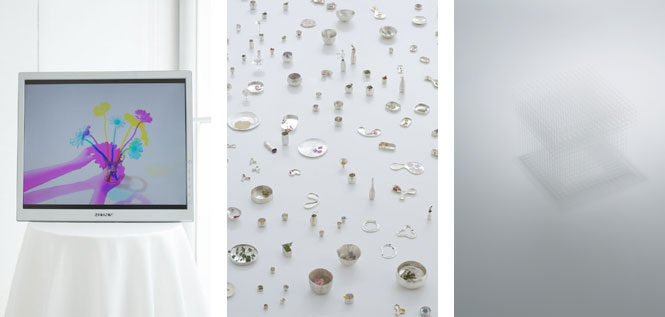
Yes. Ryue Nishizawa's was the most last-minute. Regardless, each of the small containers has a different shape, and these aren't arbitrary shapes; they are all decided upon. To create 370 pieces, he made several times that number of sketches and several times that number of models. Then he refined them. So, naturally, it took time.
— What about Hideyuki Nakayama's work?
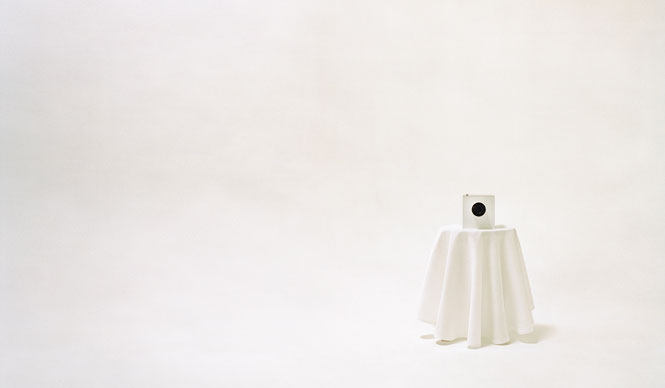
Hideyuki Nakayama had a clear direction from the start. The demo images from the Time Camera seem to clearly show a part of what Nakayama is trying to achieve in architecture. The background is pure white, and space only comes into existence when a person appears. He's not manipulating the form of space, but rather expanding the possibilities of space by controlling time. That work is also architecture.
The Architects' Individual Approaches
For DEROLL, we also produced a catalog to accompany the exhibition. We rented a studio for a day to do the photoshoot, and it was fascinating because everyone had their own style. Yuko Nagayama prepared props and shot with a very specific concept in mind. Her work reflects her concept that one should create spaces that are visible but out of reach, much like in her architecture. Nagayama says that having such places, which cannot be owned by anyone, contributes to richness.
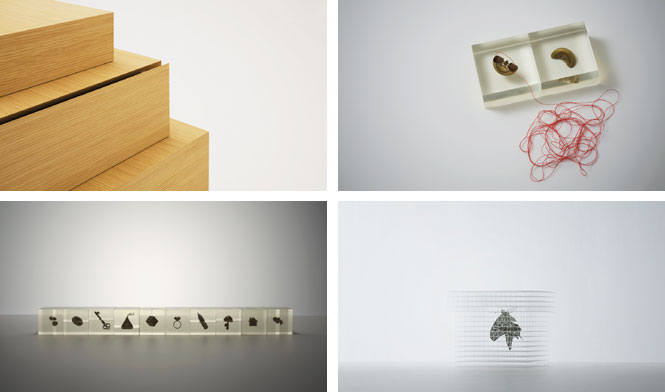
Makoto Yamaguchi included photos taken in his own home beforehand, along with those taken at the studio. I've been collaborating with Makoto Yamaguchi since the Ribbon Project, and I believe he has a strong awareness of what becomes possible when the level of completion of an object increases. "DRAWER, 2007" is a prime example of this. When I first heard about it, my imagination could only grasp 'a stack of drawers.' But the finished product shows no sign of drawers at all. I was truly impressed.
I was struck by how Ryuji Nakamura continued to ponder until the very end during the photoshoot. His "Insect Cage" is a work where he meticulously drew lines in space, each only 0.3mm thick. By focusing on the thinness and number of lines, he created a product with an unprecedented level of abstraction. I think this is also common in Nakamura's interior design work. It's interesting how the lines appear sharp from one angle and blur into a haze from another, and the contrast between the living butterflies within a CG-like grid is also striking.
— If I had to point out a commonality, I felt a similar approach in how they handled biological imagery, such as plants and butterflies.
Ryue Nishizawa says he wants to create landscapes, not architecture. "Little Garden" is a work that, whether viewed from afar or up close, always possesses the same level of detail. It conveys a world where the extremely large and the extremely small have the same resolution. In that sense, it can be said to be close to nature. It's not just because he uses flowers in his work.
— Like Hideyuki Nakayama, I feel there's a shared perspective in how you both perceive plants not just as cute or beautiful, but from a different viewpoint.
The nature depicted by Nakayama always evokes a sense of human presence. In the "Time Camera" movie, even though it's just a tree standing there, a person cycling around it appears as time shifts. He may have a desire to design the relationship between people and nature.
— What are DEROLL's plans for this year?
This year, we're focusing on product designers. The theme is "Japanese History." The designer is Hisakazu Shimizu, who is also an in-house designer at Canon and whom I've also commissioned for the Ribbon Project. He's a designer I've deeply respected for a long time. Please look forward to it.

Eizo Okada
Associate Professor, Kyoto Institute of Technology
Completed Doctoral Program, Graduate School of Chiba University (Doctor of Arts)
While researching the social processes of design at university,
he directs the "Ribbon Project," which explores the potential of ribbon as a material. Presides over dezain.net, a daily updated design news website.