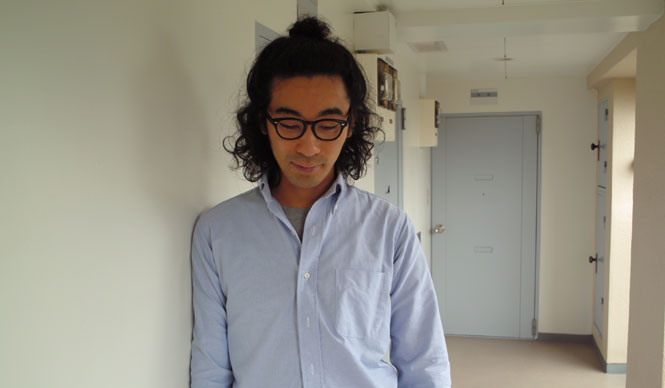
Vol. 2: Hideyuki Nakayama Interview
Vol.2 Hideyuki Nakayama Interview
The Future of Dreamlike Architecture
In an era where diverse values coexist, where does the architect stand? Hideyuki Nakayama's architecture, honed by intuition, translates the "ephemeral" nature of human sensibility into homes for living, filled with delicacy and vibrant fantasy.
Interviewer, Summary = Takashi Kato
—Tell us about your encounter with architecture.
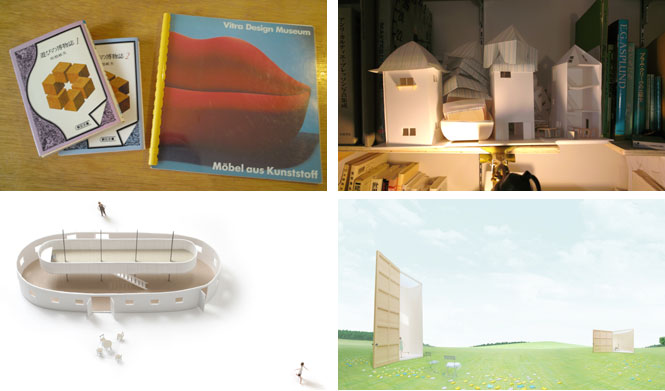
I have a favorite book called "The Natural History of Play." It's a 1970s book compiling articles serialized in the newspaper by Gen'o Sakane, introducing curious toys from ancient and modern times, and art using simple scientific tricks. My parents first borrowed it from the library. I loved it so much that they ended up buying it for me. I was in elementary school then.
—What kind of things are written in the book?
For example, it features a photo of a table with a top shaped like a "superellipse," and it says this table can "save 15% of a restaurant's floor space." It also shares the anecdote that this shape was born when physicist Piet Hein, consulted on the design of a station rotary, provided a brilliant solution using an equation that lies between a circle and a square. The mysterious resonance of "between a circle and a square" left me with an indescribable, wondrous impression.
Through this book, I also learned many strange foreign words, like "holography" and "metamorphosis." Among the people featured, I never encountered Piet Hein in another book again, but Charles Eames, for instance, did appear. Because of that, for a long time, he was to me "the man who collected spinning tops from around the world and made a movie out of them."
I wouldn't meet Eames again as a furniture designer until I was a prep school student, much later. One day, at a foreign bookstore, I found a beautiful photo book of chairs bound with a yellow ring. In that book, the chairs that caught my eye were consistently credited to Charles & Ray Eames. My interest in furniture design was sparked by thinking, "These Eames brothers are amazing!" I soon learned that "Eames" is pronounced that way, and that they were a married couple, not siblings. They weren't just furniture designers. Architecture, toys, photography, and film. Soon after becoming a university student, I ended up getting a part-time job at a furniture store, where I first saw that movie about spinning tops on VHS. It was around this time I also learned that Arne Jacobsen was the one who made the superellipse table.
—How did these connect to architecture?
The direct trigger for considering architecture as a profession was largely due to the presence of GA Gallery, an architecture bookstore, near my home. However, more than architects themselves, it was the book that instilled in me an admiration for diverse individuals—like a physicist (Piet Hein was also a poet) inventing table shapes, or a furniture designer making films about spinning tops.
—It feels like such diversity is precisely what's needed today, yet also something that has been lost.
Therefore, perhaps my ideal architect is someone who, while engaging with various things of their time, thinks and creates in a way that conveys a sense of life from that era, not as a simple cross-section, but as a mysterious, enigmatic whole that approaches us. Just as we imagine the 1920s, the 2000s will also be remembered someday.
Regarding the Private Residence "2004"
—What led to the creation of "2004," the first house you designed after going independent?
I was at Toyo Ito's office for eight years, and my last project there was the new library for Tama Art University. Around the time I finished that preceding job, my eagerness to start my own practice and various encounters converged, allowing me to specially design a small house privately while simultaneously working on the library project.
I hired one staff member, rented a small room near Ito's office, and began a life of commuting there only at night and on weekends. This staff member had just graduated from graduate school in the spring. I spent most of my time on the library project, and in fact, I had never designed a house before. If we just proceeded normally with such a team, we couldn't possibly create anything new, could we? So, we decided that since we didn't know, we might as well proceed without thinking about what a "house" should be. We initially discussed that if we, in our ignorance, could each understand the reasons and meanings we decided upon, we might be able to create something new yet natural.
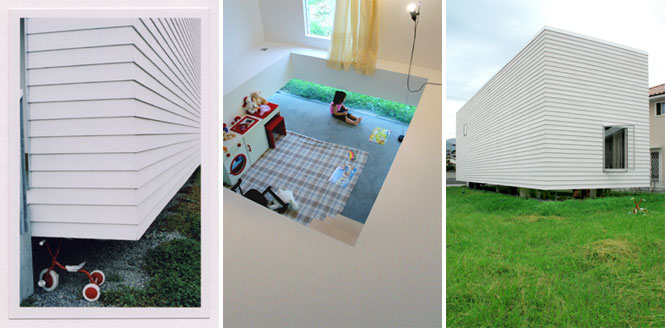
So, instead of starting with the overall form, we began by thinking about the stories behind everyday objects we could imagine, like desks, chairs, cups, or the grass outside the window. Since the scene comes before the form, as a quick method, we often ended up drawing with colored pencils or mechanical pencils on copy paper, and my staff would forcefully translate these into models. When we turned these drawings, with their haphazard perspectives and scales, into models, connections between spaces would emerge that I hadn't imagined at all, or there would be completely illogical parts, or shapes would appear that were hard to attribute to anyone. Even if the resulting forms didn't connect logically, we wouldn't worry too much and would just continue to connect them with entirely different fabricated stories. That's how the forms were decided.
—So it feels like the whole emerged from imagining scenes of life?
That's a bit subtle. While the sketches depict quite specific scenes, I strongly dislike the idea of dictating to the inhabitants, "Please use it this way." What we've drawn is merely a record of what we could conceive regarding the form up to a certain point.
Therefore, even if specific "objects" are depicted in the sketches, it doesn't mean we meticulously simulated daily life down to the finest details to ensure everything worked perfectly. Rather, the world depicted in the sketches is quite abstract, but I see it as something fluid, where the focus shifts to the form of the space the moment someone has an idea, and the space itself dissolves or blurs when they abandon or change that idea.
For example, if I draw a pair of glasses, a horizontal plane where the glasses are placed becomes visible on the white paper. What I'm thinking about here isn't "Please place your glasses here," but rather how a horizontal plane and a sense of scale emerge in an empty space the instant glasses are placed there. So, in a way, I consider the things depicted in the sketches to be things that can disappear, things that are okay to disappear. Yet, they somehow help us perceive the space.
—So, the ambiguity where the space is barely discernible due to the presence of the sketched objects, is that it?
Yes. At the same time, and this might contradict what I've said so far, I also have a considerable interest in formal elements. Previously, I thought architects supported someone's free imagination by creating purely abstract things. But consider a stage play with an unusual entrance for the audience, perhaps through the stage door. The thrilling sensation you get in such a situation arises precisely because the theater has a clearly defined form, doesn't it?
Creating a box with extremely ambiguous directionality and form, where "you can use it however you want," doesn't evoke that feeling. I believe that objects existing at a point where both what is considered formal and what is not considered formal can simultaneously emerge are perhaps quite universal.
Therefore, rather than creating a world of perfect abstraction, I hope to find a method that can naturally create a state where the tangibility of a drawing and the diversity of things that cannot be drawn are sensuously blended.
—As an architect living in Tokyo, what are your thoughts on "building architecture in the city of Tokyo"?
I'm not sure if this will answer your question, but I often feel that creating and choosing are similar. When we talk about architecture, it feels like building everything from scratch, but Tokyo already has so many diverse elements. Therefore, I think it would be good to have a way of living that lies somewhere between "creating" and "choosing." For example, renovating existing buildings, which is precisely half "choosing" and half "creating," feels very characteristic of the city. As in the theater example, entering through the main entrance versus the stage door creates a completely different feeling, and many such things happen with building renovations. Even when buying land and building anew, perhaps a way of living and building that is characteristic of the city, where the sense of creating and choosing are born simultaneously, is possible.
—Connecting this diversity to the city of Tokyo, it seems like a specific human image might emerge.
Just as a person who is both a physicist and a poet gave mathematical form to a poetic idea like "between round and square," I believe that such diverse and complex human figures, through trial and error in ways of building and thinking, and combinations that could only arise in the present era, can lead to the creation of something that, while difficult to explain precisely, becomes "a landscape of a certain era that everyone can understand."
Hideyuki Nakayama
Born 1972 in Fukuoka
1998 Graduated from the Department of Architecture, Tokyo University of the Arts
2000 Completed Master's program at the Department of Architecture, Tokyo University of the Arts
2000 Joined Toyo Ito & Associates, Architects
2006 Established hideyuki nakayama architecture