Vol. 1: Ryuji Fujimura Interview
Vol.1 Ryuji Fujimura Interview
Towards the City, Beyond the Landscape
Ryuji Fujimura, an architect who is generating discussion within the architectural world by advocating his own ideas centered on two architectural philosophies: "Critical Engineering" and the "Hyper-linear Design Process." We interviewed him at BUILDING K, a residential complex he designed in Koenji.
Interviewer, Summary: Takashi Kato
—Tell us about your encounter with architecture.
I was originally interested in urban planning. My father's hometown is Kobe, and I used to go there often when I was young. At that time, Kobe was in the midst of developing Suma New Town (in the hilly area west of the Rokko Mountains) and Port Island (an artificial island in the harbor). I heard that the development method, which used soil excavated from the hills to fill the sea via conveyor belt and then used the tunnels created for the development as sewers after completion—a three-birds-with-one-stone approach—was the idea of Tadaichiro Haraguchi, the mayor of Kobe at the time (who served for 20 years from 1949). Mayor Haraguchi was a politician and also held a doctorate in engineering, which led me to become interested in architecture and urban planning at the intersection of politics and engineering.
—So, those kinds of developed landscapes became your formative memories?
Yes. I am precisely a generation that grew up with the new town developments of the 1980s. Even so, when I went to the city center, there were still traditional storehouses and townscapes, giving me a sense of connection to history. However, when I was in high school, another development began, and now it has become a suburban, diluted town lined with high-rise condominiums.
—Around 1990, wasn't it? A time when the landscape, including the city center, changed dramatically.
Yes. In that situation, Kobe had an urban atmosphere that the new towns in the Tokyo suburbs lacked, so I was always drawn to it.
Objective: BUILDING K
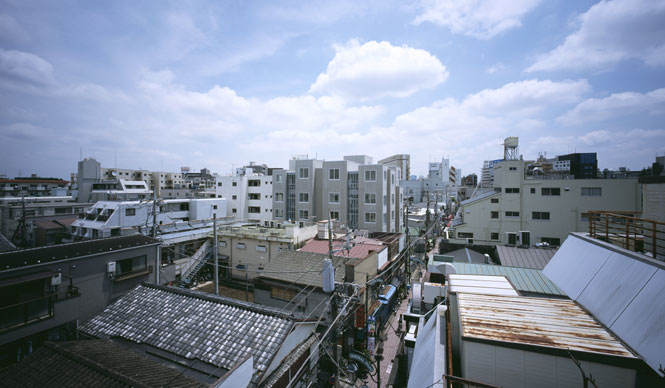
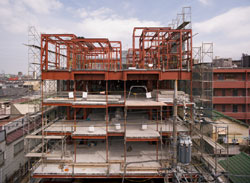
BUILDING K is a very generic urban building, but its characteristic is that it was conceived with a focus on facility planning. In urban buildings, external spaces, whether rooftops or grounds, are often sacrificed for equipment. Here, by consolidating the equipment spaces, I thought it might be possible to reclaim external spaces like rooftops and grounds as living areas.
—The rooftop garden on the fifth floor seemed to connect with the narrow alleys of Koenji, giving a sense of openness along with a sense of place.
Integrating with the environment was also an important theme. The rooftop space can serve as a place for the community, and I believe it contributes to the enduring value of architecture that transcends time, even as the building ages.
—This stems from what you advocate as the "Hyper-linear Design Process," doesn't it? Could you explain what the Hyper-linear Design Process is in concrete terms?
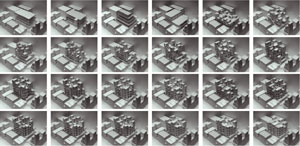
Simply put, the "Hyper-linear Process" is a feedback-based design method where you endlessly repeat the process of making one model and then making just one correction, without first envisioning the final goal. Themes like facility planning and the relationship with the environment naturally emerged as I was designing through such a process.
—The idea of not envisioning the final form struck me as very characteristic of you.
When you adopt a feedback-based design process, you can build directly upon discussions with the client and engineers, allowing you to accurately read the conditions and simultaneously generate unexpected forms that you wouldn't have conceived on your own.
—Then, what becomes a bit of a concern is, when and how is the final form decided in your mind? Perhaps time and budget are also related to this?
There are two points where we draw a line. The "search phase," where the conditions are identified, and the "comparison phase," where variables are successively substituted and adjusted in the solidified operational formula. It's difficult to determine when to stop the final process, but it's when all stakeholders are present and you feel that their respective issues have been voiced.
—Does it also stop naturally as all conditions are taken into account?
Yes. It's more about social relationships, really. When the conflicting interests are reconciled (laughs).
—I believe you are a highly socially conscious architect. Considering the current state of Tokyo, for example, where individual architects cannot change things on their own, how do you seriously engage with these problems without escaping into fantasy? I feel you are genuinely tackling this. Although it may seem inorganic at first glance, I wonder if you are thinking about architecture on a human scale.
I believe that an attitude of believing in reality is extremely important. When the surrounding environment is not very good, rather than pretending it doesn't exist, I want to create architecture that leverages the potential inherent in reality.
—Has this been influenced by anything in particular?
I believe my attitude towards the city is influenced by my university professor, Yoshiharu Tsukamoto, and the education I received during my studies in the Netherlands. The approach of researching the city and then considering its architectural form is a mainstream way of thinking in Europe and America, where there is an awareness of the relationship with the environment, but unfortunately, it is not commonly seen in Japan today.
What is Critical Engineering?
—However, I feel that you, along with architects of your generation and sociologists who study cities, and by involving journalism, possess a sense of potential to change the somewhat stagnant urban problems from an architect's perspective. For example, how do you view the work of Kenzo Tange and Kisho Kurokawa in the 1960s, and Kurokawa's late-life attempts to connect with politics?
I believe there are several ways for architects to connect with society. One is to present concepts. Another is to connect with mass media. And the third is to engage in political activities. These correspond roughly to the ages of 30s, 40s, and 50s, respectively. I think the way one connects with society changes as one's career as an architect progresses. In that sense, Kisho Kurokawa's attempt to connect with politics in his later years is something I understand very well.
—Will you eventually...?
I believe the ultimate challenge lies in the kind of actions one can take at a political level, but I don't think that's something to be done in my 30s. The most important thing right now is to present concepts.
—Speaking of which, could you tell us about your manifesto-like "Critical Engineering"?
"Critical Engineering" is a concept I am advocating along with my peer architect Yūsuke Kanzaki and sociologist Yoshikazu Nanpo. In contemporary society since the 1990s, with its increasing reliance on technology and specialization, there has been a demand for quantity and speed, leading to architects being deemed unnecessary. My concern is that if this continues, we will be left merely playing with superficial appearances on top of infrastructure. I want to call for a way to critically overcome this situation, without simply denying or affirming it.
As I mentioned earlier, I grew up in a suburban new town, and I have a sense that the experience of living has become increasingly diluted as the city developed. While I didn't pay much attention during the process of losing urban spatial density, it became clear that what was lost was immense only after the 2000s. I want to share this concern with architects of my generation first.
—Do you feel a response?
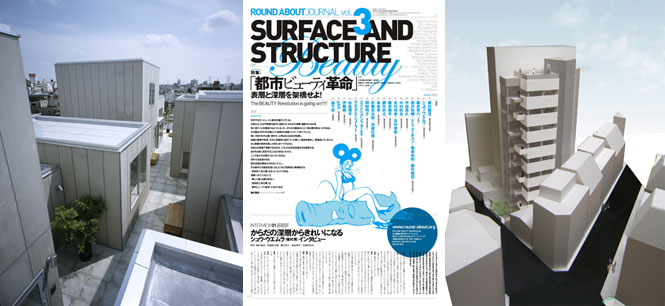
Yes. We send some of our free paper, "ROUND ABOUT JOURNAL," directly to editors we know and to those who apply online. Initially, there might not be much of a reaction, but it gradually permeates. It's a strategy to leverage the insularity of architectural journalism. Regarding "Critical Engineering," it's a minor ripple at first, but as we continue, the discussion is gradually expanding through specialized magazines like "10+1" and "JA," and the architectural institute's journal "Architecture Magazine," reaching not only atelier-based architects but also organizational and general contractor architects, researchers, and sociologists.
—Architecture emerges with an overwhelming force in the city. In that sense, do you feel a sense of responsibility as an architect?
The architecture that appears in the city is, after all, designed by an architect at some point. In that sense, I believe it is important what kind of ideas architects of each era share.
—Can you create architecture continuously with the concept of Critical Engineering?
Yes. I intend to present it not as a personal assertion, but as a stance that contemporary architects can take. Just as Sori Yanagi, a product designer, advocated "Anonymous Design" as the stance of designers in an industrialized society, I am interested in how to design vernacular in the age of information.
—What is the position of internal space relative to external space for you?
So-called bodily sensations are personal, and they naturally emerge in the internal spaces of buildings I design. Without them, architecture would become a mere system.
—Do you also have a desire to design cities someday?
Yes. Since I advocate for "restoring density to the city," I ultimately want to delve into the political processes of the city. Presenting theories and methodologies, and developing media, are all part of that process.
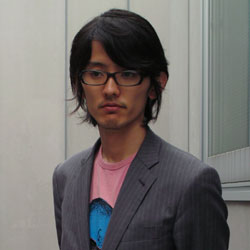
Ryuji Fujimura
Born in Tokyo in 1976.
Graduated from the Department of Urban Engineering, Faculty of Engineering, The University of Tokyo in 2000.
Completed Master's program in Architecture, Graduate School of Science and Engineering, Tokyo Institute of Technology in 2002.
2002-2003 Berlage Institute (Netherlands)
Established Ryuji Fujimura Architects in 2005.