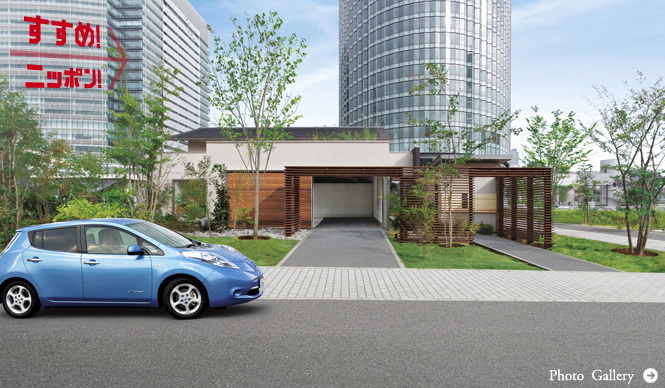
People and Companies Building a New Era: Sekisui House, Ltd.
People and Companies Building a New Era: Sekisui House
The Latest Homes Pursuing Comfort Will Form the Foundation of the Next Society (1)
With the limits of nuclear power generation now apparent, what about the next generation of energy? And how will we coexist with it? We face many challenges that we must consider from now on. It's a difficult problem. However, if we shift our perspective slightly, we can see that now is a turning point toward a completely new era. And it is we who hold the casting vote.
Text by Fumio OgawaPhotos by Kenta Yoshizawa (people)
Designing the Next Generation of Social Infrastructure: The Smart Network Project
Including the next-generation automobiles that are frequently discussed in OPENERS, homes based on new energy, so-calledsmart homesare also at a point where they are about to take a big leap forward. In fact, even before the nuclear accident, a project involving various industries such as housing, telecommunications, and automotive companies was underway to explore how to build the social infrastructure of the next generation. This is the "Smart Network Project."
Simply put, a "Smart Energy Network" is a system that uses IT to coordinate homes, power supply systems, and vehicles to provide comfortable and efficient energy supply.
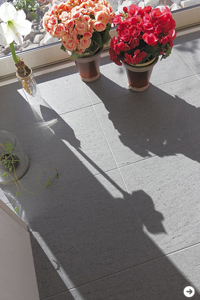
In the family room of the "Kankan-kyo" (a home designed for environmental harmony), a heat-storing floor that accumulates solar heat is used, which can primarily reduce the heating load at night.
It is a concept for "life where people and homes are connected through communication" (press release). The basic idea is to place a small mobile phone base station (also called a femtocell-integrated home) in each household. Information is then aggregated there. For example, information such as home lighting, window openings and closings, temperature, humidity, and power consumption is constantly collected. Furthermore, this project assumes that each household will have a solar power generation system and use an EV, as it is primarily focused on detached houses. Therefore, the amount of solar power generated and the storage capacity of EVs are also constantly monitored.
The home base station collects information from the household and the EV. Additionally, exchanging information with the local community is another important point of this project. The system is constantly connected to a service provider server that aggregates local information. Examples of local information include the networking of EV charging stations, car sharing based on vehicle location and battery level, and criteria for improving charging infrastructure based on the usage of EVs in the community.
In other words, homes and communities become connected, and car sharing can operate more effectively, including vehicle location and charging status. Next-generation new energy, from an efficiency perspective, should be something that connects homes and communities more closely.—This is what various companies are currently considering.
People and Companies Building a New Era: Sekisui House
The Latest Homes Pursuing Comfort Will Form the Foundation of the Next Society (2)
Building the Infrastructure for a Comfortable Life Without Worry
We interviewed Sekisui House, Ltd., which is participating in the "Smart Network Project" in the housing sector. They are proposing a lifestyle geared towards a low-carbon society with higher environmental compatibility by combining "new homes as hardware"—which involves new energy utilization and efficient electricity consumption, shifting away from conventional power generation infrastructure—with "network technology," as described earlier. Kenichi Ishida, General Manager of the Environmental Promotion Department at Sekisui House, Ltd., who also holds a Ph.D. in Engineering and is the Director of the Global Warming Prevention Research Institute, provided the answers.
—As a housing manufacturer, how do you envision the future of housing?
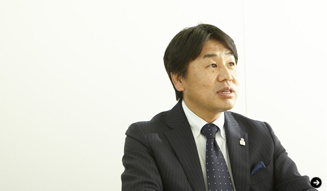
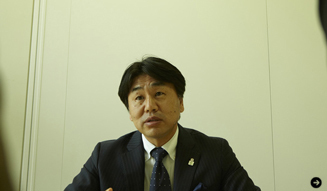
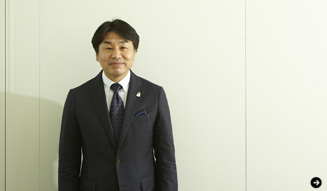
Kenichi Ishida, General Manager of the Environmental Promotion Department, Sekisui House, Ltd.
Simply put, the most important thing is for residents to live comfortably. If they feel hot, they should be able to use the air conditioner without hesitation. However, our challenge is to build the infrastructure for this without burdening the environment. We have no customers who say, 'I want a more energy-saving house, even if it's uncomfortable.' Everyone says, 'We want a more comfortable home.' Generally speaking, humans have always strived for a more comfortable life. Our task as a housing manufacturer is to find a way to combine this with clean and efficient energy for the urgent need of a low-carbon society.
—Specifically, what kind of lifestyle proposals are you making?
Living in a house with more people can reduce electricity consumption. For example, a house with five people is about 1.5 times more efficient than a house with two. Changing lifestyles is also one method. However, since many people want to maintain their current lifestyles, we are currently focused on creating homes that are comfortable and environmentally friendly by incorporating both power generation and charging systems. For instance, we are integrating self-generation systems into homes, such as solar power andfuel cells. Electricity is lost as heat during generation and through transmission when produced far away, so from an efficiency standpoint, it is best for the place of generation and consumption to be close.
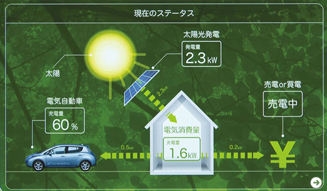
It is possible to monitor the amount of solar power generated, the charging status of EVs, and power consumption.
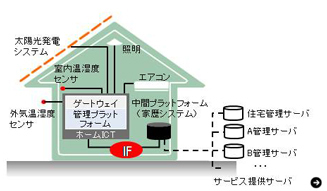
Sensors are installed both indoors and outdoors. Energy information is collected and managed via the cloud and home ICT to prevent wasteful energy consumption.
—What constitutes efficient electricity usage?
During the day, individual homes often have surplus power generation, so supplying that electricity to offices or other places with higher electricity demand is an efficient use of electricity. The smart grid is the system for this. It is also possible to store some of the daytime generation in batteries for nighttime consumption.
In the US, power from large-scale solar power generation called mega-solar is distributed, but in Japan, especially in urban areas, distributed generation like that from homes is the norm. Therefore, a system that distributes power while monitoring generation status will be necessary. This will lead to the establishment of a power infrastructure.smart gridThis enables a small-scale, distributed society. I believe it will start to take concrete shape in about 10 years.
People and Companies Building a New Era: Sekisui House
The Latest Homes Pursuing Comfort Will Form the Foundation of the Next Society (3)
Automobiles Serving as Generators
—Thesmart meter, a communication-enabled electricity meter, is a hot topic. Will these systems be integrated to create a highly efficient energy infrastructure?
Smart meters are important items for advancing the smart grid, but since the meters need to be replaced, it will take about 10 years to replace them all. Certainly, they are useful for measuring and aggregating electricity consumption and converting it into data. However, what is most needed is a system that can grasp where power is insufficient and where surplus power is generated at a specific moment, for example, at 2 PM during a heatwave, and distribute electricity appropriately.
We sell tile-type solar panels integrated with the roof that can be installed seamlessly. With government subsidies, we have set a sales price that allows for the recovery of initial costs within 10 years. As a result, approximately 70% of our new homes are currently equipped with solar power generation. However, the drawback of solar power generation is that it stops when the sun sets. Household electricity consumption is highest in the evening and at night, so generation cannot occur at this time. Fuel cells (equipped with power generation functions) can generate electricity even at night, so by combining solar power generation and fuel cells, most of the electricity used in a home can be covered by self-generation. We have already built 2,000 such homes in the past year. Homes that allow comfortable living while purchasing almost no electricity are already in the diffusion stage.
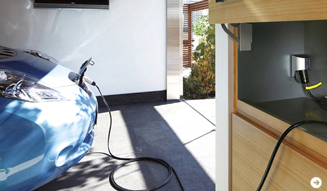
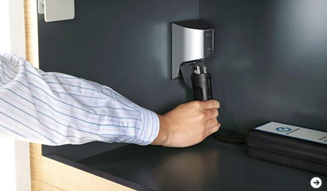
—What is the affinity between electric vehicles (EVs) and homes?
If we can store surplus electricity during the day and use it at night, we can reduce the amount of electricity purchased from the power company. However, since home storage batteries are expensive, using the battery in an EV incurs no additional cost. This is managed by the home computer, and the center server connected to it. This is the network technology advocated by Sekisui House. Another future challenge is for each automobile manufacturer to standardize charging plug specifications.
People and Companies Building a New Era: Sekisui House
The Latest Homes Pursuing Comfort Will Form the Foundation of the Next Society (4)
A New Community Based on Power Supply Systems
What emerges from this interview is that what we need now is the construction of systems that support new energy infrastructure. While it is meaningful for individuals to have solar power generation systems and drive EVs, it is also necessary to create a social infrastructure that allows for the mutual exchange of electricity generated in homes. The emergence of opinions suggesting that transmission lines should be usable for inter-individual power transmission is an example of this.
Furthermore, the establishment of a smart grid is necessary for the networking of power transmission and distribution. However, even with the installation of smart meters, the issue of who will bear the enormous costs involved has not yet been decided. Moreover, unlike EVs, the standardization of specifications and standards has not progressed. What became clear from the recent nuclear accident is that having a single entity bear the responsibility for energy supply poses a crisis management problem. For the electricity we use, we purchase some from the power company and generate some ourselves. This is called a best mix.
In a speech at the OECD prior to the G8 summit held in May 2011, Prime Minister Naoto Kan announced the government's intention to achieve a ratio of 20% renewable energy, such as solar and wind power, in the total power generation by the earliest possible time in the 2020s. This would be highly desirable if realized. While discussing feasibility is important in a sense, if we agree with the fundamental idea of seeking alternative energy, we should actively support household power generation and inter-individual power transmission (which also involves buying and selling electricity).
In Europe and the United States, people sometimes expect politicians to formulate and execute policies based on similar ideas. This is a legitimate exercise of voter rights. In Japan, candidates who advocate for such policies may emerge in the future, but first, let us establish our own mindset. Kenichi Ishida, General Manager of the Environmental Promotion Department at Sekisui House, Ltd., who we interviewed, said something pertinent.
"If you want to do it, you can. If you don't think you can, you never will."
There may be no more fitting concluding remark.
Kenichi Ishida
1985: Completed Doctoral Program in Engineering, Architecture, Kogakuin University. Joined Sekisui House, Ltd. Tokyo Design Department. 1999: Established Environmental Declaration. 2001: Received the Minister of Land, Infrastructure, Transport and Tourism Award at the Building Environment and Energy Conservation Awards by the Building Environment and Energy Conservation Organization. 2002: Director, ICT Promotion Department. 2006: Director, Global Warming Prevention Research Institute. Current position. 2008: Developed CO2 Off House, which achieves net-zero CO2 emissions during living by combining fuel cells and solar cells. 2008: Constructed the Zero Emission House for the G8 Summit in Toyako.

