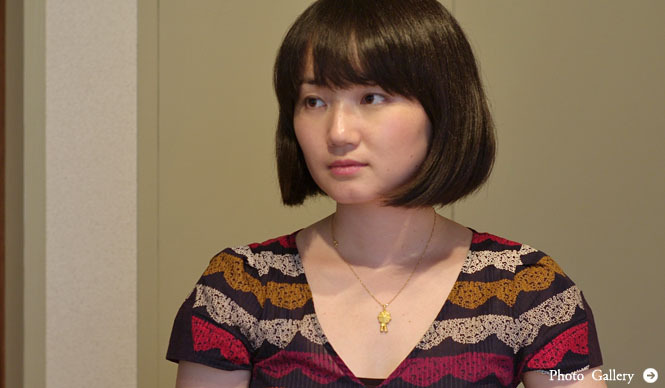
Feature: OPENERS' Picks of Japan's Women Architects Vol. 2: Maki Onishi Interview
Vol. 2: Maki Onishi Interview (1)
The Future of Connecting Architecture
Architecture, through its design, serves as a platform that connects cities, people, and architects, allowing for the sharing of dreams that cannot be conceived alone and emotions too profound to bear. Maki Onishi is one of the most talked-about architects today, a rising star who has received numerous awards since her university days. We spoke with her about several installations she created during her university years, her first residential project, which recently broke ground, and the future of urban development.
Interviewer and Summary: Takashi Kato
What Inspired You to Pursue Architecture?
—We hear you are currently pursuing your doctoral studies while also managing your own design practice.
Yes. But lately, I've been focusing almost entirely on my design work.
—Your activities seem to extend beyond simply running your own design firm, given your academic pursuits. How do you see the scope of your work?
During my master's program, I had opportunities to be involved in projects with the intention of realization. Architecture inherently involves long lead times, often one or two years for a single building to be completed. I considered finding employment after my master's, but I missed the right timing to leave. I am currently enrolled in Professor Akira Fujii's lab. Many seniors in the lab started their own design activities while in the doctoral program, and thanks to the professor's personality, it's a lab where we can freely pursue our interests. This environment has encouraged me to continue my work.
—So, you had a supportive environment for studying architecture.
Yes. If I hadn't been at university, I might not have considered the research activities I recently started with friends from Kyoto University in Arashiyama, Sagano. Though it's still in its early stages.
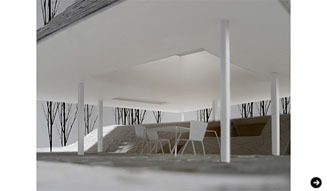
'Villa at Sengataki' (2008, co-designed with Yuki Momoda)
—Could you tell us what inspired you to pursue architecture?
Actually, my decision to major in architecture stemmed from a vague desire to create things. Once I started learning design, I found it many times more enjoyable than I had imagined, to the point where I was moved by the realization that such fascinating things existed in the world.
—So, this realization came to you while you were studying at university.
Yes. At first, I don't think it was necessarily about architecture specifically.
—When you say 'creating things,' there are many fields like industrial products, crafts, and fashion. Why did you choose architecture?
That's true. Why indeed? (Laughs)
—I believe the number of women aspiring to be architects is increasing. Perhaps it's a prejudice on my part, but architecture often carries a rugged image, more of a man's world.
Even so, from around middle school, I had a vague idea of pursuing architecture. However, there wasn't a specific, clear reason for it. I wasn't particularly good at drawing or art either.
Vol. 2: Maki Onishi Interview (2)
Daily Events and Life in Kyoto During University
—Where are you from?
I'm from Nagoya city, near Higashiyama Zoo and Botanical Gardens.
—That area, unlike the urban centers like the station area or Sakae with their large-scale buildings, has a comfortable, human-scale feel with its continuous rows of smaller houses. Also, perhaps due to the several major roads running east-west, it feels like an intermediate zone that gently connects to areas with large buildings, like the city center and suburbs. I imagine that growing up in such a comfortable, small-scale town might have led you to your current path as an architect. Is that correct?
Strangely enough, from the time I started thinking about architecture, I've been drawn to massive structures with scales that transcend human existence, like ancient cathedrals, temples, and grand halls, rather than smaller buildings or houses. My image was not of wanting to build houses, but of wanting to create something monumental that only architecture could achieve.
—That's surprising. So, you aspire to create such large-scale works in the future?
I do. I want to create scales within this world that can only be expressed through architecture.
—You spent your university years in Kyoto. What was the reason for choosing Kyoto?
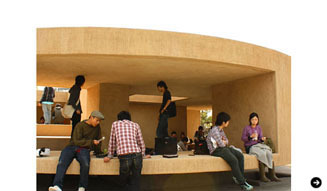
'Folies of Stratification' (2008, co-designed with Yuki Momoda, Yuki Ogawa, Tomohiro Kumazawa, and Yuki Minamikata)
Kyoto itself is a city with immense charm, isn't it? So, I had a strong desire to go to Kyoto. To Kyoto, I was like a foreigner, so I had an overly romanticized image of it as an 'ancient capital.' However, when I visited, I saw many large buildings and initially thought, 'Is Kyoto just like any other city?' But as I lived there, through the daily events and the way of life, I began to perceive the subtle considerations people had for sensing the changing seasons, and there were moments when I truly felt, 'Ah, this is indeed Kyoto.' I realized then that these are things you can only understand by living there, even if it was only for four years.
—Compared to Tokyo, Kyoto is physically closer from Nagoya. But why Kyoto and not Tokyo? As someone from Tokyo, I'm curious.
I was drawn to Kyoto's charm, partly because I liked its streets and temples. I was attracted to how old and new elements coexist harmoniously, and how historical elements are skillfully passed down. Moreover, once I actually went there, I found Kyoto to be a very student-friendly city.
—It seems that your four years as a student in Kyoto have influenced your architectural perspective in various ways.
It was the first time I lived alone in Kyoto. Since I could go anywhere in the city by bicycle, I visited temples and old bookstores almost every day. Although I have now lived in Tokyo for longer than I lived in Kyoto, I still haven't grasped the entirety of Tokyo. I explored most of Kyoto by bicycle, so I have a general understanding of it. I feel very fortunate to have been in Kyoto when I began studying architecture.
Vol. 2: Maki Onishi Interview (3)
What Architects Should Share with the City
—In the world of architecture, activities during one's student years can garner significant attention both socially and in the media. You are one of those who gained attention from your student days.
During my university years, Yuki Momoda and I worked on projects like a villa for a friend. Also, five of us, including graduate students from Kyushu, built a folly in a park in Fukuoka. At that time, Toyo Ito, Masao Yahagi, and structural engineer Shinnosuke Shintani taught us a great deal.
—In that sense, your current style has been shaped through various experiences, encounters during your student days, and projects you've been involved in. Are there any particular individuals who have influenced you?
Indeed, Toyo Ito and Professor Kiyoshi Takeyama from Kyoto University have had a profound influence on me.
—In what specific ways?
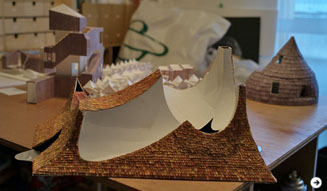
'Beast, Roof, and Mountain Range in the City' (2008, Installation for the 'Double Chronos' exhibition, Hasegawa Seminar, Tama Art University)
Mr. Ito was a part-time lecturer when I was in my second year of university. I remember his words being incredibly powerful. As a rather audacious student at the time, I asked Mr. Ito, 'Can we create architecture today that rivals buildings made over decades with the collective thoughts of hundreds of people, like ancient temples and cathedrals?' He responded powerfully, 'There is definitely architecture that can only be made in this era.' When Mr. Ito spoke, everyone around him, including myself, felt united in the same direction. I witnessed firsthand that architecture is a profession where one can involve others and share the same dream, and my perspective changed significantly.
—The words of someone who has had such extraordinary experiences and accomplishments often carry a depth that might be difficult to grasp at first, but whose meaning expands the more you contemplate them. That's quite profound.
Regarding my experiences in Kyoto, when I interviewed monks at temples, many held negative views on contemporary architecture. Yet, the temples where these monks reside are often rich in a way that is evident to anyone. I struggled with how to convey the value and necessity of what we are trying to create to people who live with such richness daily. I hope to create architecture that even they might find appealing, though I don't know when that will be.
—This connects with your idea that you want to create architecture that even someone like your mother, who doesn't understand architectural theory, can appreciate.
Yes. For example, people say that eccentric houses quickly become tiresome. I never aim to create something eccentric, but I believe that precisely because it's a house, people can more concretely imagine living there, even if the space is unfamiliar. For instance, if I were to ask you to imagine living inside this cup, shrunk to 1/100th of your size, I believe anyone, from a grandmother to a child, could think about what kind of ladder to use, how to construct a slab, and where to place the bedroom. I think many people can imagine such ways of living if given the opportunity, even if they don't normally consider it. My greatest happiness would be to discover new and rich ways of living with clients, ways that haven't been realized yet. I hope to extend this idea of architectural discovery—that something is new and rich simply because it hasn't been noticed—not only to houses but also to larger public buildings like libraries and museums.
—Precisely. Whether it's a house or a city, by sharing some form of imagery or a way to empathize, what is shared between the object, the creator, and the user can expand significantly.
Yes. With the Arashiyama project, for example, my initial intention was to propose something, but that was perhaps too presumptuous (laughs). Naturally, those who actually live there know the place far better. The more I talk with people there, the more I feel I must proceed with greater sincerity.
—However, living in Asakusa, I sometimes find myself only seeking limited information. Therefore, perspectives from outsiders are very helpful when considering my own town. I would be very pleased to receive opinions from experts in architecture and urban planning.
What I find appealing about people in architecture is their ability to move freely between a bird's-eye view and an intimate perspective. Beyond simply designing buildings, planning events, or conducting research, I believe it's important to have a bird's-eye perspective on the structure and formation of a city by stepping back from the immediate surroundings.
Vol. 2: Maki Onishi Interview (4)
Connecting Networks
—As an architect, when did you begin to consciously consider these contrasting perspectives—the bird's-eye view and the intimate view?
I believe anyone involved in design naturally possesses both an internal perspective, such as the sequence of spaces, and an overhead perspective for looking at drawings and considering concepts. Therefore, I feel it's a sense acquired naturally through the process of design.
Changing the subject, I used to work on a museum project that required me to visit Kiba, Tokyo, almost every day. When I exited the subway station, there was a large main road, and it was very hot and humid. However, if I turned into a narrow, old-fashioned downtown alley, a pleasant breeze would blow, offering coolness. It was then that I learned that Kiba, as its name suggests, once had several large ponds that served as lumberyards. Furthermore, waterways were spread throughout the town, connecting these ponds and creating a unique and attractive landscape.
One day, I suddenly realized that this town had three networks: the network of main roads, the network of narrow, old-fashioned downtown alleys, and the network of waterways. Along the main roads, high-rise condominiums stood in rows, driven by economic logic. In the downtown areas, small houses, restaurants, new galleries, and shops were beginning to appear, conveying the town's vibrant activity. The waterway network, however, has largely disappeared, with parts being divided or filled in. I often imagined while visiting the town that if this waterway network were revived, connecting, for example, the Tokyo Metropolitan Modern Art Museum with the galleries scattered around Kiyosumi-Shirakawa, a unique landscape could be created.
—As one walks through a town, accumulating small discoveries, there comes a moment when some of these suddenly connect from a bird's-eye perspective. I wonder if this way of thinking is characteristic of architects. What are your thoughts?
But that's true not only physically but also temporally, isn't it? Thinking about the future from the present moment, or referencing the past in our imagination. I believe this ability is a skill possessed by excellent architects.
—With someone like you, who has such a keen sense for a place, perhaps entirely new cities could be created if you were to undertake urban planning in the future. The Kiba area, before the advent of museums and galleries, was a district retaining a modern downtown character with the old Dojunkai apartment buildings. In today's era, urban development often seems to result in the construction of condominiums and shopping centers, leading to suburban-style development regardless of whether it's urban or suburban. With both the economy and architecture said to be in decline, I sometimes imagine if urban and architectural development could be more human-scaled. Don't you think we should be more conscious of the inherent memories of a place? What are your thoughts, Ms. Onishi?
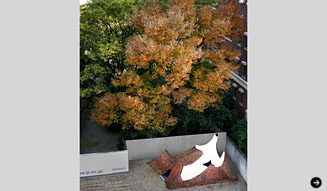
'Beast, Roof, and Mountain Range in the City' (2008, Installation for the 'Double Chronos' exhibition, Hasegawa Seminar, Tama Art University)
Indeed. The kind of development you mentioned feels like something imposed from above. As for what someone like me can do in response, I'm still unsure... However, I want to start with a single building or a single activity. By accumulating individual activities and connecting them through networks, I aim to find structure from a bird's-eye perspective. This includes bringing different viewpoints to existing networks. I hope to foster urban development that harmoniously blends intrinsic qualities with structural elements, rather than being merely gentle.
—In that context, engaging with the people who are there becomes crucial, doesn't it?
Yes. But it's difficult, isn't it? Cities are suburbanizing at an even faster pace. How to respond to that is very challenging. What do you think?
—It is indeed difficult. The direction is often determined by what the residents desire. For example, I live in Asakusa, a downtown area. From the 1980s to the 1990s, while some considered downtown areas to be rural, I had this strange feeling that Asakusa itself was the city center. During that time, I often used to say, 'Asakusa doesn't have Denny's or Gusto; those are in the suburbs' (laughs).
However, there are now two Denny's right in the heart of Asakusa. This wasn't simply imposed by economic logic; in a sense, it's what the residents wanted. As Asakusa is a tourist destination, such facilities are convenient for visitors, but locals also seek convenience. The presence of 100-yen shops and convenience stores in every town indicates their necessity. We have reached a point where we cannot live without them.
In today's highly advanced information society, where values are literally diversifying, everything tends to diffuse. I am fully aware that it is difficult for an individual architect to physically bind these elements. While it has been said for a long time that grand narratives, including urban development, are becoming harder to create, I believe that if we can create small narratives, like tweets on the internet, the connections between these small stories become important.
I am very interested in connections and networks. Currently, we can only strive to create what is given to us in the richest, most beautiful, and most cherished way. However, if several of these can come together, a network can be born between them. If we merely act in a scattered manner, it ends there. But if we can design these connections, perhaps we can gradually change the city and the urban environment as a whole. I believe a structural perspective as an architect is necessary for this.
—How does that structural aspect come about?
I believe it varies depending on the situation, but I always want to be conscious of the existing networks of a city and consider how to change those networks by initiating new activities. I want to constantly think about this.
—As an architect who designs buildings, you are sometimes expected to behave like an artist who creates installations in museums. Do you encounter any difficulties with this?
When I create installations, I aim to be as experimental as possible.
—Are these experiments that feed back into actual architectural projects?
Yes. For example, I might use styrene paper, which is not typically used as a structural material, as a structure, or I might do something very vernacular, like pasting fallen leaves onto a work. I see it as a space to express the uncertainties I encounter while designing buildings. It's a place to express what I'm struggling with in my daily architectural practice.
Vol. 2: Maki Onishi Interview (5)
About the Double Helix House
—Could you tell us about your first residential project, which recently broke ground?
It's a house planned for Yanaka, Tokyo. The clients are a young couple in their thirties with two small children. The design began with the couple's request to 'create a house like a gallery.' Because the site is a flag-shaped lot, a corridor starting from the alley winds around the house. The corridor, with its varying widths and slopes, serves as a gallery, a library, and a small study space.
At the center is a white cube space containing the essential functions for daily life. The surrounding corridor is designed to be a space that becomes more attractive as objects are added—like planters or pinned-up pictures—reminiscent of the alleys in Yanaka. The corridor area is utilized not only indoors but also as a terrace on the roof, creating a double helix of indoor and outdoor spirals that intertwine. This is the origin of the name 'Double Helix House.'
This land was originally part of a larger plot that was subdivided. It is anticipated that eventually, buildings will be constructed on the currently vacant adjacent lots, resulting in a house with no exterior view. As you can see, this house has a very distinctive overall shape. At the same time, the spatial composition of this house—the corridor leading to rooms, then to stairs—can be considered very internal.
While contemplating this house, I was reminded of a passage from Marcel Proust's novel 'In Search of Lost Time,' where the protagonist, upon drinking a cup of tea, recalls memories of places from his childhood. The way he recalls spaces isn't by remembering the entirety of the house at once; rather, it's like a stage set, where one room, then the town square, the color of the sky, the street, all emerge sequentially. Considering this, can't this house's internal spatial composition be described as a house that directly embodies the spaces recalled in memory?
—Listening to your explanation of this house, Ms. Onishi, the spatial experience, which I haven't yet seen or experienced, vividly unfolded before me, much like the experiences of characters in Proust's novel. It's akin to recalling a dream, where details are remembered first and then connect to the whole. Architecture is truly fascinating (laughs).
I'm not sure if my interpretation is correct, but as I read that passage, I felt as if I could see spaces being drawn out from a single cup of tea. This house is close to that image.
—Beyond the structural aspects, what narrative lies behind making it a spiral?
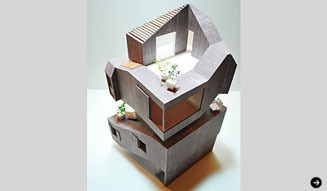
'Double Helix House' (co-designed with Yuki Momoda)
The site's nature, being a flag-shaped lot with an alley, greatly influenced this. When I first saw the site, considering that it would eventually be surrounded by other houses, I felt it was a utopian, secret garden-like, enclosed space. At the same time, it was a peculiar place with an alley, resembling an extension of the road in front, and possessing a sense of continuity. Therefore, I wanted to create a house that had both characteristics: a highly enclosed white cube at its core, and a corridor that connects to the town like the alleys of Yanaka.
—The shape somehow reminds me of a musical melody that continues infinitely.
Yes, I struggled greatly with how to design the endpoint of the spiraling corridor. To go into a minor detail, when I design, I usually start with a very complex and cluttered image, and then gradually simplify it through the study process. I always struggle with how much to abstract it. The Villa at Sengataki, which I worked on as a student, initially had a primitive, Jomon-like shape that wasn't cute at all. I was delighted, thinking, 'I've made a cute owl-like model,' but when I showed it to my professor, he dismissed it as 'looking like a taro root' (laughs). I then realized it needed further abstraction, and after stripping away various elements, it reached its final form. The Double Helix House also began with a more complex image, which I then organized, removing unnecessary elements. I always struggle with how far to take this process. I establish rules and try to create designs that can be explained as much as possible.
—As this is your first realized project, I heard that the ground-breaking ceremony for the Double Helix House was recently held. As you gain more experience as an architect, have your feelings or your consciousness as an architect changed?
Yes. I'm incredibly happy. At the ground-breaking ceremony, I was truly moved, realizing it was actually being built. At the same time, I felt a sense of responsibility.
—When is the completion expected?
It's scheduled for around February or March of next year.
—We look forward to your future endeavors. Thank you very much for your time today.
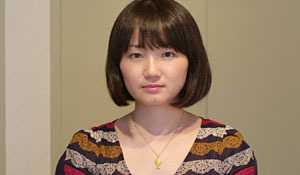
Photo by Takashi Kato
Maki Onishi
Born in Aichi Prefecture in 1983. Graduated from the Department of Architecture, Faculty of Engineering, Kyoto University in 2006. Completed her Master's degree at the Graduate School of Engineering, University of Tokyo in 2008. In 2008, while enrolled in the doctoral program at the same university, she established Onishi Maki + Yuki Momoda Architects with Yuki Momoda. Major works include 'Villa at Sengataki,' 'Folies of Stratification' (2008, co-designed), 'Beast, Roof, and Mountain Range in the City' (2008, installation for the 'Double Chronos' exhibition, Hasegawa Seminar, Tama Art University), and 'PUBLIC ‘SPACE’ PROJECT Cave in a Dream' (2009, Museum of Contemporary Art Tokyo).
http://oaharchi.exblog.jp/