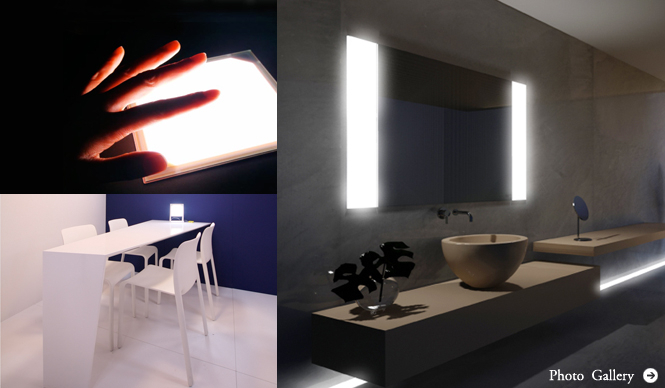
An Innovative, Eco-Friendly, Thin, and Highly Flexible Organic EL Lighting
Lumiotec│The World of Architecture and Interiors Takes Notice
Revolutionary OLED Lighting: Eco-Friendly, Thin, and Highly Flexible
Since the Fukushima Daiichi nuclear disaster, the momentum for energy conservation has grown significantly. Lighting, which currently accounts for about one-sixth of household electricity consumption, is no exception. This has brought OLED lighting into the spotlight. Lumiotec, based in Yonezawa City, Yamagata Prefecture, is developing and producing revolutionary OLED panels that are not only eco-friendly but also harmonize with various interior designs. What does this new generation of eco-lighting, drawing global attention, look like?—.
Text by YANAKA Tomomi
A New Style for Lighting
OLED panels have a structure where thin films are layered on a substrate, and the entire surface emits light when voltage is applied to the organic material. Lumiotec has been producing OLED panels, approximately 2 millimeters thin, since 2009.

Theoretically, these panels have the potential to consume less than half the electricity of current lighting systems for the same amount of light.
Their thinness and precision demand high technological expertise, and Japan is at the forefront of OLED development. In particular, Yamagata, where Lumiotec is based, launched the "OLED Electronics Valley Initiative" for seven years starting in 2003, and the "OLED Electronics Research Institute" was established in Yonezawa City. The Tohoku region, deeply affected by the earthquake, is poised to become a major OLED development hub, bringing about significant transformations in lighting.
Beyond the industrial aspect, the architectural and interior design industries are also taking notice, as the thin, lightweight, and energy-saving characteristics of OLED panels can be utilized in highly design-oriented spatial arrangements. Featured prominently in the media at the recent Milan Salone, these are highly anticipated globally as next-generation eco-lighting.
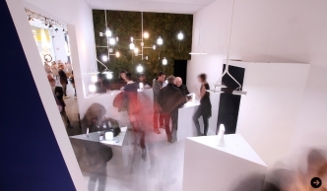
OLED panels, which were previously difficult to implement due to high costs or the need for large-scale equipment, enable simple spatial designs such as illuminating from the sides or floor with soft light, promising innovative styles in terms of environmental impact. As technology advances, material costs decrease, and equipment becomes larger and faster, unit prices are expected to fall. The day when OLED panels illuminate our everyday surroundings may not be far off.
Lumiotec
Tel. +81-238-29-0725 (General Inquiries)
http://www.lumiotec.com/