April 7, 2015
Architect Kengo Kuma Discusses the 'East Japan Project' and Reconstruction in Tohoku (3) | INTERVIEW
SPECIAL INTERVIEW
Architect Kengo Kuma Discusses the "East Japan Project" and Tohoku's Reconstruction (3)
Challenging the Origins of Architecture in Tohoku
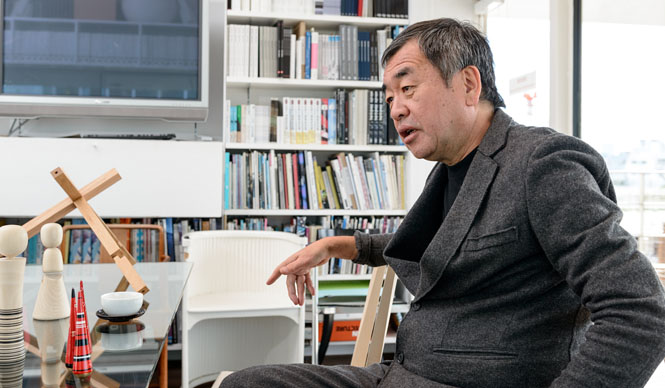
In this third and final installment of our interview with Kengo Kuma, we asked what many OPENERS readers might be wondering: "Why are so many architects involved in supporting the reconstruction of the disaster-stricken Tohoku region in various ways?" Kuma's answer is, "Because that's where the origins of architecture lie."
Vol. 2 "Architect Kengo Kuma Discusses the "East Japan Project" and Tohoku's Reconstruction" here
Photographs by SUZUKI ShimpeiText by KAJII Makoto (OPENERS)
Society Began to Focus on Architects, and Architects Became Brands
OPENERS has also featured articles on various architects engaged in reconstruction efforts in Tohoku. While we sense diverse sentiments and intentions behind these activities, one might ask: why are architects drawn to Tohoku?
"Since the 1980s, the field of architecture has seen architects treated as brands, with clients increasingly requesting 'architecture that is characteristic of them,'" Kuma explains.
"The branding and symbolization of architects led to an increase in commissions. While architects' spheres of activity indeed expanded globally, the opportunities for genuine communication have actually diminished. It's true that architects felt a sense of crisis about this. Architects who were frustrated by their branding sought the inherent 'origins of architecture' in the Great East Japan Earthquake – that is, a desire to create something together with local people and the land itself," he says.


Actively Engaging with the Community and Fostering Dialogue
"The desire to return to the original form of architecture, a form that Tohoku might be able to embody once again as it recovers from the earthquake, is what motivates architects," Kuma states.
Kuma, who is involved in the master plan for the town development of the Shizu-gawa district in Minamisanriku Town, Miyagi Prefecture, notes, "By considering 'warm architecture that can rival temporary prefabricated shopping streets,' something I hadn't thought much about before, I feel I'm discovering new possibilities." He adds, "While architecture is sometimes expected to possess artistic quality, in the town development of Shizu-gawa, which is not about architecture as a mere commodity, it's essential to meet with local residents, share drinks in the evening, and stay overnight. We are also expected to enjoy that time together."
"The town development in Shizu-gawa is a new challenge where I feel I am being tested for the sake of Tohoku. While reconstruction in Tohoku varies by location, Tohoku itself is a diverse region. We should aim to find unique answers for each area."


A Message for Reconstruction
"Through my involvement in the recovery from the earthquake, I've rediscovered the joy of taking things slowly. I believe this can become a new model for Japan. The origins of Japan's unique pace lie in Tohoku, and through Tohoku's reconstruction, I hope we can rediscover Japan and find its original essence."
East Japan Project
EJP Secretariat General Incorporated Association
Within Kengo Kuma Architects and Associates
Aoyama Tower Building 12F
2-24-15 Minamiaoyama, Minato-ku, Tokyo
Tel. 03-5771-7577
http://e-j-p.org/