March 26, 2015
Architect Kengo Kuma Discusses the 'East Japan Project' and Reconstruction in Tohoku (1) | INTERVIEW
SPECIAL INTERVIEW
Architect Kengo Kuma Discusses the "East Japan Project" and Tohoku's Reconstruction (1)
What Was Lost and What Was Realized in the Great East Japan Earthquake
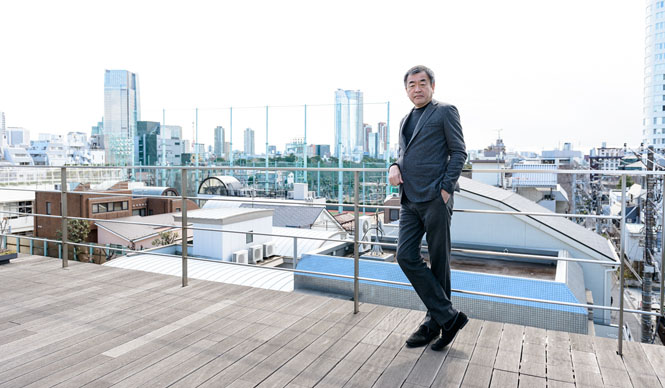
Four years have passed since the Great East Japan Earthquake, which devastated the Tohoku region. While we must not forget this massive earthquake disaster, architect Kengo Kuma is leading the "Ejp (East Japan Project)" initiative. This project collaborates with traditional craftspeople from Tohoku, applying time-honored techniques and materials to propose everyday items that enable an ecological and sustainable new lifestyle. We interviewed Mr. Kuma over three installments.
Photographs by SUZUKI ShimpeiText by KAJII Makoto (OPENERS)
Frankly, What Have We Achieved in These Four Years?
Before discussing the "Ejp (East Japan Project)," we asked about the four years since the earthquake.
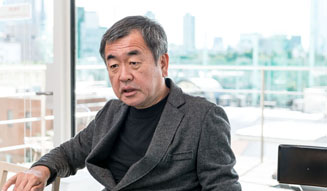
"I was asked by Mayor Jin Sato of Minamisanriku Town, Miyagi Prefecture, which suffered severe damage in the Great East Japan Earthquake, to develop a master plan for the town's reconstruction in the Shizugawa district. When I visit the site, Minamisanriku Town is progressing with reconstruction relatively quickly, but my frank impression is that this is all that has been achieved so far."
"Four years is a long time in a person's life. Everyone there is motivated and their passion hasn't waned, but they are blocked by various institutional and systemic hurdles. It's easy to see their doubt about whether they can sustain their motivation going forward," Mr. Kuma commented.
Many people may already know this from television documentaries, but the Shizugawa district of Minamisanriku Town is home to the "San San Shotengai" reconstruction shopping street. This temporary market, which opened on February 25, 2012, less than a year after the earthquake, features 32 local businesses involved in the reconstruction and attracts many tourists daily.
A Prefabricated Yet Human-Filled Shopping Street
"Mayor Sato of Minamisanriku Town is passionately dedicated to the reconstruction. I received the request for the master plan about a year and a half ago. Since then, through explanations to residents and meetings with those at San San Shotengai, I've been able to share both their anxieties and expectations."
"The prefabricated shopping street is always bustling with tourists and has become a kind of brand. However, as they transition to permanent stores, we must find a way to carry forward the current warmth and joy of this 'prefabricated yet so welcoming' place. We need to create something that lives up to the value of the shopping street so far – something low-cost, simple, yet unique."
Kuma's master plan for the Shizugawa district was finalized, and a report session for residents was held last year. Local newspapers reported that for the challenging task of creating "vibrancy and interaction" within a disaster-prone area where people cannot live, the plan proposed various features, such as waterfront spaces and promenades along the seawall, leveraging Shizugawa's characteristic natural environment of rivers and the sea.
The Finest Craftsmanship Resides in Tohoku
Let us return to the "Ejp (East Japan Project)." This project, spearheaded by architect Kengo Kuma, brings together multiple sales and manufacturing companies, designers, and craftspeople from Tohoku, transcending the boundaries of corporations and organizations. It was launched immediately after the earthquake.
"We had undertaken a lot of work in Tohoku before the earthquake, and we knew that the craftspeople there were incredibly persistent, reasonable, and did excellent work. We believed that the finest craftsmanship was in Tohoku when the earthquake struck."
"After the earthquake, when considering how we could be of service, my first thought was to create things together with the local craftspeople to help revitalize them. Once a craftsperson's skill is lost, it disappears, and successors are not found. So, I wanted to ensure their 'lineage' was not broken and to connect their 'line' with ours. In fact, I had wanted to collaborate with Tohoku's craftspeople on something even before the earthquake, but there was a certain hesitation on both sides," he shared.
The first product of the "Ejp (East Japan Project)" is "Chidori," designed by Kengo Kuma & Associates and produced by Fujisato Woodworking in Oshu City, Iwate Prefecture. It is a piece of furniture where 12 components are assembled to create a unit frame, which can then be freely connected to suit individual lifestyles.
"This system is based on an installation I presented at Milan Salone in 2007. By assembling it with three types of notches, it is expandable. Unlike architecture, it required meticulous precision, and it took considerable trial and error to complete. The notched parts are cut by hand, so I was amazed by the perseverance of the craftspeople."
In the second part of our interview with Kengo Kuma, we will discuss the latest work from the "Ejp (East Japan Project," titled "Stand Up Pen."
Vol. 2 "Architect Kengo Kuma Discusses the "East Japan Project" and Tohoku's Reconstruction" here
East Japan Project
General Incorporated Association Ejp Secretariat
Within Kengo Kuma & Associates
Aoyama Tower Building 12F, 2-24-15 Minamiaoyama, Minato-ku, Tokyo
Aoyama Tower Building 12F
Tel. 03-5771-7577
http://e-j-p.org/