ReBITA: Considering Homes Passed Down Through Generations at "Kyudo Gakusha"
ReBITA
Talk Event Held for 'Kyudo Gakusha Renovation Story,' an 88-Year-Old Renovated Residential Building
Thinking About Homes Passed Down Through Generations at 'Kyudo Gakusha'
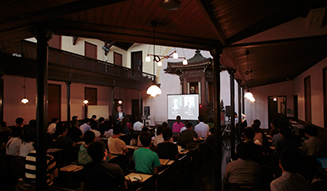
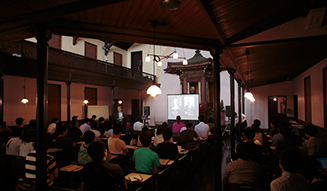
What constitutes a home passed down through generations?―On August 2nd, a talk event titled 'Kyudo Gakusha Renovation Story,' focusing on the renovation of 'Kyudo Gakusha,' Japan's oldest renovated condominium building at 88 years old, was held at the historic Buddhist chapel 'Kyudo Kaikan' in Hongo 6-chome, Tokyo. Architect Shinichi Chikakushi, the original owner of Kyudo Gakusha, spoke at the event, beginning with the circumstances surrounding its construction, while referencing valuable photographic materials.
Text by KAJII MakotoPhotographs by JAMANDFIX
Event Begins to a Near-Full House
The talk event for the 88-year-old renovated residence 'Kyudo Gakusha Renovation Story' was hosted by ReBITA, a company whose concept is 'Changing Lives Through Renovation.' ReBITA proposes new urban lifestyles and housing options by utilizing existing buildings. They actively hold consultation sessions and open houses for their renovated condominium projects.
For this talk event, architect Shinichi Chikakushi, grandson of Tsunenori Chikakushi, the owner of both Kyudo Gakusha and Kyudo Kaikan, was invited to share the story of how the Western-style building, constructed in 1926, was transformed into a condominium through renovation.
Renovation Goal: A '200-Year Building'
'Kyudo Gakusha' was built in 1926 by architect Goichi Takeda as a dormitory for young men studying Buddhism. It garnered significant attention at the time as a rare white, reinforced concrete structure in Japan.
Despite surviving wartime, the building fell into disrepair over time and was forced to close. In 2002, it was restored as a designated cultural property of Tokyo. However, due to the high maintenance costs, a plan was devised to sell it as renovated residences to generate funds.
With Shinichi Chikakushi, a descendant, being an architect, the project adopted a construction method enabling a '200-year building' to regenerate 'the oldest existing reinforced concrete building in Tokyo.' After extensive renovation work, it was reborn as a condominium complex in 2006, with all 11 units selling out.
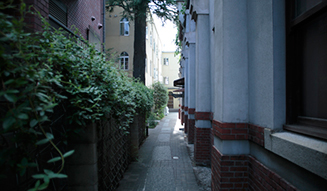
Kyudo Gakusha and Kyudo Kaikan, where the event was held, are adjacent. The serene atmosphere, unusual for central Tokyo, and especially the large trees on the premises, spoke to the history of the buildings and site, conveying the significance of regeneration and the value of homes being passed down and lived in across generations.
Proposing 100 sqm Apartments for 100 Years of Living
ReBITA operates 'R100TOKYO,' a premium series of renovated condominiums. This series carefully selects rare properties exceeding 100 square meters in verdant residential areas steeped in history and tradition, such as Setagaya, Meguro, Yoyogi, Hiroo, Daikanyama, Ebisu, Aoyama, Azabu, Akasaka, Shirokane, and Shinagawa. The series also offers custom design options to maximize the spaciousness of these 'over-100 sqm apartments,' which constitute only 1.1% of new properties and 4.4% of used properties.
'Le Class Daikanyama': Privacy with One Unit Per Floor
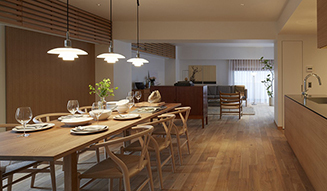
Located in an area that allows enjoyment of both Daikanyama and Ebisu, 'Le Class Daikanyama' offers Unit 301 as a concept room embodying the R100TOKYO philosophy. The design was supervised by ',Gowari Ichibu (51%) / 51% Tokyo', known for their architectural design and interior coordination work in both Toyama and Tokyo's Jinbocho.
Le Class Daikanyama is the fourth building in the 'Le Class' series of whole-building renovations by R100 TOKYO, offering an experience of the enduring, rich living that R100 TOKYO envisions.
'Le Class Himonya': Hotel-Like Interior Corridors
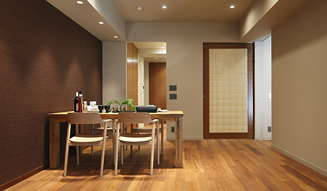
Situated in Himonya, one of Meguro's premier residential areas, 'Le Class Himonya' offers spacious residences with an average area of 108 square meters. The hotel-like interior corridor design leading from the entrance to the units, along with the staggered building shape, enhances the corner-unit feel and privacy of each residence.
'Le Class Himonya 101,' featured here, is a unit compatible with R100 TOKYO's My Order System (custom design), boasting a bright and open south-facing aspect. It proposes a lifestyle unconstrained by fixed layouts, adaptable to the changing life stages of the resident family.
Le Class Himonya 101
Exclusive Area | 2LDK + W + S / 100.68 sqm
Price | 78.8 million yen
1-Chome Himonya, Meguro-ku, Tokyo
'Le Class Meguro': Courtyard-Style Building with a Central Garden
Leveraging the characteristics of its low-rise residential zone, R100 TOKYO presents a new residential design concept: 'Urban Resort Court.' Eighteen residences can enjoy the luxurious relaxation of spacious homes averaging 116 square meters, alongside a picturesque central garden that changes with the Japanese seasons.
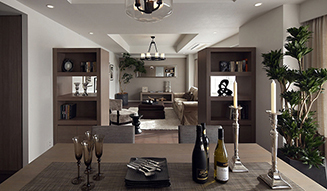
'Le Class Meguro 206' features a layout that evokes the spaciousness of a hotel suite, a hallmark of its over-100 sqm size, and an interior unified in stylish gray, among other highlights.
Le Class Meguro 206
Exclusive Area | 2LDK / 107.60 sqm
Price | 89.8 million yen
5-Chome Shimo-Meguro, Meguro-ku, Tokyo
ReBITA
http://www.rebita.co.jp/
R100 TOKYO
Inquiries
Tel. 03-6756-0100
Business Hours | 10:00–18:00 (Closed Saturdays, Sundays, and holidays)
http://r100tokyo.com/