March 18, 2015
PROJECT | Rikuzentakata Town Living Project: Temporary Living Space 'Riku Cafe' Opens
Rikuzentakata Town Living Project
Temporary Living Space 'Riku Cafe' Opens
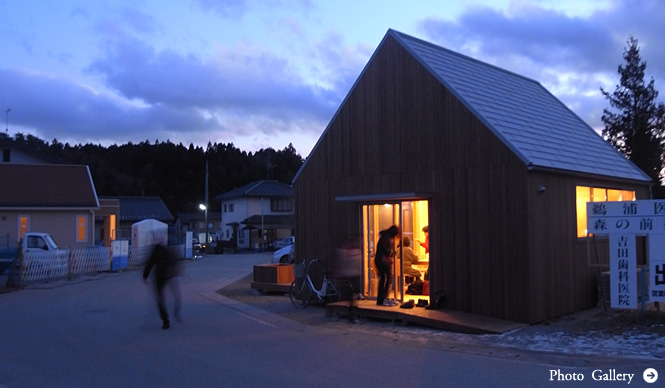
Rikuzentakata City in Iwate Prefecture suffered the most devastating damage during last year's Great East Japan Earthquake. Most of the town was affected, and places where locals could easily gather, like coffee shops, disappeared. In response, the 'Rikuzentakata Town Living Project Team,' composed mainly of local residents, has finally opened 'Riku Cafe,' a temporary living space designed as a welcoming hub for the community, on January 9th.
Text by KAJII Makoto (OPENERS)
A Community Hub for an Aging Population
The Town Living Project began with the initiative of residents who wanted to create a place for people to gather freely. It aims to establish such a space with the support of experts and corporations, embodying a project that gives form to 'new public' initiatives.
This 'Riku Cafe' was made possible through the collaboration of urban planning, community development, and architecture experts and students from the University of Tokyo and Tokyo Metropolitan University, including Associate Professor KOIZUMI Hideki (Urban Engineering) from the University of Tokyo's Graduate School, and architects YURI Naruse (Assistant Professor, University of Tokyo), Jun INOKUMA (Assistant Professor, Tokyo Metropolitan University), and Chikako GOTO (UDCK Director). Support also came from companies such as Sumitomo Forestry.
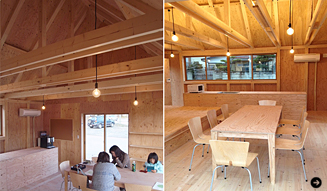
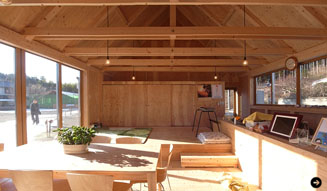
In disaster-stricken areas, common rooms and meeting spaces within temporary housing complexes primarily serve the residents of those complexes. Places like 'Riku Cafe,' accessible to everyone, were desperately needed.
Various uses are envisioned: enjoying conversations over simple tea or coffee, purchasing bread and sweets, using it as a resting area, serving as a waiting space for the nearby hospital and pharmacy, or providing shelter for those waiting for the bus in the cold.
The cafe is operated by an NPO formed by local women. It is expected not only to serve as a community space for disaster survivors but also as a shared space accessible to everyone within walking distance, even for those without cars, in a region facing increasing aging.
Following the completion of this temporary cafe, the project plans to construct a permanent cafe next year. This long-term initiative warrants attention.
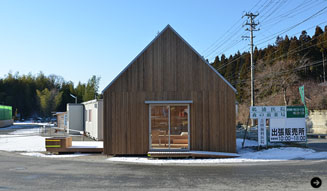
'Riku Cafe'
Size: Total floor area 34.78㎡ (10.52 tsubo), single-story building
Structure: Timber frame construction
Location: Rikuzentakata City, Iwate Prefecture
Rikuzentakata Town Living Project
http://rikucafe.com/