May 11, 2015
Makoto Tanijiri | Commemorating the 9th Exhibition 'Relation': A Conversation Between Makoto Tanijiri and Kenichi Aono
The person who inspired me to decide, "I will convey architecture in my own words."
Makoto Tanijiri x Kenichi Aono Dialogue (1)
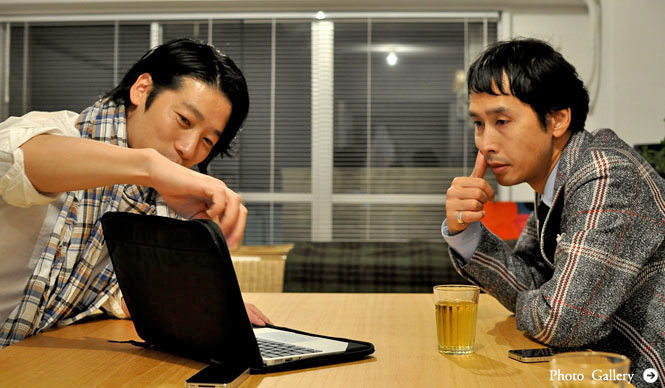
Translation──It was Kenichi Aono (Creative Director, BEAMS / Director, BEAMS RECORDS) who first said this to me. He suggested thinking about music through architecture, and fashion through architecture. When I told him that I pondered such things daily, he said, "What you're doing, Tanijiri, is translation." I still remember how surprised and deeply moved I was to find such a fitting word. It goes without saying that I became intensely interested in Aono's clear-headed thinking from that point on. So, I invited him for a conversation.
Text by Makoto Tanijiri (Suppose Design Office)
What first came to mind when I heard the exhibition's concept
AonoTanijiri-kun, do you know about the "Hollow Earth theory"?
TanijiriWhat a sudden question!
AonoThe generally accepted view is that the Earth has a core, a mantle (the outer layer), and a surface. But before this theory became widespread, imaginative people proposed various ideas. The "Hollow Earth theory" is one of them. It suggests that the Earth's interior is hollow, with a passage connecting the North and South Poles, forming a void. Furthermore, it posits that people live inside this void, like in a parallel world... Normally, one would think that people inside would fall out due to gravity, but this theory holds that "the Earth is governed by centrifugal force." As evidence for this centrifugal force, they claim that lighter substances exist in the air, while heavier materials like minerals and rocks are found on the ground.
TanijiriThat's fascinating! It almost sounds plausible.
AonoApparently, some people even approached the US government asking for funding to travel to Antarctica to prove this theory, and they raised money through lectures. I had also been rereading books by the German literary scholar Sueki Tanimura, who touched upon this theory. So, when I heard the concept of Tanijiri-kun's exhibition (Makoto Tanijiri's "Relation" at B GALLERY, which started on October 25th. The concept is: "What if we could float architecture that relies on gravity?" The installation attempts a new proposal for conventional architectural concepts by suspending architectural models in the venue.), the "Hollow Earth theory" was the first thing that came to my mind.
TanijiriIs that so! This theory also divides people into two camps: those who claim it exists and those who claim it doesn't. However, the moment it's proven to exist, those who claimed it didn't change their minds. I'm always intrigued by such ways of perceiving things. In social life, I often feel that people are too quick to say "it's impossible." They don't pursue whether something is possible or impossible based on any solid grounds. I always believe that discerning "possibility" and "impossibility" is crucial. Especially when trying to do something new, if you say "it's impossible," it will never happen. So, rather than saying "it's impossible," I always try to think about "how to make it possible."
In this exhibition, by designing a "magnetic field," we've created architecture where "the structure that should exist is absent." While it's still a small possibility, I believe it could function as a dwelling if technology advances. It's like applying architectural thinking to the levitating trains of the maglev system. When you actually try it, they do float quite well.
AonoThe earthquake on March 11th made us re-examine the nature of things and how we live. Did Tanijiri-kun's idea of "floating architecture" also stem from the earthquake?
TanijiriIt feels like I've finally given form to feelings I've had for several years. Buildings designed to protect lives can become buildings that take lives... I felt a fundamental contradiction and a persistent sense of unease. When considering a "house that protects life," the instinct is to build it strong and rigid. This inevitably increases its weight, and if it collapses, there's a risk of people being crushed and losing their lives...
AonoIndeed, conventional buildings typically involve digging foundations and driving piles into the ground.
TanijiriThe "foundation" of a building is quite peculiar. The Itsukushima Shrine in Hiroshima stands over the sea without a foundation. So, I wonder why foundations became the norm. While foundations can prevent land subsidence, they have become standard practice now. We often hear, "If the ground is unstable, build a strong foundation," but I sometimes wonder if such heavy foundations are necessary if the ground is weak. If we design lighter structures, the burden on the ground can be reduced... Well, I suppose I'm just a contrarian (laughs).
The person who inspired me to decide, "I will convey architecture in my own words."
Makoto Tanijiri x Kenichi Aono Dialogue (2)
The beauty in "emptiness." The relationships born from "emptiness."
AonoThere are many things in the world that feel off, but if we neglect even minor issues, we become desensitized to various things. We become less responsive. I often feel this way. Nowadays, the world is designed to be "kind and polite." This makes us live without having to think too much. For better or worse, because it's so convenient, it all comes down to whether we choose to notice it or not.
TanijiriAs a result, our brains are being used less. When designing buildings, trying to create convenient homes invariably leads to boring houses. However, when we create things without specific functions, they become richer homes.
AonoExactly. Because there is beauty in emptiness.
TanijiriYes, truly.
AonoIt's the same with book design and layout; the things that impress me have consideration for the empty spaces. Our feelings naturally gravitate towards them.
TanijiriHaving empty space allows us to rest while reading. That's why we can engage with it, and it creates a rhythm.
AonoArchitecture also has rhythm, doesn't it? Whether it's the flow of people or the act of climbing and descending stairs. In other words, instead of limiting actions by saying, "This is the only way to go," you are constantly exploring possibilities like, "You can go this way, and you can also go that way."
TanijiriYes. I do it because I think it would be better that way.
AonoThat must lead to negotiations with the client, right?
TanijiriIt does. From the client's perspective, creating extra space means either reducing the living space they need or making the house larger. So, it's necessary to gain their understanding. When building a small house, if there's a space and you want the living room to be as large as possible, you'd want to make the entire space the living room. However, if you make half of it the living room and create empty space, a relationship is formed. Even if the "size" is smaller, you can achieve a sense of "expansion." In this way, even if something can be understood through words and thought, when asked "How many tatami mats is it?" or expressed in concrete numbers, these relationships can suddenly break down.
AonoIf you think about it carefully, even if you create a living room space of 20 tatami mats, the "place where you are" becomes fixed. For example, "where you can watch TV," or other specific points. As a result, you might pay attention to things within a radius of a few meters, but things further away become irrelevant. I think it's better to have a sense of spaciousness that allows you to view the scenes of life within the dwelling from the outside.
TanijiriIt's definitely better to have relationships. If we lived in a world where only "size" existed, the concept of size couldn't be discussed. By creating "smallness," we can talk about "largeness." This applies to everything, and creating these relationships is very important. This requires emptiness.
AonoIt's like if you paint everything black, there's no room for "white" to be inserted. Speaking of black and white, since the earthquake, I feel like we've been living in a world of "black or white?" Personally, I think, "No, no, isn't life lived in shades of gray?" Radical individuals only speak in a dichotomy of "this" or "that"... I find that trend unsettling. Every field needs its gray areas, and whether it's dark gray or light gray, I feel that something resembling the "essence" lies within them.
TanijiriEven in music, there are notes between "Do" and "Re" that make music possible; it's not just made up of "Do, Re, Mi, Fa, Sol, La, Ti, Do."

AonoJust like a piano has black and white keys. Speaking of scales, beyond the Western scale... for example, Okinawa and India have unique scales, but they appear different depending on the perspective from which one views things. What is normal for an Indian might seem unusual to a Westerner, and vice versa. It's not about which is correct; there are things that can coexist, and relationships can be nurtured through mixing.
TanijiriExactly.
The person who inspired me to decide, "I will convey architecture in my own words."
Makoto Tanijiri x Kenichi Aono Dialogue (3)
"Misconceptions" play a significant role in creating something new.
AonoBy the way, Tanijiri-kun, your book coming out next January includes the word "misconception" (Makoto Tanijiri's "1000% Architecture: I've Lived My Life with Misconceptions" published by X-Knowledge) (laughs). Let's share some "misconception stories" here (laughs).
TanijiriThat sounds good (laughs). Aono-san, have you ever had a "misconception"?
AonoQuite a few (laughs).
TanijiriFor me... I saw "Dash! Kappei" (a manga about basketball. The protagonist, despite being extremely short, has athletic abilities beyond his high school peers and is active in the sport) and thought that even someone short could play basketball.
AonoWas that a misconception?
TanijiriAlso, I saw "Tsurumoku Dokushinryo" (a romantic comedy manga set in a bachelor dormitory where the protagonist, an employee of "Tsurumoku Furniture," lives) and aspired to be an interior designer, and then I decided to become an architect.
AonoIt's all manga (laughs). I used to think that all foreigners were left-handed.
TanijiriThat's true! I thought so too.
AonoAnd I also thought that foreigners laughed in English when they laughed.
TanijiriIs that so? (laughs) The reason I wove the keyword "misconception" into my book was that I wanted to convey that these assumptions, these misconceptions, can sometimes lead to positive ways of thinking. Continuing from what I said at the beginning, things that I believe I "can do" might be considered outside the norm by society, leading to the thought, "Why is that guy trying to do something he can't?" However, as my knowledge and experience grow, the range of things I "can do" expands, but at the same time, I feel the scope for trying new things narrows. Looking back, as a child, I had misconceptions and strong beliefs, and I made many mistakes because of them.
AonoIt's trial and error.
TanijiriAs we get older, we try less, so we make fewer errors.
AonoAs adults, we acquire a certain kind of wisdom that can be detrimental.
TanijiriI think that's problematic. We need to try and face things as we did in the past. I believe that "misconceptions" play a significant role in creating new things. However, I don't think it's quite right to call it talent. Calling it a "misconception" seems to make it easier to connect with society. I put it in the subtitle of my book because I want everyone to remember the "misconceptions" they once felt.
AonoHearing your explanation now, I think many people will resonate with the idea of "misconception." Also, I believe the attitude of "just give it a try" is important, without necessarily distinguishing between what we "can do" and "cannot do."
TanijiriI became an architect through a "misconception," and at some point, I started to think, "Maybe I can do it," which allowed me to do various things. Looking back, I've done many embarrassing things (laughs). Because I didn't know the rules, I acted boldly. It was through Twitter that I first met Aono-san, wasn't it? I resonated with Aono-san's tweets, and when I retweeted them, a mutual acquaintance asked, "Tanijiri-kun, are you acquainted with Aono-san?" Then we decided to have dinner together... that was this year.
AonoThat's a very contemporary anecdote (laughs).
TanijiriWhen we first met, Aono-san called what I do "translation." That word really resonated with me, and I was incredibly happy. It was the catalyst for me to decide, "I will convey architecture in my own words." It might have been the most gratifying thing anyone said to me this year. Music, art, fashion... I encounter various things and then "translate" them into "architecture" through my own filter. I truly feel this.
AonoI believe translation involves taking ownership of something as your own problem. The act of digesting and then expressing is based on the premise of "taking ownership." People who can output using their own language, rather than being like a "translation software," are talented and interesting.
TanijiriWhen I look back, I don't know when I became able to translate. Am I actually capable of translation, or do I just think I am? However, I believe anyone can translate. By translating within the field of architecture, I hope to increase the number of people who have "misconceptions" in various fields, and if they eventually cross over, I think society will become more enjoyable.
The person who inspired me to decide, "I will convey architecture in my own words."
Makoto Tanijiri x Kenichi Aono Dialogue (4)
Why the comfortable back-and-forth in conversation.
AonoWhen people engage with Tanijiri-kun's translations and understand them within their respective contexts, we gain the ability to view things from various angles, which I believe brightens the world.
TanijiriLooking at the plating of a dish, the relationship between the plate and the food can be seen as the relationship between the site and the building. Then, conversely, when a cook looks at a site and a building, they might imagine the plating of a dish. When such relationships are formed, things that were not of interest become "things of interest."
AonoFurthermore, Japanese people have a sense of "mitate" (appreciation or interpretation) and the philosophy of "shakkei" (borrowed scenery). When our hearts are fulfilled in this way, it leads to good health.
TanijiriAlso, talking with people like this is important. Right now, with Aono-san in front of me, I am translating, and because of that, I can convey my thoughts and ideas. And Aono-san teaches me many things. I'm not good at reading books... or rather, when I see the word "tone" (音色, neiro, literally sound color), I wonder "What color is it...?" and I drift away from the book, unable to finish it (laughs). I gain more from talking with people than from reading books. Both words and sounds enter my consciousness simultaneously.
AonoIt provides direct stimulation. The words received directly can make subconscious thoughts manifest, and the moment they connect feels wonderful. Those moments of "aha!" By the way, Tanijiri-kun, do you consider yourself lucky?
TanijiriExtremely lucky.
AonoMe too. Perhaps that's another misconception (laughs). And I have this baseless optimism, so I always think, "It'll probably work out somehow."
TanijiriIn my case, that often causes trouble for those around me (laughs).
AonoIt has worked out so far... To a strict person, it might seem baffling, but...
TanijiriThat's why various things are drawn to me. When I strongly think, "I will create this, I will create that," opportunities to create it truly arise. It's like self-hypnosis (laughs). I believe my ability to attract things is growing stronger.
AonoIn my case, when I'm in a situation where I "have to write," I can't write when I actually sit down to do it (laughs). Words come to me when I'm spacing out. Ideas are the same.
TanijiriAono-san, you've had regular columns and published books (e.g., "Meikyu-iki" published by Tennen Bunko/BCCKS). Have you always been able to write?
AonoNo, I didn't learn it from anyone, nor did I particularly like or dislike it. Opportunities to write, such as "Please write liner notes" or "Please do a regular column," have led me to where I am today. Just as Tanijiri-kun values emptiness in architecture, I approach writing with a similar mindset. I want readers to have moments of rest where they need them. Words affect consciousness, so even a single conjunction can have a significant impact on a person... because it reacts to the reader's "imagery." Therefore, I pay attention to subtle nuances and am careful. For example, I say, "This is good," rather than "This will do."
TanijiriI understand that! When my staff says, "This will do," I immediately reject that idea. Because it doesn't convey "This is good."
AonoAs expected (laughs). I'm careful even when ordering at a restaurant. If I think about the person who is cooking, saying "This will do" feels wrong, like compromising. A proactive attitude of "I want to eat this" makes the food taste different. And...
TanijiriYou're absolutely right!
AonoAlthough our fields are different, Tanijiri-kun understands the nuances of words and we share common ground. That's why the conversation flows so comfortably. I'm an outsider when it comes to architecture, but today we've had a truly "constructive" discussion (laughs).
TanijiriThank you very much!
Kenichi Aono
Creative Director, BEAMS / Director, BEAMS RECORDS
As Creative Director for the select shop "BEAMS," he engages in activities that connect fashion, music, art, and literature. In 2010, he published his first collection of writings, "Meikyu-iki" (Tennen Bunko/BCCKS). He currently writes columns for magazines such as "OCEANS," "ROCKS," and the literary magazine "IN THE CITY." He also performs as part of the DJ unit "Massao" with Mao Yamazaki (gm projects) and Sohei鹤谷 (NEWPORT), and has appeared at events like "SPECTACLE in the Farm 2010" and "Port Spectacle" (2011).
Makoto Tanijiri Exhibition "Relation"
Period: Ongoing until Sunday, November 13, 2011
Hours: 11:00 AM - 8:00 PM (Open daily during the exhibition period)
Location: B GALLERY (BEAMS JAPAN 6F)
3-32-6 Shinjuku, Shinjuku-ku, Tokyo
Tel. 03-5368-7309
http://www.beams.co.jp/b-gallery/
Makoto Tanijiri Talk Show Announcement
Date & Time: Saturday, November 5, 2011, 3:00 PM - 4:30 PM
Venue: B GALLERY (Shinjuku / BEAMS JAPAN 6F)
Reservation Required | First 40 guests
Reservations: Contact B GALLERY (Tel. 03-5368-7309)
*Scheduled to publish his first book, "1000% Architecture: I've Lived My Life with Misconceptions," from X-Knowledge in January 2012.