December 26, 2014
Are We Entering an Era of “Ownership” and “Sharing” for Goods?
A Growing Trend: Renting Instead of Owning, Especially Among Women in Their 30s and 40s
The New Ideal: A Balance Between Ownership and Sharing
"What's yours is mine, and what's mine is mine." This is the famously memorable line spoken by Gian in the manga Doraemon. While Gian is an extreme example of someone who claims even others' possessions as his own, in a society that clearly defines ownership, such boundaries around belongings play a crucial role. However, in recent years, an increasing number of people are skillfully integrating items into their lives by borrowing and sharing them, without adhering to such strict boundaries.—revealed in a survey by Research and Development.
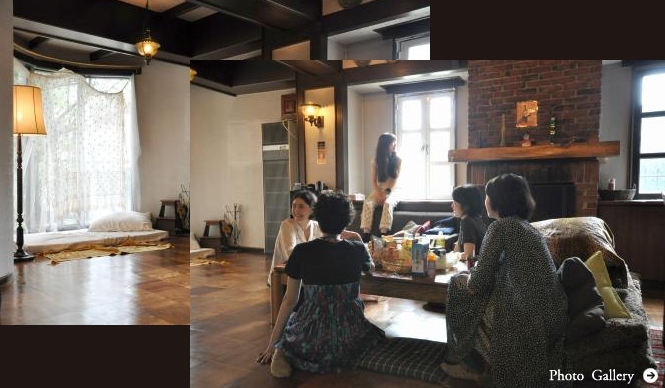
Text by TANAKA Junko (OPENERS)Photographs by Hituji Real Estate (taken at YOGA ULUKA)Data courtesy of Research and Development, Inc
What is a "Rent-Based Lifestyle"? Living Without Possessions
In October 2011, Research and Development conducted an "Awareness Survey on Rental and Sharing" targeting 3,000 general residents aged 18 to 74 living in the Tokyo metropolitan area. This survey was part of the company's annual "CORE" survey, which has been observing changes in consumer awareness and behavior since 1982.
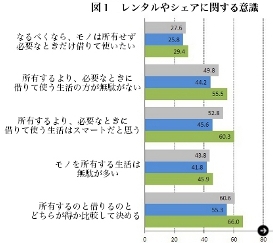
The survey revealed that 60% of respondents believe in deciding whether to own or rent based on a "comparison of which is more advantageous," indicating that consumers are not necessarily fixated on "ownership." This sentiment is more prevalent among women than men, and particularly among women in their 30s and 40s (the "arasaa" and "arafoo" generations), where more than two out of three favorably view a lifestyle of "borrowing and using what is needed, when it is needed." A positive image of a lifestyle without possessions, or a "rent-based lifestyle," appears to be spreading.
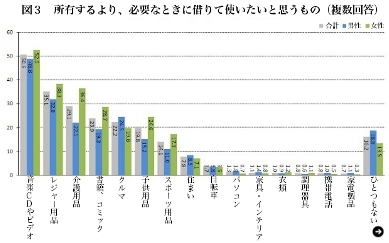
Looking closer at the survey results, the top item people want to borrow and use when needed is "music CDs and videos." This is followed by "leisure goods" such as camping equipment. For women specifically, many cited items needed temporarily, such as "nursing care supplies" and baby strollers, indicating a growing inclination towards a rational and waste-free lifestyle.
What this survey reveals is a shift in consumer attitudes towards "borrowing and using things," an idea that was often perceived negatively, associated with "poverty" or "lack of money."
Why are people's minds turning towards a "lifestyle without possessions" now? In their book "The Sharing Economy: The End of Employment and the Rise of Crowd-Sourced Capitalism" (published December 16, 2010, by Nihon Hoso Shuppan Kyokai), business consultant Rachel Botsman and entrepreneur Roo Rogers boldly declared, "We are moving to a time when what you have is less important than what you can access, and how you share it defines you." The following is an excerpt from the book.
"We are only now waking up from the 'trance' of consumption that has lasted for about 50 years. Underlying this change are two interconnected phenomena. One is a shift in values. With economic growth stagnating, it's unsustainable to continue consuming as if resources were infinite, and this awareness is spreading among consumers. Therefore, people are seeking to make better use of 'what they have bought' and, more importantly, to gain something from 'what they haven't bought.' (Omitted) We are at a major turning point, moving from pursuing 'what's in it for me' to considering 'what's in it for everyone.'"
The results of this survey indicate that such a shift in consciousness is indeed beginning to occur, even here in Japan. It's not a matter of choosing between "ownership" and "sharing," but rather organizing one's own thoughts and feelings about which items to "own" and which to "share," and then making choices. A lifestyle that skillfully combines "ownership" and "sharing" in this way has already begun.
Awareness Survey on Rental and Sharing
Survey Method: Door-to-door placement survey
Survey Area: Within 40 km of the Tokyo metropolitan area
Survey Period: October 1-31, 2011
Number of Valid Responses: 3,000
Respondent Demographics: 18-29 (21.0%), 30-39 (22.3%), 40-49 (16.6%), 50-59 (18.2%), 60-69 (16.0%), 70-74 (5.9%)
Gender: Male (50.9%), Female (49.1%)
Research and Development
Tel. +81-3-5642-7711 (General Inquiries)