May 20, 2015
Daiwa House | Smart Homes Equipped with Solar Power, Batteries, and HEMS | SHIFT JAPAN
Daiwa House
Smart House with Solar Power, Battery, and HEMS
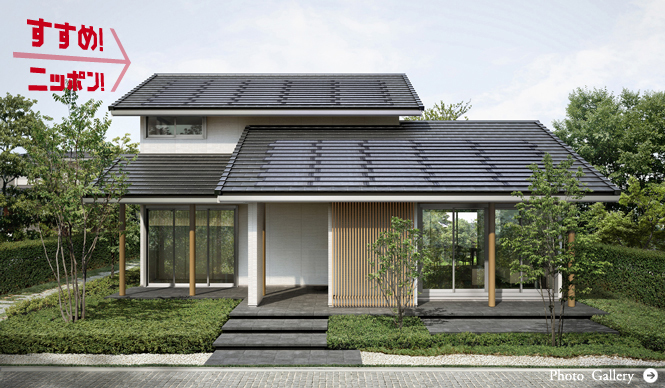
For Home UseLithium-ion Battery, HEMS (Home Energy Management System), and a solar power system, Daiwa House'sSmart House"Suma-Eco Original" will be released on October 1st.
Text by OPENERS
The Next-Generation Home Capable of Energy Self-Sufficiency
In July 2010, Daiwa House launched the "Smart xevo Eco Project" with the goal of evolving into an energy self-sufficient home that achieves zero environmental impact (zero CO2 emissions and zero utility costs) by 2020, while enhancing quality of life. As the first step, a demonstration experiment began in July 2010 at "SMA×Eco HOUSE," a model home featuring Japan's first domestic lithium-ion battery. The experiment was conducted at three locations nationwide: Saitama, Nagoya, and Osaka. The newly released "Suma-Eco Original" combines the "xevo" detached house with a 2.5kWh domestic lithium-ion battery, "D-HEMS" (a system for visualizing and managing household electricity), and a solar power system, leveraging the know-how gained from this demonstration experiment.
The "Suma-Eco Original," which combines a domestic lithium-ion battery, "D-HEMS," and a solar power system, can reduce energy consumption by 78% and CO2 emissions by 70% compared to homes built to previous energy conservation standards, without requiring drastic energy saving measures.
During the day, electricity generated by the solar power system is used within the home, and surplus electricity is sold to the power company. At night, electricity from the midnight power supply is stored in the domestic lithium-ion battery. This stored power is then preferentially used for lighting and appliances in living and dining areas during the day, reducing electricity purchased from the power company by up to 2kWh. In the event of a power outage, the system automatically switches to battery discharge mode, supplying power to specific lighting and appliances as an emergency power source.
Calculations for a "xevo" (136.23 sq m) based on the electricity and gas rate plans of Kansai Electric Power and Osaka Gas indicate an annual reduction in utility costs of approximately 270,000 yen. In this scenario, the home actually generates a profit through electricity sales.
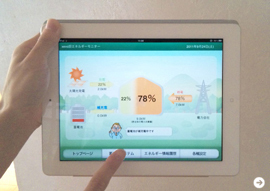
The terminal used to monitor the HEMS, which manages household electricity, is an iPad 2. This is truly a next-generation home where all domestic energy is made smart.
Suma-Eco Original
Release Date | October 1, 2011
Sales Region | Properties located within the service areas of Tohoku Electric Power, Tokyo Electric Power, Chubu Electric Power, and Kansai Electric Power
Additional Cost for "Suma-Eco Original" Specification Upgrade
Domestic Lithium-ion Battery | ¥1,621,200
D-HEMS (including iPad 2) | ¥279,300
Solar Power System (3.5kW) | ¥577,500/kW
Total ¥3,921,750
http://www.daiwahouse.co.jp/jutaku/smart/original/index.html