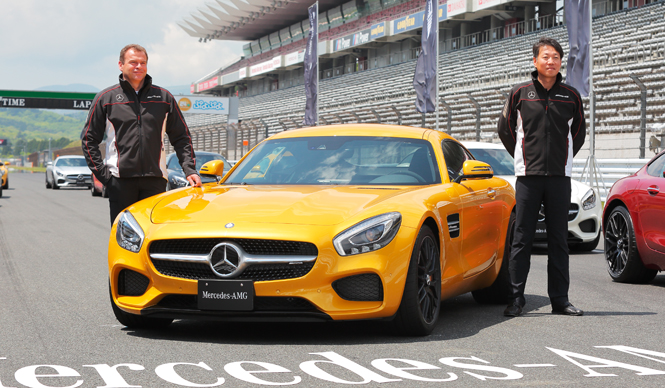
Unveiling the New Mercedes-AMG GT | Mercedes
Mercedes AMG GT | The Mercedes-AMG GT
Mercedes' New Generation Super Sports Car Debuts in Japan
Unveiling the New Mercedes-AMG GT
Following the SLS AMG, the second sports car from Mercedes-AMG, the "Mercedes-AMG GT," has finally landed in Japan. Tatsuya Otani reports from the Fuji Speedway, the venue for the event, on this new generation of high-performance sports car, crafted with the slogan "Handcrafted by Racers."
Text by OTANI TatsuyaPhotographs by HANAMURA Hidenori
The Second "Full AMG Original Model"
"We will challenge the top competitors in this class. You all know them well; they are competitors from Southern Germany, not far from our headquarters."
Although not named, it was clear to everyone that he was referring to Porsche. The speaker of these provocative remarks was AMG CEO Tobias Moers. This occurred at the "Mercedes-AMG GT" announcement event held at Fuji Speedway on May 8th.
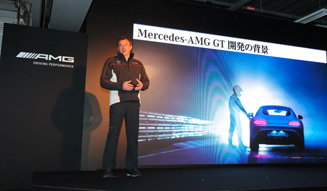
AMG CEO Tobias Moers attending the press conference at Fuji Speedway
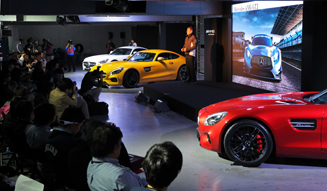
The announcement of the sub-brand system, calling AMG "Mercedes-AMG" and Maybach "Mercedes-Maybach", was made at the LA Auto Show last November. With this change, models like the C63 AMG were renamed to "Mercedes-AMG C63". Therefore, the AMG GT introduced here should officially be called the Mercedes-AMG GT.
The AMG GT is the second "Full AMG Original Model," following the "SLS AMG" announced in 2010. Technically, the new GT shares many similarities with the SLS. For instance, both feature a "front-midship" layout with the V8 engine mounted between the front axle and the cabin. Additionally, they both employ a transaxle system, separating the engine and gearbox and placing the gearbox on the rear axle. A significant portion of the body is also made of aluminum, a commonality with the SLS.
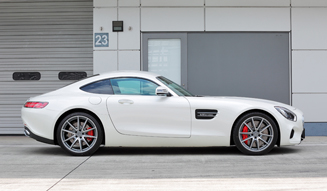
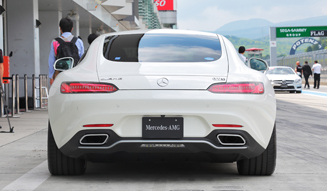
With the Porsche 911 directly in its sights as a rival, why did AMG insist on the front-midship plus transaxle configuration? At a workshop held last September at AMG's headquarters in Affalterbach, Markus Hofmann, who led this project, explained, "Because it allows us to achieve both performance worthy of a true sports car and stability that is easy for the driver to control."
Mercedes AMG GT | The Mercedes-AMG GT
Mercedes' New Generation Super Sports Car Debuts in Japan
Unveiling the New Mercedes-AMG GT (2)
A Philosophy Opposed to the Porsche 911
In other words, by choosing a front-engine layout, which offers superior basic stability compared to a rear-engine, they aimed for ease of handling. By employing a transaxle system, which facilitates a near-50/50 weight distribution, they sought to achieve handling performance close to that of a mid-engine car.
What's particularly noteworthy here is the selection of a front-engine layout, prioritizing "ease of control." This approach is diametrically opposed to Porsche's 911, which has historically adhered to a rear-engine layout. It also suggests a difference in the target customer base for the 911 and the AMG GT.
Incidentally, it appears that Mr. Hofmann was involved in the chassis development of the Porsche911 Turboat Porsche. This means AMG entrusted the development of their rival to an engineer who knows the benchmark better than anyone.
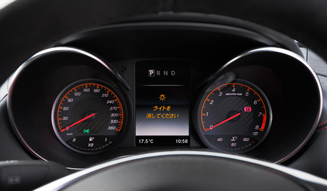
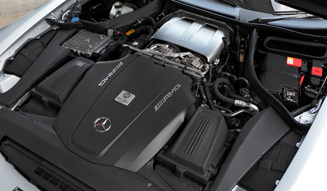
On the other hand, the AMG GT has seen significant advancements in several areas compared to the SLS. While both use V8 engines, the AMG GT is equipped with a newly developed 4.0-liter direct-injection twin-turbo engine, the "M178." Replacing the SLS's 6.3-liter naturally aspirated V8, this new engine achieves smaller size, lighter weight, and higher efficiency, meeting the era's demand for fuel economy.
Its performance figures are 510 hp / 650 Nm for the higher-spec GT S and 462 hp / 600 Nm for the standard GT. In comparison, the rival 911 Turbo offers 520 hp / 660 Nm in its standard configuration, and the more powerful 911 Turbo S boasts 560 hp / 700 Nm. While the AMG GT may fall slightly short in sheer numbers, it possesses a powerful weapon: its price (detailed later). How one evaluates this aspect could be another point of divergence between Porsche and AMG enthusiasts.
The newly developed "M178" features a "hot inside V" layout, where the intake system is positioned within the V-bank. This design shortens the distance from the turbochargers, located on the exhaust side, to the intake manifold, improving response. Furthermore, it adopts a dry-sump lubrication system, common in racing cars, to lower the center of gravity.
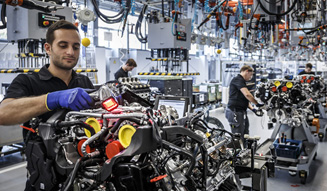
AMG fans will also be pleased to know that it adheres to AMG's tradition of "One Man, One Engine" – a system where a single mechanic is responsible for the entire engine assembly process, with their signature plaque affixed to the completed engine.
While the gearbox is an AMG Speedshift DCT dual-clutch unit, inherited from the SLS, the reaction time (the delay between operating the paddle shifter and the actual gear change) – which was considered a weakness in the SLS – has been significantly reduced.
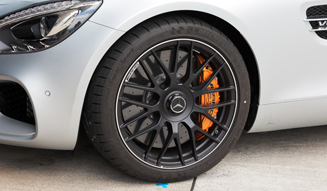
The suspension is a conventional double-wishbone setup at both the front and rear. The AMG Ride Control sports suspension with variable dampers is standard on the GT S and available as an option on the GT. Both models come standard with steel brake discs, but the GT S offers an optional upgrade to ceramic brakes.
Mercedes AMG GT | The Mercedes-AMG GT
Mercedes' New Generation Super Sports Car Debuts in Japan
Unveiling the New Mercedes-AMG GT (3)
The Next Generation of Mercedes Design
Similar to the SLS, aluminum is extensively used for the spaceframe and body materials. However, by incorporating steel and magnesium in appropriate places, a rear-biased weight distribution of 47% front / 53% rear is achieved, despite the front-engine layout. Notably, like the SLS, the aluminum body is supplied to AMG by an external manufacturer, with ThyssenKrupp now selected as a new supplier.
In terms of design, the AMG GT, like the SLS, adopts the classic long-hood, short-deck proportions of a sports car. However, this is an inevitable choice given the front-midship configuration. The exterior impression has shifted significantly from the somewhat rugged and powerful style of the SLS to a more feminine design that extensively utilizes elegant curves.
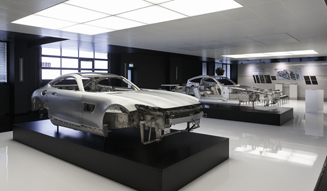
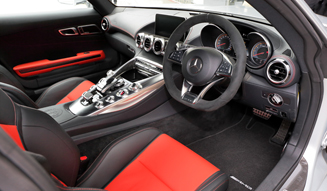
This symbolizes that the AMG GT was designed under the direction of Gorden Wagener, Mercedes' Chief Design Officer. The interior also features a gently sloped center console, which actually hints at the next generation of Mercedes design.
At Fuji Speedway, where the event was held, we had the opportunity for a brief circuit drive after the presentation. Equipped with Michelin Pilot Super Sport tires, the car's easily discernible grip limit, as claimed by AMG, left a strong impression.
The announced prices are 15.8 million yen for the AMG GT and 18.4 million yen for the AMG GT S (delivery is scheduled to begin in mid-May for the GT S and from September onwards for the GT). In comparison, the rival 911 Turbo costs 21.28 million yen and the 911 Turbo S is 25.39 million yen, making the AMG GT 6 to 8 million yen cheaper.
While the Porsche 911 is a 2+2 seater, the AMG GT is a pure two-seater. However, the luggage space accessible via the tailgate offers a practical 350 liters. If its performance truly rivals that of the 911 Turbo, it represents a formidable new competitor for Porsche.

Mercedes AMG GT S | Mercedes-AMG GT S
Body Dimensions | Length 4,550 x Width 1,940 x Height 1,290 mm
Wheelbase | 2,630 mm
Tread Front/Rear | 1,680 / 1,650 mm
Weight | 1,670 kg
Engine | 3,982 cc V8 Direct Injection Twin-Turbo
Bore x Stroke | 83.0 x 92.0 mm
Compression Ratio | 10.5:1
Max Output | 375 kW (510 ps) / 6,250 rpm
Max Torque | 650 Nm / 1,750-4,750 rpm
Transmission | 7-speed Dual Clutch (AMG Speedshift DCT-7)
Drivetrain | FR
Suspension Front/Rear | Double Wishbone / Double Wishbone
Brakes Front | Ventilated Discs
Brakes Rear | Ventilated Discs
Tires Front/Rear | 265/35R19 / 295/30R20
0-100 km/h Acceleration | 3.8 seconds
Top Speed | 310 km/h
Trunk Capacity | 350 Liters
Price | 18.4 million yen
Mercedes-AMG GT | Mercedes-AMG GT
Body Dimensions | Length 4,546 x Width 1,939 x Height 1,287 mm
Wheelbase | 2,630 mm
Tread Front/Rear | 1,686 / 1,651 mm
Weight | 1,615 kg
Engine | 3,982 cc V8 Direct Injection Twin-Turbo
Bore x Stroke | 83.0 x 92.0 mm
Compression Ratio | 10.5:1
Max Output | 340 kW (462 ps) / 6,000 rpm
Max Torque | 600 Nm / 1,600-5,000 rpm
Transmission | 7-speed Dual Clutch (AMG Speedshift DCT-7)
Drivetrain | FR
Suspension Front/Rear | Double Wishbone / Double Wishbone
Brakes Front | Ventilated Discs
Brakes Rear | Ventilated Discs
Tires Front/Rear | 255/35R19 / 295/35R20
0-100 km/h Acceleration | 4.0 seconds
Top Speed | 304 km/h
Trunk Capacity | 350 Liters
Price | 15.8 million yen
Mercedes-Benz Contact
0120-190-610