Nissan Juke | A New Face in Small Crossovers
NISSAN JUKE | The New Face of Compact Crossovers
The New Face of Compact Crossovers
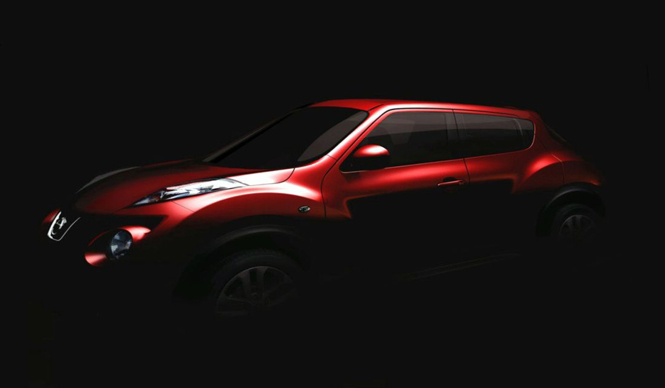
Nissan Europe has announced that the model name for its new crossover, scheduled for release in October, will be the "JUKE."
Text by Giraffe
Official Debut at the 2010 Geneva Motor Show
This Juke is the production version of the "Qazana" concept car unveiled at last year's Geneva Motor Show. Teaser photos released so far show that it inherits the Qazana's signature round headlights and flared front and rear fenders.
Nissan Europe positions this new model as a vehicle that bridges the gap between compact hatchbacks like the "Note" and the "Qashqai" (known as the "Dualis" in Japan), aiming to attract buyers looking to upgrade from smaller hatchbacks in Europe's key markets.
Simon Thomas, Vice President of Nissan Europe, commented on the Juke, stating it is "a model that will bring us new success." This suggests a significant level of anticipation for the new vehicle.
The new Juke is scheduled for its official unveiling at the Geneva Motor Show, which begins in March. Sales in European countries are set to commence in October.
BRAND HISTORY
Nissan Motor Corporation began producing the Cedric under its own name in 1960, with its origins tracing back to 1937. After World War II, it engaged in knock-down manufacturing of British Austin vehicles. In 1966, it merged with Prince Motor Company. Between 1983 and 1987, it established a joint venture with Alfa Romeo, producing passenger cars in Italy. At one point, Nissan rivaled Toyota in market share, but faced a management crisis in the 1990s, leading to a capital investment from France's Renault in 1999, which continues to the present day.
Nissan's distinctiveness may lie in its ability to create cars that resonate with the Japanese lifestyle. Whether it's the dream of owning a personal car, the aspiration for high-performance vehicles, pride in Japanese cars with global appeal, or a penchant for luxury, Nissan has skillfully translated the evolving desires of the Japanese people throughout the motorization era into its products.
In 1966, during the dawn of motorization, the small car Sunny offered the dream of personal car ownership. In 1967, the Bluebird emphasized high performance. Recognizing the growing interest in motorsports among young people, the Skyline was introduced in 1968, followed by the Fairlady Z in 1969, marketed as a sports car recognized in the United States. These releases came in rapid succession.
Furthermore, during the bubble economy era, reflecting the market's demand for luxury cars, the Cima achieved significant success in 1988. Concurrently, the Skyline GT-R, embodying the high performance of Japanese cars, was launched in 1989, solidifying the legend of the (Skyline) GT-R, a legacy that continues to the present-day NISSAN GT-R.
The company's approachability, exemplified by featuring developers in advertisements to foster a closer connection with consumers, remains a strong point. The image of an anthropomorphized corporation, driven by purpose and advancing forward like a living entity, reminiscent of an era that championed performance and technology, is Nissan's unique characteristic.
It is true that Nissan has lagged behind competitors like Toyota in developing next-generation technologies. Among the many ventures closed following the capital alliance with Renault in 1999, it is said that hybrid technology, which was ahead of its time, was also included. While the Leaf, a four-door electric vehicle, is slated for release in autumn 2010, Nissan's direction in environmental technology remains somewhat unclear, lacking a definitive commitment.
(Updated August 2010)