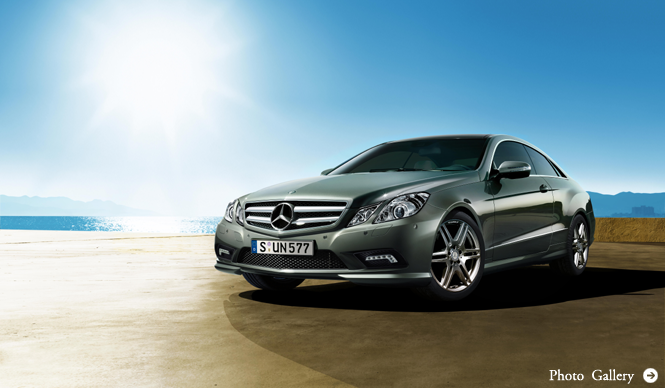
Mercedes-Benz E-Class Coupe | An Elegant Coupe Revived After 14 Years
Mercedes-Benz E Class Coupe | The Elegant Coupe Returns After 14 Years
The Elegant Coupe Returns After 14 Years
Mercedes-BenzJapan has launched a two-door coupe model, characterized by its sporty yet elegant styling, to join the lineup of the newly debuted Mercedes-Benz E-Class.
Photos: Mercedes-Benz Japan
An Interior Space Where Four Adults Can Relax
The new E-Class Coupe marks the return of the E-Class Coupe after a 14-year hiatus. This model, while equipped with the safety, comfort, and environmental compatibility derived from Mercedes' various innovative technologies shared with the E-Class sedan that underwent a full model change in May of this year, is a premium two-door coupe that fuses the elegant form traditional to Mercedes coupe models with a modern, high-quality interior and sporty driving performance.
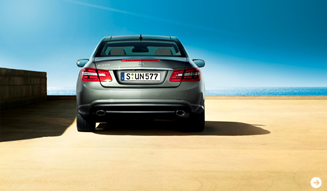
The most striking feature of the exterior is likely the flowing roofline created by the pillarless side windows, a tradition of Mercedes coupes. Furthermore, the side view, which incorporates a modern interpretation of the distinctive rear fender design motif from the 1960s Mercedes, similar to the E-Class sedan, achieves a graceful styling unique to Mercedes where elegance and dynamism are exquisitely balanced. Incidentally, the body, measuring 4705mm in length, 1785mm in width, and 1395mm in height, is 165mm longer and 70mm narrower than the E-Class sedan.
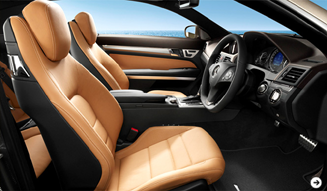
The interior, crafted from high-quality materials with a clean design, adopts a spacious layout and a four-independent-seat concept. By providing ample space between the front and rear seats, it achieves an interior environment where four adults can relax in comfort.
Two Types of V6 Units
The powertrain options are two types: a 3.5-liter V6 installed in the E350 Coupe and a 5.5-liter V8 used in the E550 Coupe. The former produces a maximum output of 200kW [272ps] at 6000rpm and a maximum torque of 350Nm [35.7kgm] at 2400-5000rpm. The latter achieves a maximum output of 285kW [387ps] at 6000rpm and a maximum torque of 530Nm [54.0kgm] at 2800-4800rpm. Both are paired with an electronically controlled 7-speed transmission.
The inclusion of numerous cutting-edge safety features is also characteristic of new Mercedes-Benz models. For instance, there are a total of nine airbags, including driver and front passenger airbags, front and rear side airbags, and window bags. Additionally, to prevent accidents caused by driver fatigue or drowsiness, Attention Assist, which analyzes the driver's behavior and alerts them to fatigue or sleepiness during prolonged driving, is standard on all models.
The price is 8.6 million yen for the E350 Coupe and 10.95 million yen for the E550 Coupe. The latter is only available in left-hand drive.

Mercedes-Benz E350 Coupe
Body | Length 4705 x Width 1785 x Height 1395mm Wheelbase 2760mm
Curb Weight | 1670kg
Engine | 3497cc V6 DOHC
Max Output | 200kW [272ps] / 6000rpm
Max Torque | 350Nm [35.7kgm] / 2400-5000rpm
Drivetrain | FR
Transmission | Electronically Controlled 7-Speed AT
Price | 8.6 million yen
Mercedes-Benz E550 Coupe
Body | Length 4715 x Width 1785 x Height 1395mm Wheelbase 2760mm
Curb Weight | 1730kg
Engine | 5461cc V8 DOHC
Max Output | 285kW [387ps] / 6000rpm
Max Torque | 530Nm [54.0kgm] / 2800-4800rpm
Drivetrain | FR
Transmission | Electronically Controlled 7-Speed AT
Price | 109.5 million yen
MERCEDES CALL
0120-190-610
www.mercedes-benz.co.jp
BRAND HISTORY
When tracing the history of automobiles, we arrive at two German pioneers: Gottlieb Daimler and Karl Benz. It goes without saying that these two men, independently developing gasoline-powered automobiles between 1885 and 1886, laid the foundation for the automotive society. The automobile companies they founded were at times seen as rivals, but to overcome the post-World War I recession, they joined forces, and Daimler-Benz AG was established through their merger in 1926.
The name "Mercedes," bestowed upon the products, originated when Emil Jellinek, a Daimler customer, named the cars after his eldest daughter in exchange for taking over sales outside of Germany. It was registered as a trademark by Daimler-Benz AG in 1902.
Thus born, Mercedes, and subsequently Mercedes-Benz, has continued to lead the times as a driving force in automotive development, consistently introducing cutting-edge technologies such as the safety passenger cell, airbags, ESP (Electronic Stability Program), and Night View.