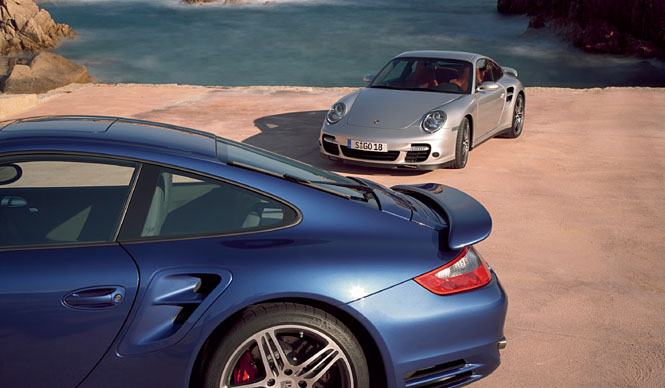
PORSCHE | 911 Turbo | Part 16 (Conclusion) | "A True Cinematic Masterpiece"
The 16th: Porsche 911 Turbo (Part 2)
A True Blockbuster
The "911 Turbo," the top model of Porsche's iconic "911." We test-drove the latest "Type 997" model.
An initially uninspiring impression completely transformed on mountain roads...
By Yasushi ShimonoPhoto by Porsche
Boring at First
The latest "911 Turbo," equipped with a new turbo system on its 3.6-liter flat-six engine, boasts 480 horsepower. At this power level, such figures become abstract. More honestly, the first contact while driving in congested Tokyo was, frankly, not very inspiring.
Thanks to the Tiptronic S (an automatic with a manual mode), it can be driven effortlessly, but when traffic prevents you from revving the engine, the 3.6-liter turbo feels rather dull. At low speeds, throttle response isn't exactly sharp, and the sound and vibration at idle are low and muffled, almost like construction machinery.
The suspension also feels overly soft and crude at town speeds. "The 911 is fun even at 40 km/h," wrote 911 fanatic journalist Takumi Yoshida, but perhaps a car designed for 300 km/h can't be enjoyed at such low speeds.
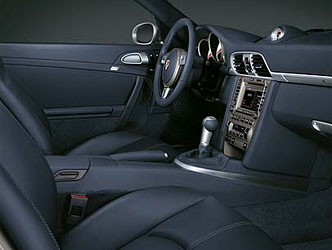
The 911 Turbo features a luxurious leather interior.
It is clad in sporty, elegant, and ergonomic designs based on human engineering.
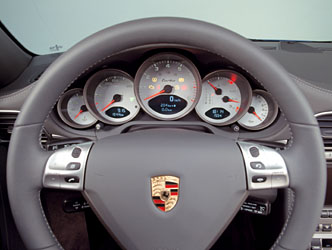
Behind the leather steering wheel lies Porsche's traditional
five-dial instrument cluster. The central rev counter bears the "turbo" logo.
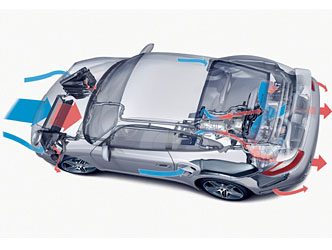
The 911 Turbo has its heat source—the engine—at the rear of the car.
It is designed for efficient cooling from the front and sides.
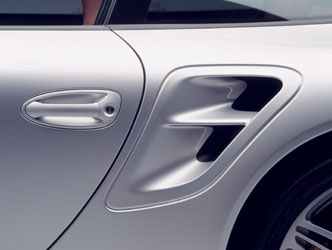
Airflow ducts open just ahead of the rear wheels.
These not only serve a cooling function but also create a distinctive aesthetic.
The Road Might Tear Itself Apart!
However, this initial impression was completely overturned the next day when I drove it on mountain roads. The 997 Turbo on my favorite winding route was a true blockbuster.
Whether there are bumps, potholes, undulations, or even off-camber turns, the 911 Turbo takes them all in stride. The stability in corners is so profound it almost makes you laugh out loud from the driver's seat.
The acceleration out of corners, backed by such superb stability, is astonishing. The traction—the driving force—feels so immense it seems like the road itself might tear apart.
Even amidst such performance, what's impressive is the gentle and refined driving feel. This makes it not only fast but also incredibly fun to drive. It's only in these high-input situations that the car truly feels alive, as if blood is flowing through its entire body. This is in stark contrast to the boring, sluggish feeling it exhibited in the city or at 100 km/h cruising speeds.
This is the state of the rear-engined sports car that, 30 years ago, used to frighten people like a nuclear power plant.
The Nissan GT-R with 480 hp, like the 911 Turbo, costs ¥7.77 million. The Lexus IS-F with 423 hp is ¥7.66 million. Compared to these newcomers, the 911 is more expensive. But buying a 911 means buying its priceless history.
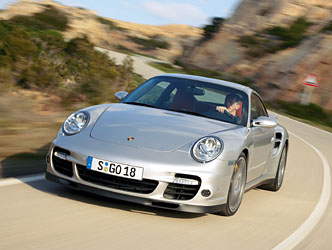
0-100 km/h acceleration is 0.2 seconds faster with the Tiptronic S than the manual
at 3.7 seconds. The 480 hp power and 63.2 kgm of torque are transmitted to all four wheels.
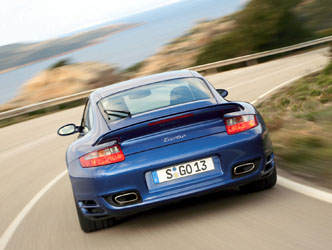
Porsche Active Suspension Management (PASM),
an electronic control damper system, is standard equipment.
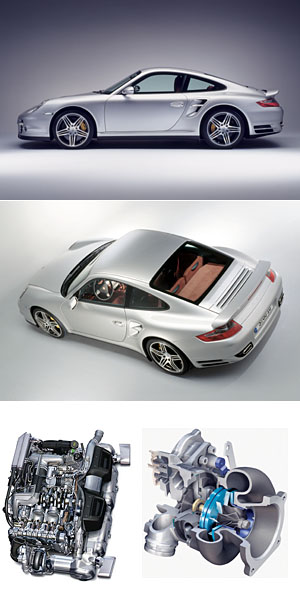
The "Boxer," the flat-six engine, is 3.6 liters (left).
Equipped with a turbocharger with variable turbine geometry (right),
power and torque have increased, although the displacement remains the same as the previous generation.
The power and torque have increased.
Vehicle Overview | Porsche 911 Turbo
Debuted in 1974, about 10 years after the "911" was born. Since then, it has reigned as the top-tier model representing Porsche.
The current model belongs to the sixth generation, known as Type 997, and like the preceding 996, it features a 3.6-liter flat-six turbocharged engine. The adoption of a new variable turbine geometry turbocharger has boosted maximum output by 60 hp to 480 hp and increased maximum torque by 6.1 kgm to 63.2 kgm. This output is controlled by the Porsche Traction Management (PTM) system and delivered to all four wheels.
The transmission is either a 6-speed manual or a 5-speed automatic called Tiptronic S. The time to reach 100 km/h from a standstill is 3.7 seconds with the Tiptronic S specification, 0.2 seconds faster than the manual. The top speed is a blistering 310 km/h.
Stopping power has also been enhanced with 6-piston front and 4-piston rear brake calipers, and brake discs enlarged to 350mm front and rear. The Porsche Ceramic Composite Brake (PCCB), known for its fade resistance and high responsiveness, is also available.
The latest control technologies, such as Porsche Stability Management (PSM) and Porsche Active Suspension Management (PASM), are standard equipment.
Overall dimensions: 4450mm (L) x 1850mm (W) x 1300mm (H), wheelbase: 2350mm. The base price is ¥18.58 million for the 6-speed manual version and ¥19.21 million for the Tiptronic S.
Additionally, the lineup includes the open-top "911 Turbo Cabriolet" (¥20.93 million) and the ultra-high-performance "GT2" (¥26.07 million) equipped with a 530 hp unit, surpassing the 911 Turbo.
http://www.porsche.com/japan/jp/models/911/911-turbo/