The Volkswagen Polo Gets a Facelift | Volkswagen
Volkswagen Polo|Volkswagen Polo
Volkswagen Polo Gets a Facelift
Significant changes have been made to Volkswagen's compact hatchback, the Polo. It features a design that follows Volkswagen's latest design language and a new engine boasting high environmental performance. Sales are set to begin sequentially in Europe from around spring, with plans for it to arrive in Asian regions as early as the latter half of this year.
Text by HORIGUCHI Yoshihiro (OPENERS)
A Diverse Range of Engine Options
The Volkswagen Polo, a B-segment model from Volkswagen, has undergone a minor change. It now sports the latest Volkswagen design, along with a new engine with improved environmental performance, and the latest safety and infotainment features.
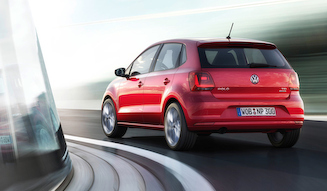
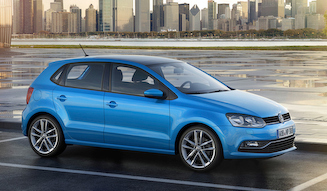
The exterior features a front bumper that spans the full width of the car, with chrome lines enhancing the sense of width. The horizontal elements inside the headlights, designed to appear seamlessly connected to the chrome line of the front grille, give an impression that is also reminiscent of the "Golf." LED headlights, a first for Volkswagen in this class, are also available for higher-grade models.
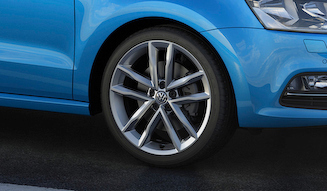
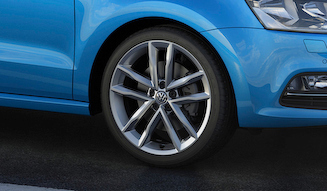
The body dimensions remain largely unchanged from the European specification: 3,972mm in length, 1,682mm in width, and 1,453mm in height. Ten types of wheels are available, including six new designs, and there are 15 exterior colors. Of these, eight are new colors, including those previously only available for special editions.
The new Polo features a newly developed compact electric power steering system. Mounted directly on the steering column, it provides agile handling while also filtering out unwanted noise from minor road imperfections. Furthermore, a sports select suspension with electronic damper control is available for the first time in the Polo. This allows for suspension setting adjustments to be made by switching between comfort and sport modes to suit driving conditions.

Along with the design, a significant change has been made to the newly developed engines, which offer improved fuel efficiency. The new Polo will be available with a wide variety of engines.
At launch, the gasoline engines will include two versions of a 1.0-liter 3-cylinder MPI engine with maximum outputs of 44kW (60ps) and 55kW (75ps), and two versions of a 1.2-liter 4-cylinder direct-injection TSI engine with maximum outputs of 66kW (90ps) and 81kW (110ps). Additionally, a "Polo 1.0 TSI BlueMotion Technology" equipped with a 1.0-liter inline 3-cylinder direct-injection turbo engine, a first for the Polo, will be introduced in the latter half of the year. This engine delivers a maximum output of 90ps while achieving fuel economy of 4.1ℓ/100km (approximately 24.4km/ℓ) according to European measurements.
The engine in the "Polo BlueGT," currently available with cylinder deactivation technology (ACT), has also been improved, with its maximum output increasing from 103kW (140ps) to 110kW (150ps). The sportiest model, the "Polo GTI," is also scheduled to see its power increased from 132kW (180ps) to 141kW (192ps).
Further Enhanced Fuel Efficiency
A wide range of environmentally friendly diesel engines will also be available. The diesel engines, previously consisting of 1.2-liter and 1.6-liter units, will be consolidated into a 1.4-liter inline 3-cylinder direct-injection turbo (TDI), offered in three output variants: 55kW (75ps), 66kW (90ps), and 77kW (105ps). Even the less powerful 75ps version of the new engine delivers 210Nm of torque from 1,500rpm. To address concerns about vibration and noise typically associated with 3-cylinder diesel engines, new bearings, a balance shaft, and a dual-mass flywheel have been employed to achieve excellent quietness.
The diesel engines achieve impressive environmental performance, with the 75ps version offering fuel economy of 3.2ℓ/100km (approximately 31.3km/ℓ) and CO2 emissions of 82g/km. Furthermore, the 90ps version combined with the dual-clutch (DSG) transmission achieves 3.4ℓ/100km, a 21 percent improvement over the previous 4.3ℓ/100km.
Safety equipment has also been updated with the latest features. These include an automatic post-collision braking system that automatically applies the brakes to prevent secondary collisions, a driver alert system that warns the driver with sounds and light flashes when fatigue is detected, a pre-crash brake system with an automatic emergency braking function to avoid or mitigate rear-end collisions, and adaptive cruise control with a follow-distance function. Many of these safety features have been inherited from higher-end models.
Inside, the redesigned center console is a notable change. The number of buttons below the air vents has increased from seven to nine, and the display located beneath them serves as the infotainment control panel. It supports the latest digital devices, including CD playback and playback of data from smartphones and SD cards. An optional MirrorLink system allows smartphone screens to be displayed on this unit, enabling touch control. MirrorLink also facilitates interaction with smartphone apps for various operations and data exchange.
The new Polo began deliveries in Germany this spring, with pricing expected to be similar to the current model. Following its release in various European countries, sales are slated to commence in Africa and Asia in the latter half of this year. In addition to the basic Trendline, Comfortline, and Highline models, derivative models such as the GTI, BlueGT, CrossPolo, and BlueMotion are also planned to be rolled out based on the new Polo platform.