CEATEC JAPAN 2011: Nissan's Vision for the Smart House
CEATEC JAPAN 2011 | CEATEC JAPAN 2011
Nissan's Vision for the Smart House
At "CEATEC JAPAN 2011" held at Makuhari Messe, Nissan Motor Corporation is proposing a smart house centered around the electric vehicle "Nissan Leaf."
Text by Dai MatsuoPhotos by Seiichi Saito
"Leaf to Home" Powering Your House from the Leaf
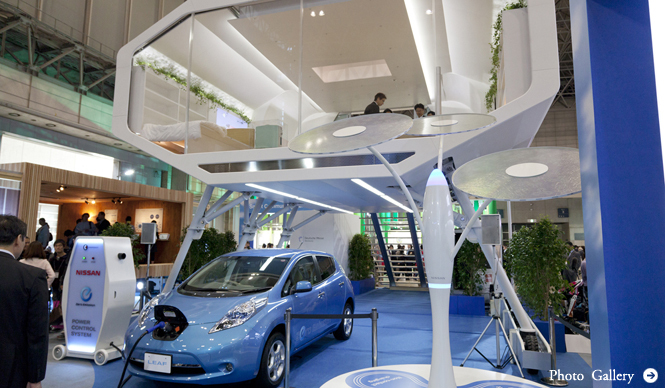
At the "CEATEC JAPAN 2011" smart community booth called "ZERO," Nissan Motor Corporation is showcasing the smart house "NSH-2012," which combines power supply from the Leaf, solar power generation, and fuel cells.
This smart house features a monocoque structure where the outer panels bear stress, utilizing lightweight aluminum. It employs a raised-floor design with parking space beneath the living area, and the hexagonal living room was chosen for its superior air conditioning efficiency due to optimal air circulation.
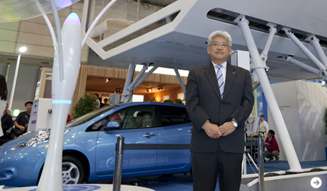
Toru Abe from Nissan Motor Corporation's Zero Emission Business Division, who was involved in the development of the Leaf and oversaw the development of the PCS.
The notable power supply system integrates solar power and fuel cells with power supply from the Nissan Leaf, termed "Leaf to Home." This system ensures stable, self-generated power independent of weather conditions. Furthermore, it can provide power even during disasters when fuel supply is interrupted, utilizing solar power and the Leaf's electricity.
Nissan's newly developed Power Control System (PCS) plays a central role in supplying power from the Leaf to the house. The base of this control system is the quick-charging system. The plug used for quick charging in the Leaf is the CHAdeMO standard, adopted by Japanese companies in March 2010. This standard is likely to become an international standard for 440V DC charging, with its adoption expanding not only in Japan but also in the United States. Its key feature is its ability to supply power not only in one direction but also in the reverse direction, meaning it can draw electricity from the Leaf as well as supply it.
SNV (Social Network Vehicle) Becomes a Reality
This is the technology utilized in the PCS. Currently, quick chargers installed at highway service areas are typically 50kW types capable of charging to 80% in about 30 minutes. However, this PCS is a 6kW type. It can not only draw electricity from the Leaf but also supply power to it, taking about 4 hours for a full charge.
The lithium-ion battery installed in the Nissan Leaf has a storage capacity of 24kWh, which is equivalent to the electricity consumed by an average Japanese household over two days.
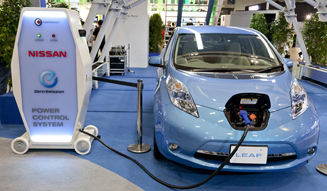
This PCS is scheduled for release by March of next year, with pricing yet to be determined. However, it is positioned against home battery storage systems, making it highly likely to be sold at a lower price point. This is welcome news for those who have already purchased a Leaf or are considering buying one and were planning to purchase a separate battery storage unit. Nissan is focusing on promoting V2H (Vehicle to Home) and is expected to seriously pursue sales of this system. While currently sold Leafs do not have the power supply program installed, it can be updated by dealers in about 30 minutes. Since the earthquake, what OPENERS has advocated for,SNV (Social Network Vehicle)is finally becoming a reality.
The Future of Eco-Friendly Smart Houses
While there are no immediate plans to sell the smart house "NSH-2012," its technology is expected to be applied to future smart house development. HEMS (Home Energy Management System) will be used for controlling electricity within the home, managing power from solar, fuel cells, and the Leaf to Home system.
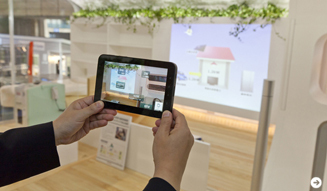
"A tablet PC displaying instantaneous power consumption within the home. It allows users to see at a glance where excessive electricity is being used."
Energy management will enable energy-saving controls based on power generation status and remote maintenance. NTT Docomo, a participant in the "NSH-2012" smart house project, is also proposing the use of AR technology to visualize in-home electricity consumption by pointing a tablet PC at different areas.
This smart house "NSH-2012," proposed by approximately 50 companies led by Nissan, is highly noteworthy as it demonstrates a new way of living, independent of existing power grids.
Other Notable Technologies Discovered at CEATEC
While Nissan's "ZERO" smart community exhibit was overwhelmingly impressive at this CEATEC, other booths also showcased interesting new technologies.
One such technology is Fujitsu's energy harvesting technology. This converts ambient heat and light into weak electrical energy, which then powers devices that operate for extended periods with low power consumption. For example, sensors could be attached to the skin for continuous health monitoring, enabling health guidance from the cloud or automatic emergency service dispatch.
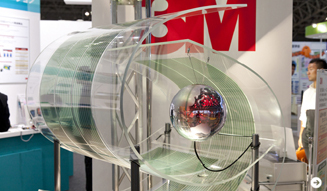
Sumitomo 3M presented a see-through solar power generation film, scheduled for release next year. This transparent film embeds organic thin-film solar cells within an adhesive layer. While typical solar energy conversion rates range from 16-18%, this film achieves 3-4% but is flexible and can be applied to window glass, opening up a variety of potential applications.
Overall, while CEATEC didn't present many groundbreaking new technologies, realistic innovations like Nissan's PCS offer significant promise for the near future.