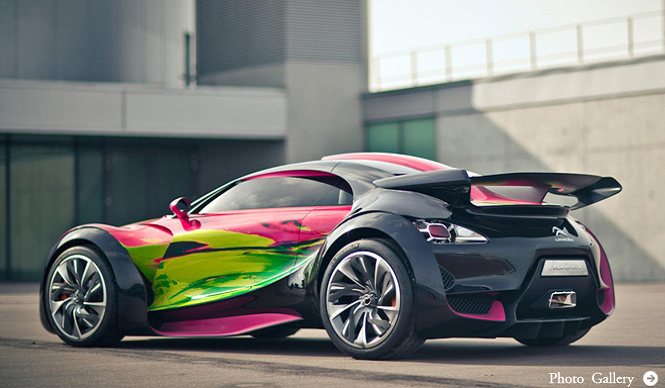
CITROEN SURVOLT Art Car Revealed
CITROEN SURVOLT
A Sports EV in Vivid Colors
Citroën has unveiled an art car version of its electric sports concept, the "Survolt."
By Giraffe
A Work of Art Based on the High-Performance Survolt
The Survolt is a pure EV that runs entirely on electricity. Featuring dual motors, it boasts a 0-100 km/h acceleration in under 5 seconds and a top speed of 260 km/h, making it a true sports EV.
This art car is the result of French artist Françoise Nielly using the Survolt as her canvas, bringing it to life with vibrant colors. Its striking design, adorned with intense pink, green, and yellow hues, makes it a captivating vehicle.
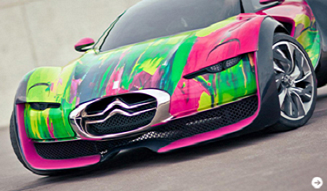
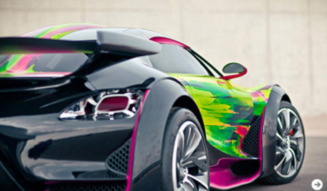
Conceived and created to coincide with the Paris Motor Show, the car is specially exhibited at Citroën's flagship showroom on the Champs-Élysées, "C42," delighting Parisians.
Citroën describes this Survolt art car as a model that "expresses the new appeal of electric cars."
BRAND HISTORY
Citroën is a French manufacturer founded in 1919. Once renowned for its innovative mechanisms, it was a leading name in creating distinctive automobiles, both in styling and engineering. Its higher-end models still feature the hydropneumatic system, which uses hydraulic pressure to adjust suspension stiffness, ride height, braking, and power steering.
The founder, André Citroën, was an automotive engineer. The double-chevron logo, still used today, originates from the gears he devised. Before the war, Citroën produced a range of vehicles from mass-market to luxury, earning acclaim for their sporty handling, low ride height, and smooth body lines. Their prevalence in French film noir, often used by gangsters for getaways, attests to their performance. Post-war, the company continued to emphasize unique engineering, introducing the hydropneumatic system in the 1950s.
The DS series, launched in 1955, is considered an eternal icon due to its hydropneumatic suspension, unique body structure, and unparalleled styling. It remains a motif in commercials and is cherished by Citroën itself as part of its heritage. This lineage continued through the CX in the 1970s, the C5 in the 1990s, and the C6 in the 2000s.
Citroën also produced highly distinctive cars in the mass-market segment. A prime example is the 2CV, introduced in 1949. This compact car featured a small air-cooled engine but maximized interior space with a high roof and flat floor. Developed with practicality in mind for rural France, it was said to be engineered to handle loads like potatoes and offer a ride smooth enough not to break an egg. Production continued until the early 1990s, and many are still driven worldwide.
Since the 1970s, Citroën has been part of the PSA Group, maintaining its distinct identity while sharing platforms with Peugeot. The current Japanese lineup includes the C5 (sedan and wagon), comparable to the BMW 3 Series; the C4, in the Golf class; the C4 Picasso, a multi-purpose wagon; the C3, in the Polo class; and the distinctive two-door coupe, the DS3. The latest iteration of hydropneumatic suspension, the Hydractive III, which combines advanced hydropneumatics with electronic control, is featured in the C5.
The current lineup uses "C" in its model names. However, models targeting niche markets, like the DS3, are planned for expansion and will be branded with "DS." (Updated August 2010)