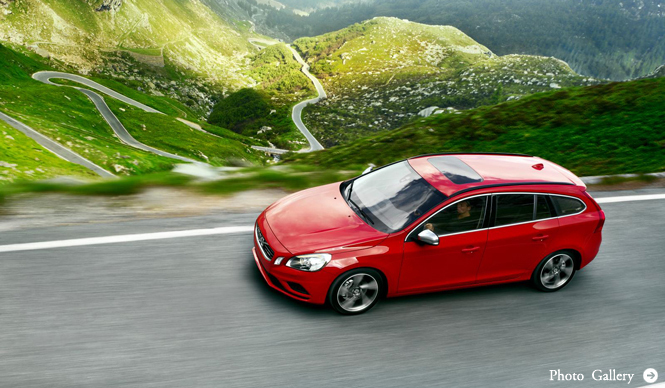
Volvo: Featuring the R-Design
VOLVO
R-Design for S60 and V60
Volvo has announced the new R-Design concept for the S60 and V60, featuring sporty interior and exterior enhancements.
By Giraffe
Sportier Inside and Out
R-Design is a concept that embodies a sporty aesthetic through the use of aerodynamic parts for the exterior and decorative panels for the interior. This R-Design will be applied to the S60, unveiled at this year's Geneva Motor Show, and the V60, whose photos were just released in July.
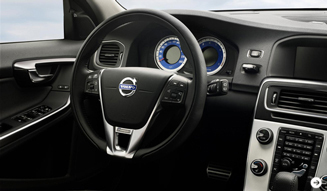
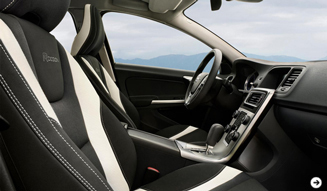
Specific R-Design features include a piano black-painted front grille, dual exhaust mufflers, and 5-spoke diamond-cut 18-inch wheels for a sporty look. A total of eight body colors will be available. Inside, the thick seats, with white accents forming lines that hug the body against a black base, are particularly striking. Their generous padding is said to comfortably hold a variety of body types, promising excellent support during driving.
The S60 and V60 featuring this concept are scheduled to begin delivery across Europe around this autumn.
BRAND HISTORY
Volvo, a Swedish company, was founded in 1927 by Assar Gabrielsson, who raised capital from the ball bearing company SKF. The company name, VOLVO, is derived from the Latin for "I roll."
Before the war, Volvo specialized in family cars with an American flavor. Post-war, they continued with family cars but adopted a design that was simple, functional, and infused with modernism. In the 1960s, they established a foothold in the US market and expanded globally.
The popular 120 series, known as "Amazon," and the P1800 series with its strikingly low roof, helped Volvo achieve a fashionable image and solidify its position. This was followed by the 100 series (such as the 144 and 164) and the subsequent 200 series (such as the 244 and 264), all based on the 4-door sedan. They continued to maintain their lineup emphasizing a boxy body shape.
Volvo's appeal lay in its simple, robust construction. While sometimes perceived as unexciting, it offered the logic and functionality akin to German cars, wrapped in a less austere design. Their early focus on station wagons from the 1950s also contributed to their broad appeal.
In the 1980s, they adopted a marketing plan called the "Northwest Strategy," positioning themselves as a luxury brand, including pricing, to compete with German manufacturers like Mercedes-Benz and BMW. This strategy was particularly well-received in Japan. In 2002, Volvo became part of the Premier Automotive Group under Ford, alongside luxury brands such as Land Rover, Aston Martin, and Jaguar.
In many respects, Volvo is a company adept at marketing, having early on focused on passive occupant safety. This led them to be the first to adopt the three-point seatbelt and to publicize their commitment to safety by forming accident investigation teams to study crash sites and verify vehicle safety. The robust body structure, along with the crushable body designed to deform and protect occupants, significantly contributed to Volvo's safety reputation before the widespread adoption of crumple zones.
Vehicle safety remains a key keyword for Volvo today. A prime example is the "City Safety" system (low-speed collision avoidance and mitigation auto-brake system) adopted in the XC60, which automatically applies the brakes at speeds below 30 km/h to prevent rear-end collisions.
The current lineup in the Japanese market includes the C30, a 2-door hatchback that competes with the Audi A3; the C40 sedan and V50 station wagon in the Golf class; and the S80 upper-middle sedan and V70 station wagon. Additionally, their Cross Country range is well-represented with the XC60, XC70, and XC80. The C70, featuring a retractable hardtop, recently underwent a model change.
A defining characteristic of current Volvos is their product strategy, which emphasizes niche markets. While their design evolved from the boxy shapes of the past towards a more emotional aesthetic with abundant ornamentation, their pricing and equipment levels offer better value compared to German luxury cars like Mercedes-Benz and BMW, which can also be seen as part of their niche strategy.
In 2009, PAG was effectively dissolved, and in 2010, Volvo was acquired by China's Geely. Volvo has announced plans to maintain its European production facilities while also commencing production in China.