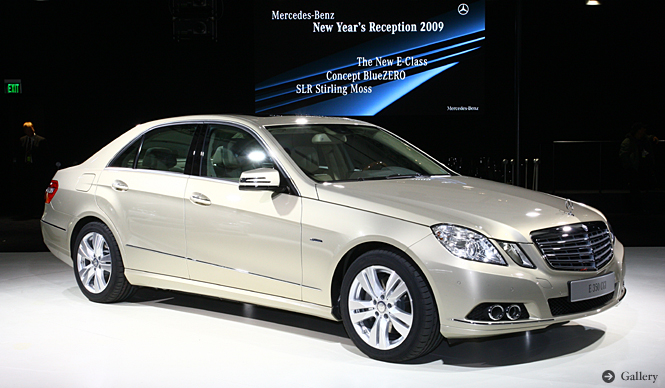
Mercedes-Benz: The New E-Class Debuts
Mercedes-Benz E CLASS
The New Mercedes-Benz E-Class Debuts
German automaker Daimler unveiled the new E-Class at the Detroit Auto Show.
By Giraffe
Significant Improvements in Safety, Comfort, and Environmental Performance
This new E-Class is said to be a vehicle that excels in safety, comfort, and environmental performance, achieved through the generous incorporation of Mercedes-Benz's latest technologies.
Regarding safety, it features numerous new technologies, including "Adaptive Main Beam Assist," which recognizes oncoming traffic via a windscreen-integrated camera and automatically adjusts the headlight beam to prevent dazzling, and "Attention Assist," which uses a camera to monitor the driver's condition and prevent operational errors caused by inattention, such as looking away. It also includes "Lane Keeping Assist" to maintain the lane and "Night View Assist" to enhance visibility at night, significantly improving safety performance.
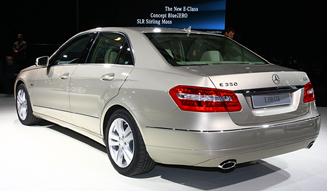
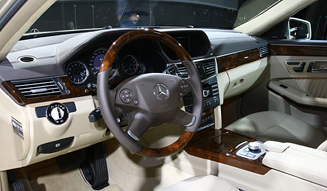
The body dimensions are 4868mm in length, 1854mm in width, and 1470mm in height. Compared to the previous generation, it is 12mm longer, 32mm wider, and 13mm lower. Body rigidity has also reportedly increased by 30%.
To enhance comfort, the vehicle features electronically controlled dampers that adjust suspension settings in real-time to maintain a comfortable ride under all conditions, and the integration of the COMAND system, which centralizes navigation and audio controls, has been announced.
Regarding the engine, development has also focused on environmental issues, with fuel efficiency improvements of up to 23%.
All models meet the European EURO5 emissions standard. Notably, the E350 BlueTEC (clean diesel) meets the EURO6 standard scheduled for 2014, achieving a fuel economy of 18.9 km/L and CO2 emissions of 139 g/km.
On the other hand, high-performance, large-displacement models such as the E63 AMG, equipped with a 6.3-liter V8 engine (525 hp), will continue to be released.
BRAND HISTORY
When tracing the history of automobiles, two German figures emerge as pioneers: Gottlieb Daimler and Karl Benz. It is common knowledge that these two men independently created gasoline-powered automobiles between 1885 and 1886, laying the foundation for the automotive society. Although their respective automotive companies were sometimes seen as rivals, they joined forces to overcome the recession after World War I, leading to the establishment of Daimler-Benz AG through their merger in 1926.
The name "Mercedes," given to the products, originated when Emil Jellinek, a customer of Daimler's, named the car after his eldest daughter in exchange for taking on exclusive sales rights outside of Germany. The trademark was registered by Daimler AG in 1902.
Thus, Mercedes and subsequently Mercedes-Benz have consistently led the way in automotive development, actively introducing cutting-edge technologies such as the safety passenger cell, airbags, ESP (Electronic Stability Program), and Night View.