Test Drive: The Lamborghini Urus Off-Road | Lamborghini
Lamborghini Urus
Test Drive: The Lamborghini Urus Off-Road
Super on and off the road
The Lamborghini "Urus," a super SUV from the Italian marque, made its global debut in December 2017 and arrived in Japan in February 2018. It is the company's third model, following the Aventador and Huracán. It boasts a comfortable ride, high ground clearance, and a luxurious interior, and is marketed as a luxury SUV designed for easy city driving, comfortable long-distance journeys, the dynamic performance of a super sports car on public roads and circuits, and off-road capability in various environments, enjoyable for both driver and passengers.
What happens when a super SUV, typically driven only on paved surfaces, tackles off-road terrain, its inherent capability? To answer this question, I participated in an off-road test drive event for the Urus to assess its performance in various situations.
Text & Photographs by HARA Akira
Exceptional On-Road Performance
Continuing the tradition of adopting names derived from the world of bullfighting, the Lamborghini "Urus" is named after the aurochs, a large wild ox, due to its strong resemblance to Spanish fighting bulls.
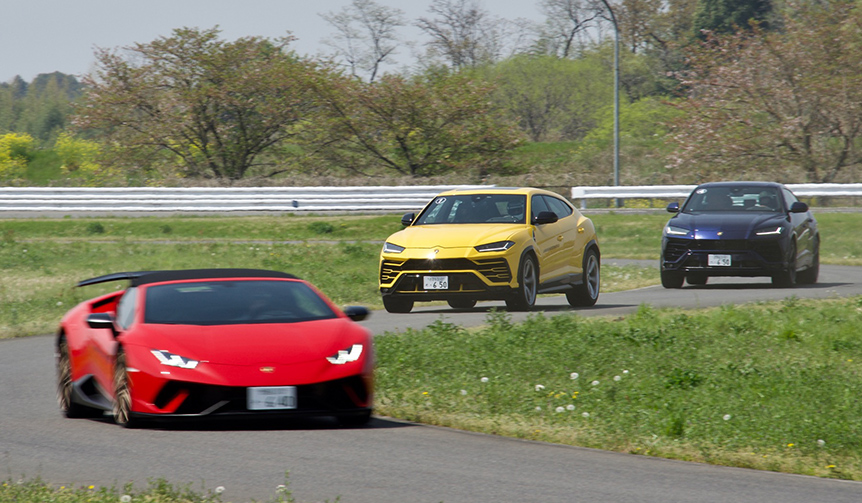
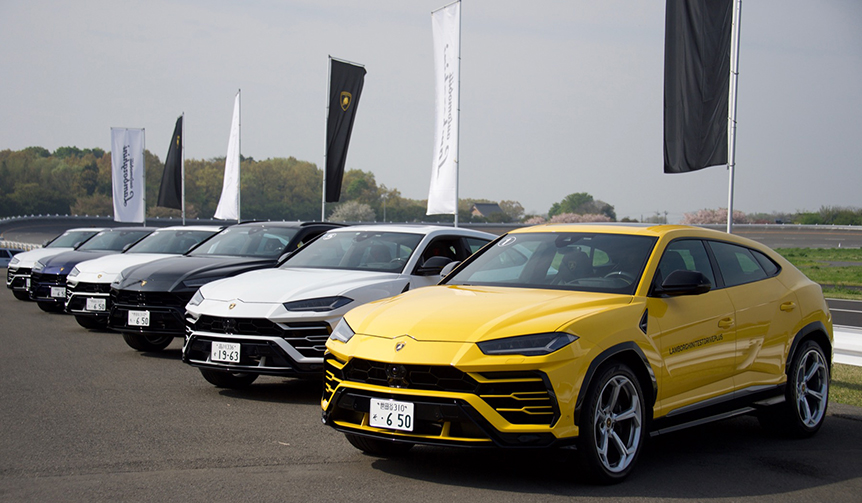
At the "GNK Drive Line Japan Proving Ground" in Tochigi Prefecture, the venue for the test drive, a spectacular lineup of "fierce bulls" painted in yellow, white, blue, and black awaited.
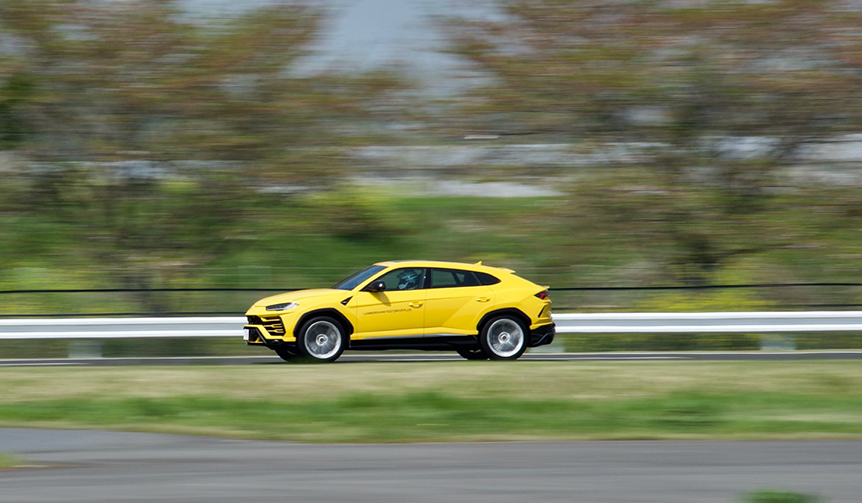
With dimensions of 5,112mm in length, 2,016mm in width, and 1,638mm in height, a wheelbase of 3,003mm, a minimum ground clearance of 158mm to 248mm, and a dry weight of 2,200kg, it possesses an imposing physique.
The 3,996cc, 90° V8 twin-turbo engine mounted at the front produces a maximum output of 650ps (478kW) at 6,000rpm and a peak torque of 850Nm between 2,250 and 4,500rpm, boasting performance figures of 0-100km/h in 3.6 seconds, 0-200km/h in 12.8 seconds, 100km/h to 0 braking in 33.7 meters, and a top speed of 305km/h.
After receiving instructions from the test drive staff, the first task was acceleration and braking tests on the paved outer circuit. Here, we were instructed to select "CORSA," the high-performance oriented drive mode, on the Tambro (Lamborghini Driving Dynamics Control) located on the center console.
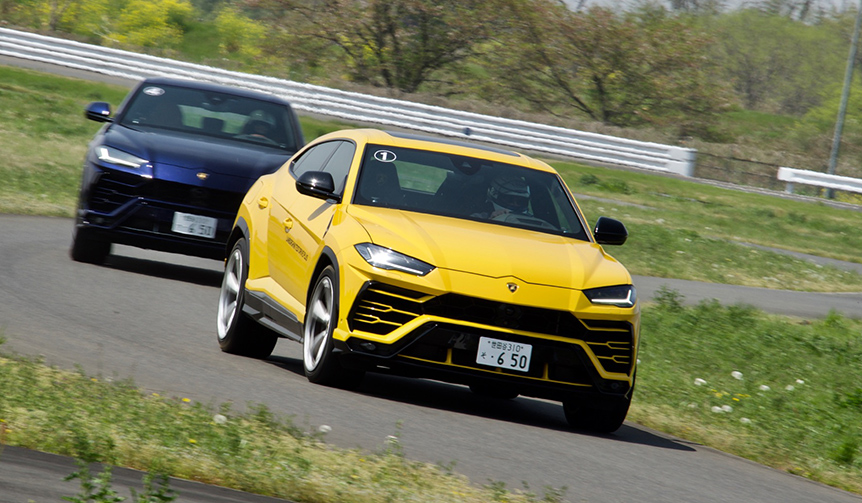
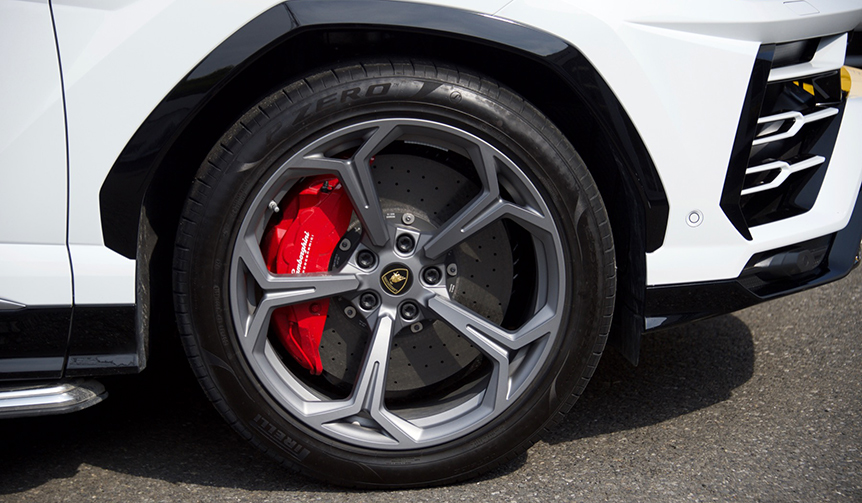
Full acceleration on a 200-meter straight, followed by a hard stomp on the brake pedal past 130km/h, brought the massive carbon-ceramic disc brakes—440mm at the front and 370mm at the rear—to rapidly decelerate the over 2-ton body. With a slight nose dive, it came to a complete stop as if nothing had happened.
During the full acceleration test on the back straight, the accelerator was floored. Releasing the 650ps by pressing the right foot all the way down, the digital speedometer climbed at an almost unreadable pace, reaching over 215km/h in just about 500 meters. It was truly overwhelming performance.
On the handling course with a series of 18-to-85R corners, we chased after the Aventador SVJ driven by racing driver and instructor Toranosuke Takagi. The combination of immense torque from low speeds, the ease of speed control with the carbon brakes, the stability of the 4WD system with rear-wheel steering (4WS), the active air suspension that minimizes body roll with electronic active roll stabilization, and the excellent visibility of the course from the high seating position allowed us to fully experience the speed of a sports car.
Lamborghini Urus
Test Drive: The Lamborghini Urus Off-Road
Super on and off the road (2)
Tackling Off-Road with Fat Pirelli P Zeros
After the on-road test drive, we moved to the off-road course for various challenges. The Tambro setting here was TERRA (off-road). On the bumpy terrain with about 10cm high undulations, the body cleared it with ease, without a single creak.
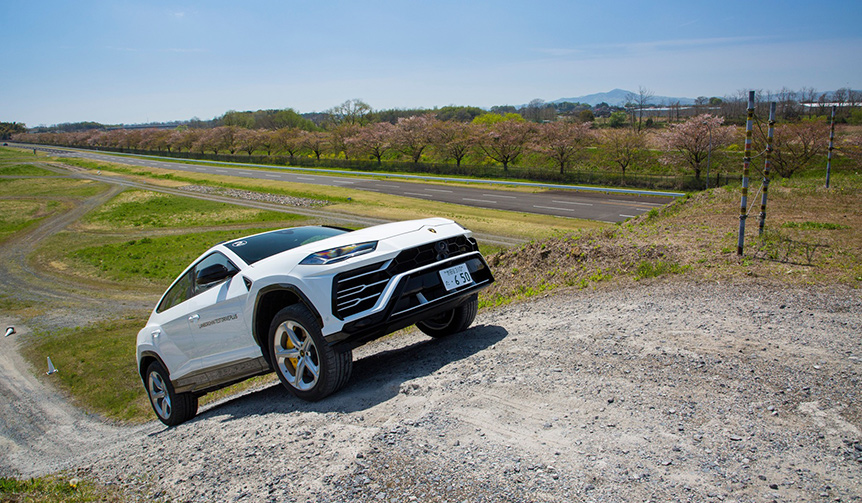
Next, we entered a steep gravel slope with a 50% gradient, approximately 30°, at low speed. Halfway up the steep incline, where only the clear sky was visible through the windshield, we stopped and then restarted. Without any wheel spin, the Urus smoothly reached the summit.
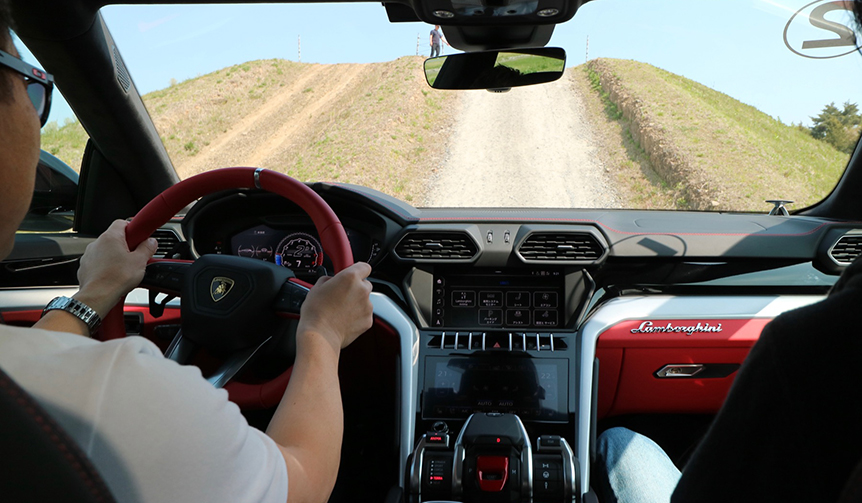
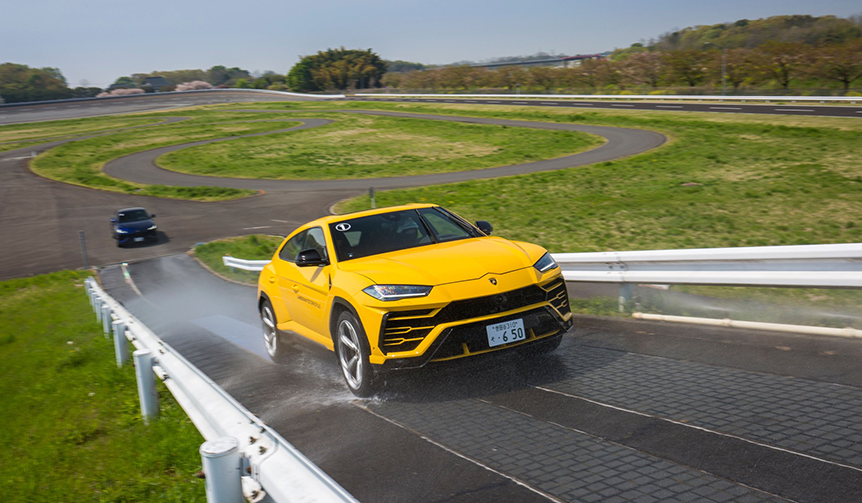
Descending the slope ahead, the view was obstructed by the hood housing the large V8 engine. However, activating the front camera via the console button allowed us to see the path. Guiding the front towards the edge of the descent, the Hill Descent Control maintained a constant speed, smoothly bringing us down to level ground. Notably, the tires were still the fat Pirelli P Zeros, sized 21-22 inches.
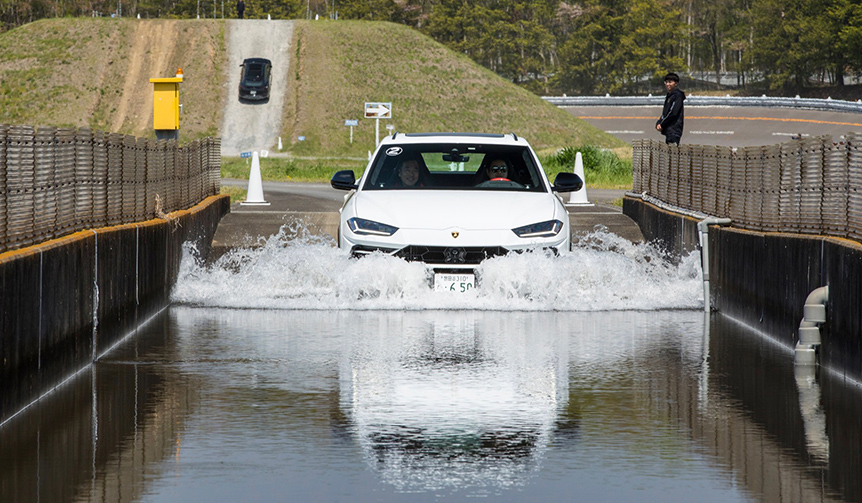
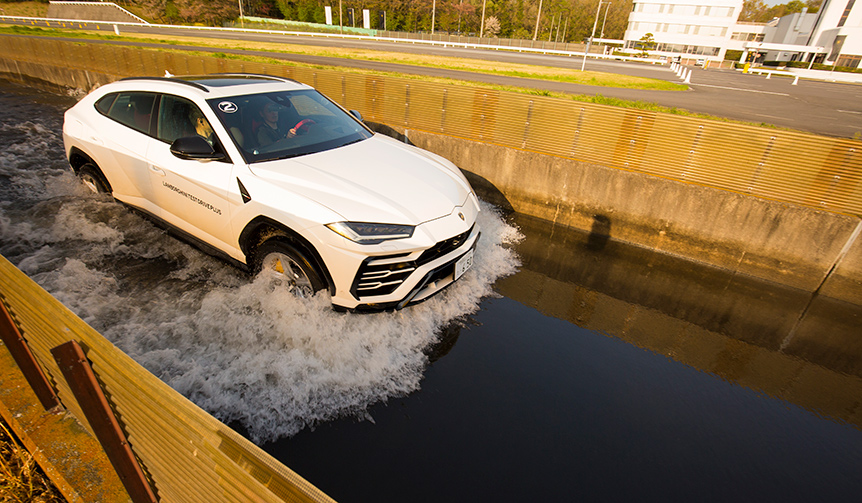
The water crossing, which was postponed due to concerns about carbon brakes losing effectiveness as their temperature dropped when wet, was a course filled with 30-40cm deep water over a length of about 30 meters. Although hesitant to drive a nearly 30-million-yen new car through it, I plunged in. Without water entering the cabin from the doors, the Urus's powerful passage through the water, creating large splashes, was truly impressive.
Lamborghini Urus
Test Drive: The Lamborghini Urus Off-Road
Super on and off the road (3)
Flawless Versatility
Driving on the off-road routes around the facility, not just within the test course, was a completely new experience. These paths included the embankment road of the nearby Omigawa River and narrow dirt tracks through rice paddies. The sight of the Urus, kicking up a dramatic cloud of dust as it drove in formation along these narrow dirt roads, usually traversed only by farmers' trucks, must have astonished not only us drivers but also the local residents.
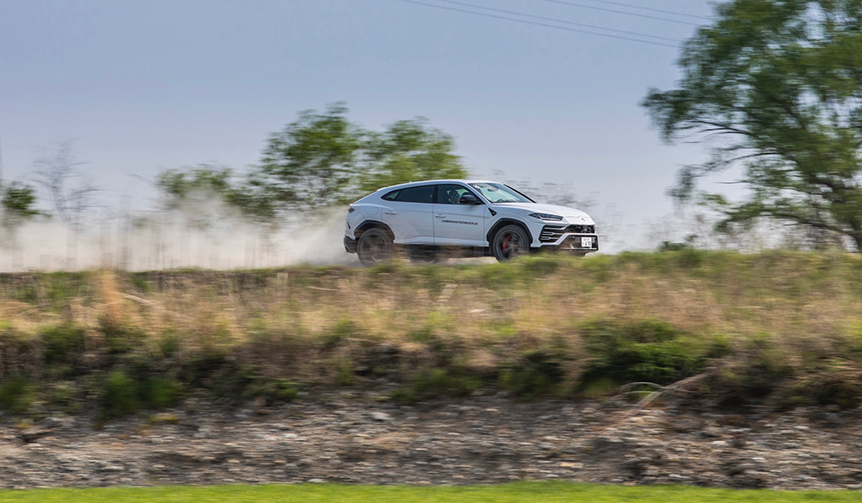
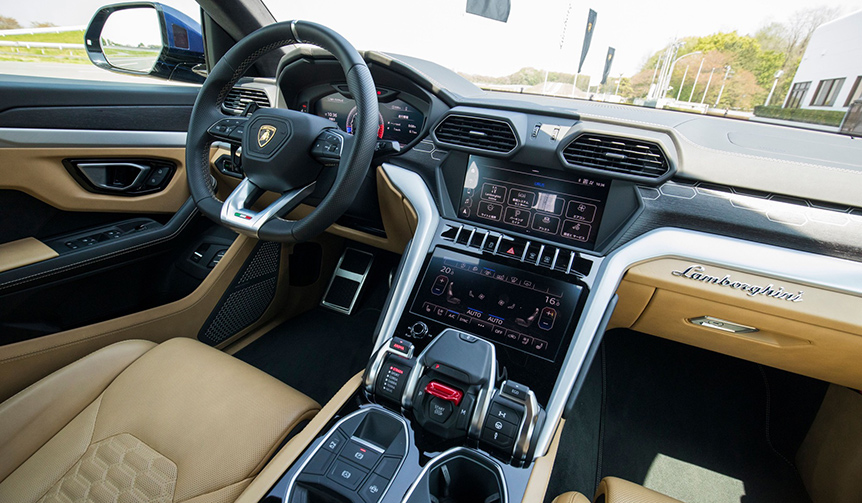
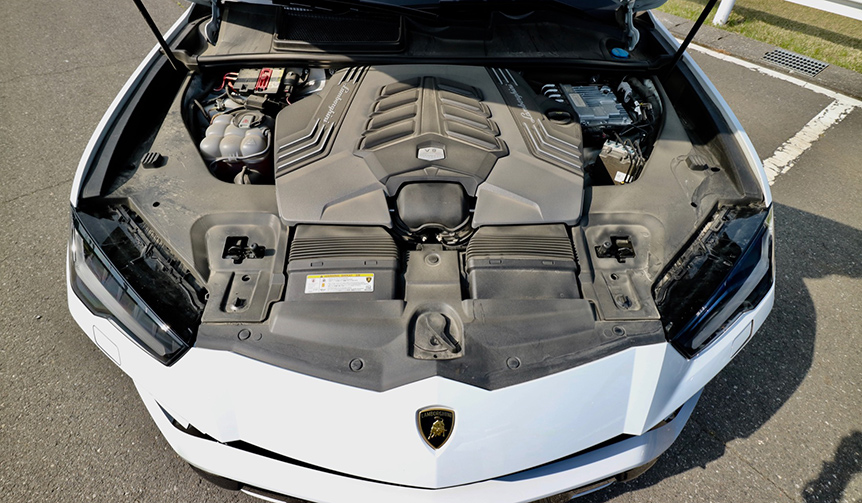
Despite its large body, the Urus impressed me with its ability to make sharp right and left turns in a single maneuver, which seemed impossible at first glance, thanks to the effective rear-wheel steering. After the drive, the Urus was naturally covered in dust, even the engine cover under the hood was coated in white powder. Lamborghini's commitment to showcasing the Urus's capabilities to customers by holding such test drive events is truly commendable.
Similar test drive events are regularly held for general customers, and participants receive a certificate of completion after experiencing all the courses, a delightful bonus.
The standard model is priced at 27,799,200 yen. The TERRA and SABBIA (desert) driving modes for rough terrain are optional extras, and the customization options, including body colors, are virtually limitless. With 100% customization to the owner's preferences, the vehicle price would undoubtedly exceed 30 million yen.
As Lamborghini CEO Stefano Domenicali stated during the 2018 launch event in Japan, "The Urus is a car that can be used daily, carrying four or five people, and it handles everything from the circuit to the highway, from urban areas to off-road. In other words, it is a completely new product that did not exist in the market before." We were able to fully experience the flawless versatility of this new SUV.
Sales appear to be strong, and the story of expanding the production facility in Sant'Agata, Italy, to double its size to 160,000 square meters and hiring an additional 500 employees is understandable.

Lamborghini Urus
Body | Length 5,112 x Width 2,016 x Height 1,638 mm
Wheelbase | 3,003 mm
Tread Front/Rear | 1,695 / 1,710 mm
Vehicle Weight | 2,200 kg
Engine | 3,996cc V8 Twin-Scroll Twin-Turbo
Max Output | 478 kW (650 ps) / 6,000 rpm
Max Torque | 850 Nm / 6,800 rpm
Transmission | 8-speed AT
Drivetrain | 4WD
Suspension Front/Rear | Multi-link (Adaptive Air)
Tires Front | 285/45R21
Tires Rear | 315/40R21
Brakes Front | Carbon-ceramic disc φ440 x 40 mm
Brakes Rear | Carbon-ceramic disc φ370 x 30 mm
Top Speed | 305 km/h
0-100km/h Acceleration | 3.6 seconds
0-200km/h Acceleration | 12.8 seconds
100-0km/h Braking | 33.7 meters
Fuel Economy (EC) | 12.7 L/100 km (approx. 7.9 km/L)
CO2 Emissions | 290 g/km
Minimum Ground Clearance | 150 – 248 mm
Minimum Turning Radius | 5.9 meters
Trunk Capacity | 616 – 1,596 liters
Price (incl. tax) | 27,799,200 yen