
Daimler, Renault-Nissan, and Ford to Jointly Develop Fuel Cells
Daimler, Ford & Renault-Nissan Alliance|
Renault-Nissan Alliance, Ford, Daimler
Daimler, Renault-Nissan Alliance, Ford to Jointly Develop Fuel Cell Technology
Daimler, the Renault-Nissan Alliance, and Ford will jointly develop fuel cell stacks and systems to realize zero-emission vehicles. Leveraging the market size of the three companies, they aim to commercialize fuel cell vehicles at an affordable price.
Text by SUZUKI Fumihiko (OPENERS)
Targeting Market Launch in 2017
Daimler and the Renault-Nissan Alliance have been collaborating since 2010, sharing powertrains and jointly developing small cars. On January 28, 2013, Ford joined them, and the three parties signed an agreement to develop fuel cells, one of the leading contenders for zero-emission energy.
The aim of this agreement is to reduce investment costs by jointly developing common fuel cell stacks and systems, and to establish common specifications and standards. Furthermore, by demonstrating the full commitment of a global alliance spanning Japan, Europe, and the US to fuel cell development, it sends a message to governments and industries to promote infrastructure development. The three companies will invest equally in this research, with the goal of launching fuel cell vehicles as early as 2017 as a result of their collaboration. This mass-produced fuel cell vehicle is planned to have a common design, maximizing economies of scale to lower the selling price.
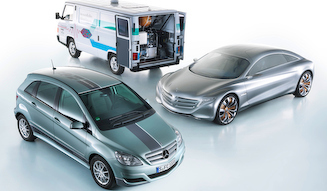
From left: B-Class F-CELL, F125!, NECAR 1
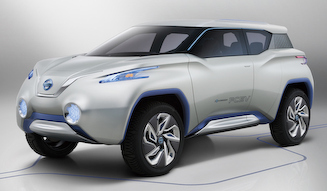
Nissan TeRRA
Unlike current EVs that are charged with electricity generated elsewhere, fuel cell vehicles run on board-generated electricity using readily available hydrogen. They are highly anticipated as a next-generation powertrain for zero-emission vehicles, emitting only water and heat.
Nissan began developing fuel cell vehicles (FCVs) in 1996 and introduced the road-legal test vehicle "X-TRAIL FCV" in 2002. This has been continuously improved, and the FCV SUV concept unveiled at last September's Paris Motor Show, called "TeRRA" is still fresh in our memory.
Mercedes-Benz began research on FCVs in the 1980s, announcing the "NECAR 1" in 1994. They continued their research and announcements, releasing the "B-Class F-CELL" equipped with a fuel cell in 2010. At the 2011 Frankfurt Motor Show, they unveiled the "F125!", aiming for introduction in 2025.
Ford also continued its research and development of fuel cell vehicles, announcing the "P2000 HFC" in 1998 and providing the "Focus FCV" as an experimental vehicle to the Canadian government in 2005.
Recently,The collaboration agreement signed by BMW and Toyotaalso included a section on fuel cell (FC) development, aiming for a market launch of FCVs in 2020. The recent agreement between Daimler, Renault-Nissan, and Ford is similar in nature and signifies that the entire automotive industry is beginning to accelerate towards the practical realization of fuel cell vehicles.