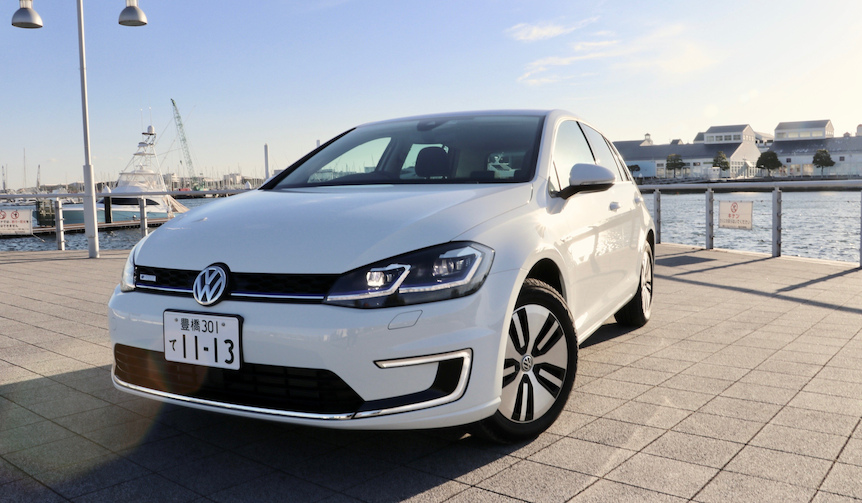
Test Drive the Latest Golf EV, the e-Golf | Volkswagen
Volkswagen e-Golf | VOLKSWAGEN
Test Drive the Latest Golf EV, the e-Golf
For Volkswagen, which is set to fully enter the EV market around 2020, the electric and PHEV versions of the Golf will be a crucial test. How much potential do they hold? Fumio Ogawa takes the "e-Golf," now available in Japan, for a spin.
Text by OGAWA Fumio
A Concentration of Advanced Technology
Volkswagen is a manufacturer that embraces new developments. Not only does the group encompass brands like Porsche, Audi, and Lamborghini, which are known for their advanced technology, but Volkswagen itself also handles noteworthy products.
A prime example is the "e-Golf", which went on sale in Japan in late 2017. This is a Golf variant that runs solely on an electric motor.
For the Volkswagen Group, which aims to have 80 EV models across its brands by 2025, this model is described as a "bridge to the next generation" (according to press materials).
Following this direction, the Golf lineup also includes the plug-in hybrid "Golf GTE," which is itself a well-executed car.

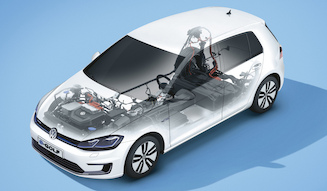
The e-Golf is a front-wheel-drive vehicle equipped with an electric motor that produces a maximum torque of 290 Nm. Its announced cruising range is up to 301 km (JC08 mode).
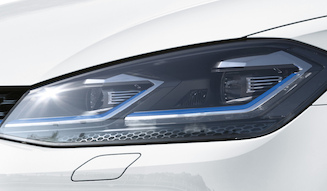
Visually, it is almost indistinguishable from the recently facelifted Golf series. The few identifying features are a blue line and C-shaped LED lamps. These are details that only a keen eye for Golf models would notice.
In terms of functionality, the e-Golf, as an EV, features dedicated equipment. One such system is the "e-Manager," which allows for charging reservations based on departure time. Additionally, features like the "Range Monitor," which displays the driving range on the navigation screen, and the "Energy Flow Indicator" make it feel like a truly next-generation vehicle.
Furthermore, Volkswagen Car-Net enables the display of charging stations on the navigation screen. This system also allows for pre-conditioning the cabin temperature before departure and making charging reservations via remote operation.
Volkswagen e-Golf | VOLKSWAGEN
Test Drive the Latest Golf EV, the e-Golf (2)
Driving Performance: What to Expect
In terms of the actual driving experience, it is, in a word, very good. The steering feel and suspension settings are precise. Frankly, it makes you wonder if it's "the same Golf."
As readers familiar with hybrids will know, EVs characteristically deliver maximum torque the moment the accelerator pedal is pressed. The resulting brisk acceleration from a standstill is different from the standard Golf.
The manufacturer states that it accelerates from 0 to 80 km/h in 6.9 seconds. Driving the e-Golf confirms this. For typical driving conditions, the torque is more than sufficient, including for intermediate acceleration.
A weakness of the Golf was its somewhat unrefined steering feel, but the e-Golf is solid. The feel when turning from the neutral position is slightly heavier, and it pairs exceptionally well with the responsive chassis.
The suspension is a bit firm, but pitching is well-controlled, and a sense of refinement is certainly present. While the primary selling point of this car is undoubtedly that it's an EV, its refined driving quality is a close second.
The transmission allows selection of "B" range via the shift lever, which increases regenerative braking (charging). When you lift off the accelerator pedal, the car enters charging mode, resulting in strong deceleration.
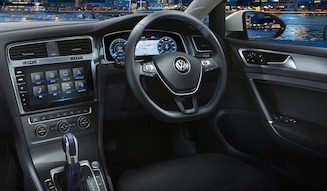
This is known as one-pedal driving. BMW'si3also employs this system. While it might be a matter of personal preference, it becomes convenient once you get used to it, as you can control speed in city driving simply by modulating pressure on the accelerator pedal.
Volkswagen e-Golf | VOLKSWAGEN
Test Drive the Latest Golf EV, the e-Golf (3)
A Bridge to the Next Generation?
Furthermore, Volkswagen Group Japan highlights that the e-Golf is unique as "an electric vehicle that can seat five passengers, which is uncommon in the market." In terms of convenience, it supports both standard charging and CHAdeMO rapid charging, making it practical for use in Japan.
The e-Golf is sold exclusively online. For Volkswagen, which is planning a more significant push into the EV market around 2020, implementing strategies that go beyond the initial sale will be crucial.
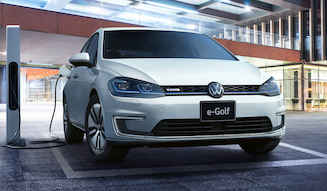
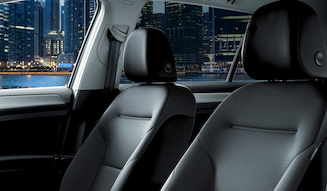
The e-Golf is priced at 4.99 million yen. It is eligible for the "Clean Energy Vehicle Introduction Business Subsidy" (301,000 yen for FY2017). The NissanLeafstarts at 3,990,600 yen, and the i3 is 5.38 million yen. Both also support CHAdeMO and have distinct characters when driven.
In this context, the e-Golf can first and foremost be recommended to those who already like the Golf. It is a car that broadens the appeal of EVs without feeling at all unusual.

Volkswagen e-Golf | VOLKSWAGEN
Body Dimensions | Length 4,265 x Width 1,800 x Height 1,480 mm
Wheelbase | 2,635 mm
Tread Front/Rear | 1,545 / 1,515 mm
Minimum Ground Clearance | 140 mm
Vehicle Weight | 1,590 kg
Electric Motor Max Output | 100 kW (136 ps) / 3,300-11,750 rpm
Electric Motor Max Torque | 290 Nm (29.5 kgm) / 0-3,300 rpm
Transmission | 1-speed fixed
Drive Battery | Lithium-ion battery
Total Voltage | 323V
Drive Battery Total Capacity | 35.8 kWh
Front Suspension | MacPherson strut
Rear Suspension | 4-link
Front Brakes | Ventilated discs
Rear Brakes | Discs
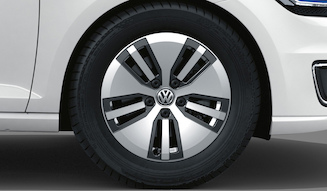
Tires | 205/55R16
Range per Charge | 301 km
Price | 4.99 million yen
Volkswagen Customer Center
0120-993-199