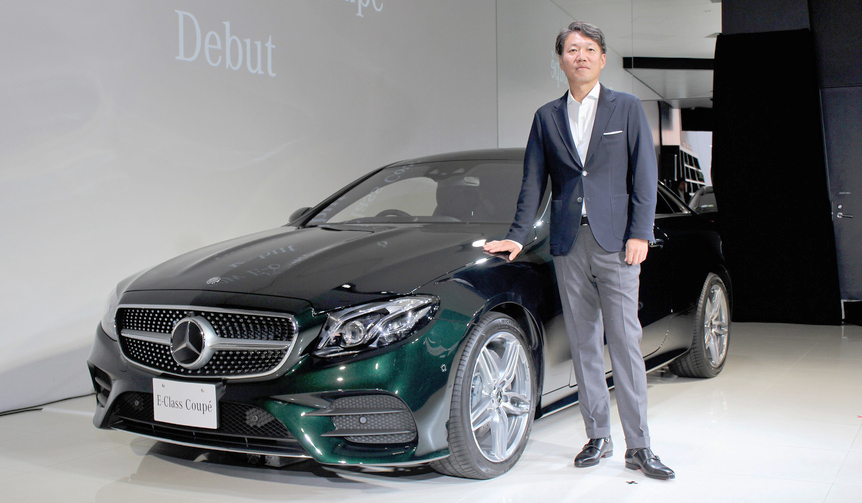
Introducing the New E-Class Coupé and AMG E 63
Mercedes-Benz E-Class Coupe
Mercedes-AMG E 63 S 4MATIC+
Introducing the New E-Class Coupé and AMG E 63
Mercedes-Benz Japan has added a coupé, the third body type for its core E-Class model, and the E 63 S 4MATIC+, the fastest E-Class ever. The coupé starts at ¥6.82 million, and the E 63 S 4MATIC+ is ¥17.74 million.
Text & Photographs by Shunichi Uchida
The E-Class Coupé: Comfortable for Four
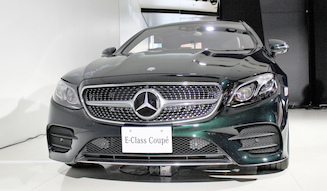
The newE-Class Coupéis arguably best defined by its exterior design. The pillarless and frameless windows, traditionally a hallmark of the E-Class Coupé, are retained in the new model. Combined with a higher beltline and a slender, flowing roofline, this design emphasizes elegance and sportiness.
A key element of the side design is the departure from the "dropping line" that flowed from the front fender on longer sports models. Instead, the rear shoulder is expressed purely through curves. The understated beltline creates a strong contrast of light and shadow, resulting in a sculpted form.
Mercedes-Benz E-Class Coupe
Mercedes-Benz E-Class Coupe
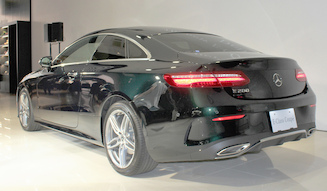
The rear is characterized by two-part LED combination lamps that extend horizontally to the trunk lid. In addition to the "Coming Home Function," already featured on the sedan and station wagon, which illuminates the parking lamps blue for three seconds upon unlocking with the remote key, the new E-Class Coupé adds a similar function for the rear. Upon unlocking the doors, the LEDs in the rear combination lamps illuminate sequentially from the center of the vehicle outwards. They illuminate in the opposite direction when locking.
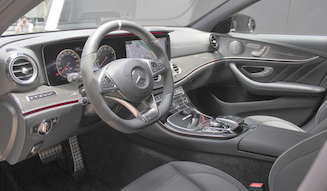
The most striking feature of the interior is the pair of high-resolution 12.3-inch wide displays. These two displays merge under a single glass cover, forming a cockpit display that appears to float, emphasizing the horizontal flow of the interior design.
The steering wheel also features Touch Control buttons. These buttons, with integrated touch-sense functionality similar to smartphones, respond to vertical and horizontal swipes. Menu items can be selected by swiping and confirmed by pressing the button, allowing the driver to operate infotainment functions easily and efficiently without removing their hands from the steering wheel.
Mercedes-Benz E-Class Coupe
Mercedes-AMG E 63 S 4MATIC+
Introducing the New E-Class Coupé and AMG E 63 (2)
Four Models in the Lineup
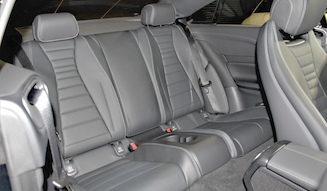
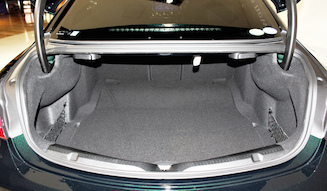
The larger body size compared to the previous model has improved interior space and comfort. Rear legroom has increased by 74mm, shoulder room by 34mm, and headroom by 15mm.
Junichi Kinoshita, Manager of Product Planning Section 1, Sales Planning Department at Mercedes-Benz Japan, stated, "We understand that E-Class Coupé buyers are often drivers themselves, with partners or friends in the passenger seat, and the rear seats are typically used for luggage. However, once they own a coupé, they often wish for more rear seat space when traveling, loading golf bags, or carrying friends." He added that the rear seat comfort has been enhanced with this in mind.
Mercedes-Benz E-Class Coupe
Mercedes-Benz E-Class Coupe
The lineup for Japan includes four models: the "E 200 Coupé" with a 2.0-liter four-cylinder turbo engine, the sportier "E 200 Coupé Sport" in terms of interior and exterior, the "E 300 Coupé Sport" also with a 2.0-liter four-cylinder turbo but producing 245ps, and the "E 400 4MATIC Coupé Sport," uniquely equipped with a V6 engine and Air Body Control.
Kintaro Ueno, President and CEO of Mercedes-Benz Japan, commented, "We have sold a total of 10,000 units of the E-Class Sedan and E-Class Station Wagon announced last year by the end of last month. This accounts for 16 percent of Mercedes-Benz sales during the same period." He emphasized that the E-Class remains one of the company's core models.
Mercedes-Benz E-Class Coupe
Mercedes-AMG E 63 S 4MATIC+
Introducing the New E-Class Coupé and AMG E 63 (3)
The Fastest Mercedes-AMG E 63 S 4MATIC+ in E-Class History
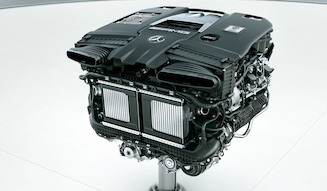
Announced alongside the E-Class Coupé is the Mercedes-AMG "E 63 S 4MATIC+". The engine is the M177, a 4.0-liter V8 biturbo direct-injection engine developed entirely in-house by Mercedes-AMG, sharing its basic design with the sports carMercedes-AMG GTThe "hot inside V" layout places the two turbochargers inside the V of the cylinder banks, making the engine as compact as possible. The twin-scroll design and optimized intake and exhaust paths for the turbochargers ensure excellent response from low RPMs.
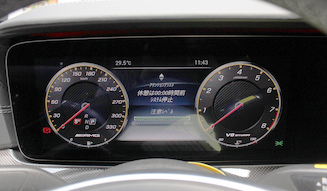
Despite a 1.5-liter reduction in displacement from the previous model, it produces a maximum output of 612ps (+27ps) and a maximum torque of 850Nm (+50Nm). It achieves 0-100 km/h in 3.4 seconds (-0.2 seconds), making it the fastest E-Class model ever.
This engine is also the first V8 turbo engine to feature a cylinder deactivation system. Instead of firing all eight pistons, it deactivates four cylinders (2, 3, 5, and 8) during low-load driving in Comfort mode between 1,000 and 3,250 RPM. This reduces CO2 emissions, improving both fuel economy and environmental performance.
Mercedes-AMG E 63 S 4MATIC+
Mercedes-AMG E 63 S 4MATIC+
The AMG E 63 S 4MATIC+ is equipped with a Drift Mode. As the name suggests, this mode enables drifting by setting the torque distribution to 100% rear. While previous AMG 63 series 4MATIC models had a fixed torque distribution, the AMG E 63 S 4MATIC+ automatically varies the torque distribution according to the situation, even outside of Drift Mode, to optimally distribute the high power to the road. The "+" signifies variable torque distribution.
To activate Drift Mode, select Race mode in AMG DYNAMIC SELECT, then press and hold the ESP button to turn it off. Select Manual transmission mode and confirm the menu using the paddle shifters to engage Drift Mode.
The launch control function, Race Start, is also easier to activate. First, select Sport, Sport Plus, or Race mode in DYNAMIC SELECT, then firmly press the brake with your left foot. Fully depress the accelerator with your right foot and then release your left foot to initiate Race Start.
Mercedes-Benz E-Class Coupe
Mercedes-AMG E 63 S 4MATIC+
Introducing the New E-Class Coupé and AMG E 63 (4)
First 9-Speed MCT in an AMG 63 Model
The transmission is the 9-speed AMG SPEEDSHIFT MCT, the first in the AMG 63 series. By using a wet multi-plate clutch instead of a torque converter, it reduces the losses found in conventional automatic transmissions and, combined with weight reduction, improves fuel economy and responsiveness.
Furthermore, it features four modes: "C" (Comfort) for fuel efficiency, which disengages the engine and transmission when the accelerator is released during high-speed driving to reduce fuel consumption; "S" (Sport) and "S+" (Sport Plus) for a sportier driving experience; and "I" (Individual) for custom parameter settings. In "RACE" mode, all parameters are adjusted for circuit driving. It also efficiently changes gears, including skipping a gear during downshifts and automatic double-clutching.
Mercedes-AMG E 63 S 4MATIC+
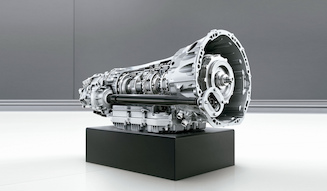
AMG SPEEDSHIFT MCT
The AMG E 63 S 4MATIC+ is the first E-Class model to feature magnetorheological engine mounts and dynamic engine mounts. These mounts automatically adjust their stiffness based on driving conditions detected by various sensors. For example, during normal driving, softer mounts effectively isolate noise and vibration from the drivetrain for enhanced comfort. During dynamic driving, stiffer mounts reduce drivetrain roll motion, enabling quicker cornering.
The exterior design features a unique front section from the A-pillar forward, adopting a coupé-like design where the bonnet is inset between the fenders and bumper – a first for a Mercedes-AMG sedan. It also features wider fenders than the standard E-Class to accommodate the increased front track width and larger wheels. The new front grille incorporates silver chrome twin louvers with the AMG logo and vertical black fins. The wide front apron, inspired by the design of a jet fighter's wing, features black flicks and a large front splitter, expressing the power of the AMG E 63 S 4MATIC+ while providing significant cooling.
Mercedes-Benz E-Class Coupe
Mercedes-AMG E 63 S 4MATIC+
Introducing the New E-Class Coupé and AMG E 63 (5)
Long-Standing Social Contribution Activities
Daimler, the parent company of Mercedes-Benz Japan, engages in various social contribution activities globally. In Japan, too, they conduct a diverse range of initiatives. At the recent announcement of the E-Class Coupé and other models, President Ueno introduced their latest plans for Japan.
One initiative is the "Smart City Project." Smart is a city compact car that condenses maximum convenience, comfort, safety, and environmental compatibility into a minimal body size. Since its debut in 1997, its innovative concept and playful design have led to cumulative global sales of 2 million units, with 36,000 sold in Japan. The Smart City Project, promoted globally by Daimler headquarters, "aims to increase awareness of Smart through unique activities tailored to the culture and climate of each city worldwide. It is currently active in 14 locations across 41 cities," Ueno explained.
Mercedes-Benz Japan has been participating in Kyoto Prefecture's PR activities, "Another Kyoto," since last year. "Therefore, we decided to conduct this initiative in Kyoto, Japan," he said. "We are already providing PR vehicles for the 'Kyoto of Tea, Half-Farming Half-Art Project' and sponsoring the MBS radio program 'Another Kyoto.' We will further deepen our collaboration with Kyoto Prefecture going forward."
It was also announced that "smart center Kyoto, the garden," Japan's first dedicated smart retail space, will open in Kyoto Okazaki on June 17th.
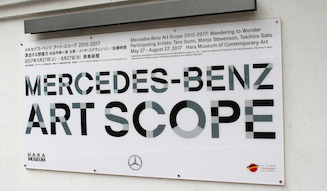
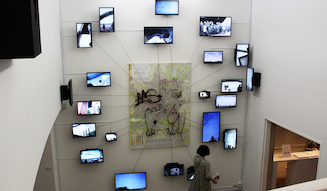
The second initiative is cultural and artistic support. As part of its social contribution efforts, Daimler has a history of supporting contemporary art. Against this backdrop, Mercedes-Benz Japan has implemented its unique cultural and artistic support program, "Mercedes-Benz Art Scope," since 1991 (President Ueno himself was involved with it at one point). Art Scope facilitates exchange between young contemporary artists from Japan and Germany through mutual dispatch and invitation, providing them with experiences of living and creating in different cultural environments.
Now in its 27th year, "Art Scope has produced numerous renowned artists, earning high praise from the art industry," Ueno noted. Currently, at the Hara Museum in Shinagawa Gotenyama, Tokyo, a group exhibition is being held until August 27th, featuring two young artists from 2015 and Mr. Tokihiro Sato, an alumnus of the program.
In addition to these, they also cooperate with "Laureus," another social contribution activity. Laureus addresses social issues through the power of sport. Daimler was involved in its establishment, and since its founding in 2000, it has supported over 1.5 million children through more than 150 social projects in 34 countries worldwide.
Supporting Laureus's activities worldwide are its ambassadors. Currently, about 160 top athletes from around the globe serve as ambassadors. Recently, Shinji Kagawa, the soccer player, became the first Japanese ambassador for Laureus. In response, Mercedes-Benz Japan has decided to support SHINJI HOUSE, a social contribution activity organized by Kagawa. "Kagawa launched this project with the desire for children to have time to engage in sports with their families, hoping to inspire dreams through this activity," he said.