Nissan Unveils Prototype of Ethanol-Powered Fuel Cell Vehicle | Nissan
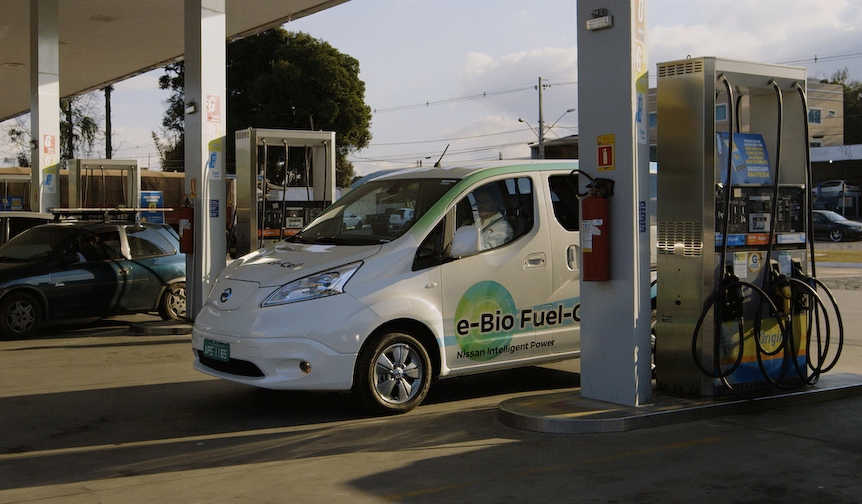
Nissan e-Bio Fuel-Cell
Nissan Unveils Prototype of Ethanol-Powered Fuel Cell Vehicle
On August 4th, Nissan Motor Corporation announced a new prototype fuel cell vehicle in Brazil that generates electricity from bioethanol.
Text by HORIGUCHI Yoshihiro (OPENERS)
Achieving a CO2-Neutral Cycle
When we think of fuel cell vehicles, we might recall the Toyota Mirai, launched as the world's first mass-produced FCV late last year, or the Honda Clarity Fuel Cell. However, the vehicle unveiled by Nissan this time runs on 100% ethanol, not hydrogen. A Solid Oxide Fuel Cell (SOFC), named "e-BIO Fuel-Cell," converts this into electricity to drive the motor. This marks the world's first automobile powered by an SOFC.
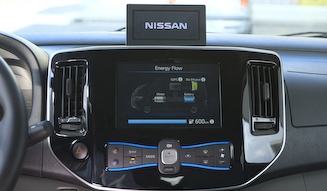
The prototype vehicle is based on the commercially available electric vehicle "e-NV200." It is equipped with a 30-liter tank for ethanol, offering a cruising range of over 600 km. The 5kW SOFC charges a 24kWh battery while driving.
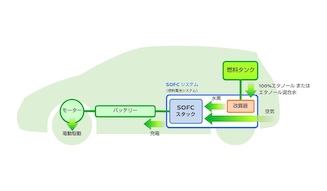
A key feature of the e-BIO Fuel-Cell is its use of 100% ethanol or ethanol-blended water as fuel, offering numerous advantages.
Since ethanol can be produced from plants like sugarcane and corn, it enables a CO2-neutral cycle where the CO2 released during power generation is reabsorbed by plants, which are then used as fuel. Furthermore, by establishing a circular system for local energy production and consumption, it eliminates dependence on the arbitrary decisions of oil-producing countries, such as fluctuations in crude oil prices.
Moreover, its liquid form offers excellent portability, and refueling takes about the same time as gasoline or diesel, overcoming the weakness of EVs, which require charging stations.
In regions like North and South America and Asia, where vehicles running directly on ethanol are common and fueling station networks are already established, Nissan plans to conduct field tests with this prototype vehicle.