CLS Shooting Brake Unveiled | Mercedes-Benz
Mercedes-Benz CLS Shooting Brake
CLS Shooting Brake Unveiled
The Mercedes-Benz CLS-Class, first introduced in 2004 based on the E-Class, has become the progenitor of the "four-door coupe"—a model now offered by many manufacturers, characterized by its four doors and coupe-like roofline. Joining this CLS-Class is the wagon version, the "CLS Shooting Brake," whose addition had already been announced. This highly anticipated luxury wagon, pursuing both utility and sport—qualities often seen as contradictory—finally revealed its form on June 29th.
Text by SUZUKI Fumihiko (OPENERS)
A Wagon Exuding Refinement
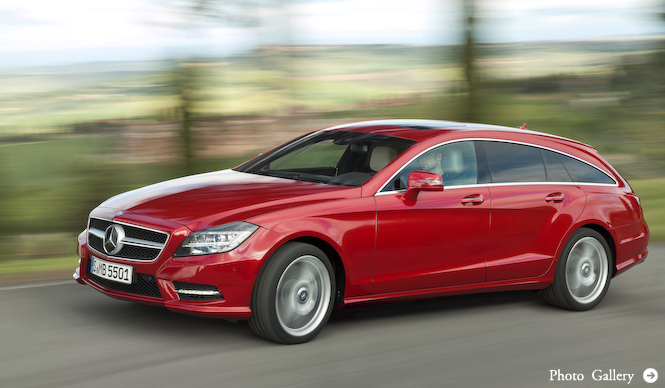
Announced as a concept model at the 2010 Beijing Motor Show,its development was reportedand the Mercedes-Benz four-door wagon, the CLS Shooting Brake, was finally unveiled on June 29th. A "shooting brake" is a car that combines the high-class appeal of a coupe with the cargo capacity comparable to a station wagon, originally designed to carry hunting dogs and guns for excursions, and to transport game back home. The "CLS Shooting Brake," which combines the four-door coupe "CLS-Class" with a wagon-like tail, perfectly matches this image of a shooting brake.
The styling, with its flowing roofline that continues to the spoiler above the tailgate, is best appreciated in the photos. The body dimensions are 4,956mm in length, 1,881mm in width, and 1,413mm in height. The headlamps incorporate U-shaped LED lighting. This body is also aerodynamically superior, achieving a drag coefficient (Cd) of 0.29.
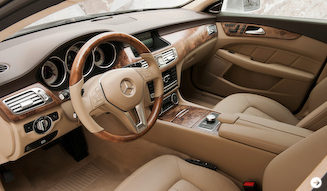
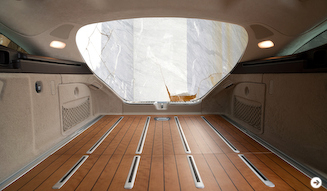
The cargo space is 590 liters in its standard configuration. By folding down the 60:40 split rear seats, this can be expanded to 1,550 liters. The cargo area features a wood floor, which, in harmony with the interior combining leather with oak and cherry wood, enhances the luxurious image. The rear suspension is air-sprung, and the doors are made of aluminum. Aluminum is also used in the tailgate, hood, and parts of the suspension, contributing to a combination of sporty driving performance and ride comfort through weight reduction, as claimed.
Engine Variations: Two Diesels, Two Gasoline Models
The engine variations announced this time are four. The "CLS 250 CDI BlueEFFICIENCY" is equipped with a 2.1-liter four-cylinder diesel engine, producing a maximum output of 150 kW (204 ps) at 4,200 rpm and a maximum torque of 500 Nm at 1,600-1,800 rpm. It accelerates from 0 to 100 km/h in 7.8 seconds and has a top speed of 235 km/h. Fuel consumption is 5.3 L/100 km (approx. 18.8 km/L), with CO2 emissions at 139 g/km.
The "CLS 350 CDI BlueEFFICIENCY" is a 3.0-liter V6 diesel engine model with a maximum output of 195 kW (265 ps) at 3,800 rpm and a maximum torque of 620 Nm at 1,600-2,400 rpm. It achieves 0-100 km/h in 6.6 seconds and a top speed of 250 km/h. A four-wheel-drive model, the "CLS 350 CDI 4MATIC," is also available. Fuel consumption for the standard and 4MATIC models is 6.0 L/100 km (approx. 16.6 km/L) and 6.6 L/100 km (approx. 15.1 km/L) respectively, with CO2 emissions at 159 g/km and 174 g/km.
The gasoline engine model, "CLS 350 BlueEFFICIENCY," is powered by a 3.5-liter V6 unit, delivering a maximum output of 225 kW (306 ps) at 6,500 rpm and a maximum torque of 370 Nm at 3,500-5,250 rpm. It accelerates from 0 to 100 km/h in 6.7 seconds, with a top speed of 250 km/h. Fuel consumption is 7.3 L/100 km (approx. 13.6 km/L), and CO2 emissions are 169 g/km.
The top-grade model is the "CLS 500 BlueEFFICIENCY." Its twin-turbo 4.6-liter V8 gasoline engine produces a maximum output of 300 kW (408 ps) at 5,000 rpm and a maximum torque of 600 Nm at 1,600-4,750 rpm. It accelerates from 0 to 100 km/h in 5.3 seconds, with a top speed of 250 km/h. A four-wheel-drive model, the "CLS 500 4MATIC," is also available. For this model, fuel consumption is 9.2 L/100 km (approx. 10.8 km/L) for the standard version and 9.8 L/100 km (approx. 10.2 km/L) for the 4MATIC, with CO2 emissions at 214 g/km and 229 g/km, respectively.
Sales in Europe are rumored to begin around September.


