Audi's Sporty SQ7 Model Debuts | Audi
Audi SQ7 TDI
The Audi SUV Flagship is the Diesel SQ7
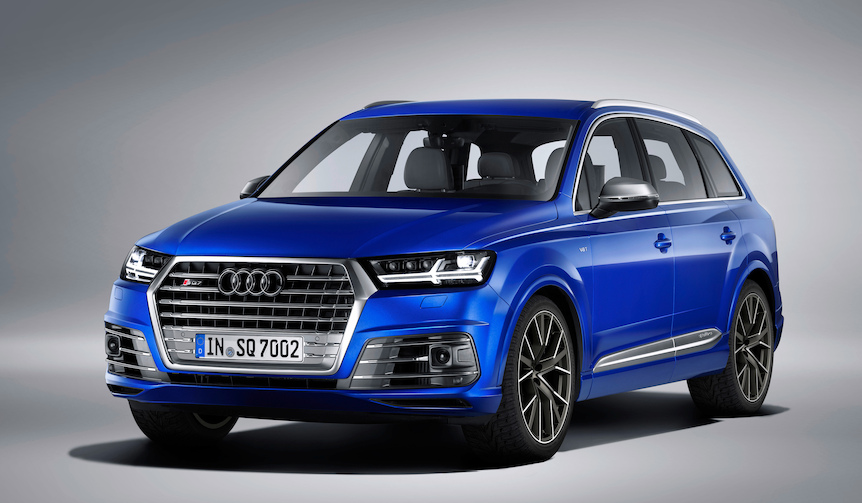
The second-generation Q7, the top model in Audi's "Q series," is set to begin deliveries in Japan in late March. Meanwhile, the flagship model of the Q7 lineup, the SQ7 TDI, has been unveiled in its home market. It's noteworthy that the top model of the Q7 series is a diesel. This model features not only twin-turbochargers but also the first-ever electric-powered compressor in a production vehicle. This triple-charging system reportedly generates a maximum output of 435ps, the highest among production diesel models.
Text by KENICHI SAKURAI
The First S Model for the Q7
As previously reported, Audi Japan will launch the second-generation AudiBegin sales of the "Q7" at authorized dealerships nationwide from late MarchThe first-generation Q7, a pioneer of the full-size SUV boom, debuted at the Frankfurt Motor Show in 2005 as a premium SUV characterized by its spacious 7-seater cabin with three rows of seats. It was introduced to Japan the following year, in 2006. The second-generation model, now undergoing a full model change, is slightly smaller and has shed approximately 300kg, achieving a balance between performance and environmental efficiency.
The models for the Japanese market will be available in two grades: the "2.0 TFSI quattro" (priced at 8.04 million yen) equipped with a 2.0-liter inline four-cylinder engine (maximum output: 252ps), the first for the Q7 series, and the "3.0 TFSI quattro" (priced at 9.29 million yen) featuring a 3.0-liter V6 DOHC supercharged engine (maximum output: 333ps). Both models come standard with the quattro permanent all-wheel-drive system and an 8-speed tiptronic transmission.
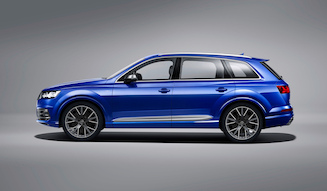
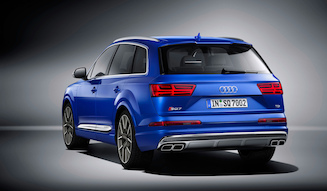
The exterior design boasts a solid feel, complemented by the familiar, imposing Singleframe grille. The high-quality interior, with its horizontal design characteristic of Audi, the expansive cabin space, the reclining second-row seats, and the versatile seat arrangements for passengers and cargo, are all distinctive features of the Q7.
In the Japanese market, alongside the timely Q7 whose launch has just been announced, another noteworthy model has emerged: the "SQ7 TDI," unveiled in its home market. As the "S" prefix suggests, this model is the sportier version, positioned above the standard series. Audi traces the origins of its "S models" back to the 1985 Audi Sport quattro "S1," carefully nurturing a lineage of high-performance vehicles. Audi offers "S models" across almost its entire series in Japan. Similarly, in the SUV lineup, theQ5" model, theSQ5" has already been introduced.
Audi SQ7 TDI
The Audi SUV Flagship is the Diesel SQ7 (2)
Top Power Among Production Diesels, Achieved with Three Superchargers
The SQ7 TDI, unveiled in its home market, is not only the first S model for the Q7 lineup but also the most powerful production diesel model, equipped with a 4.0-liter V8 diesel engine producing a maximum output of 320kW (435ps).
The secret to achieving top-tier performance from a diesel engine lies in the addition of an electric-powered compressor (EPC) – a world-first technology – alongside two turbochargers. Typically, twin-turbo systems assign one turbocharger to low-speed ranges and another to high-speed ranges. While seamless operation between these aims to deliver power instantly across all driving conditions, from a standstill to high speeds, there can be moments where a lack of torque is felt during low engine RPMs, such as when accelerating from a stop.
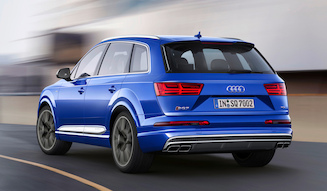
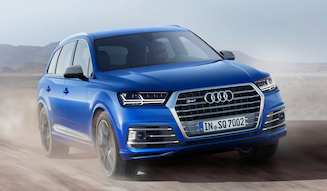
Complementing this is the EPC, a first for production passenger cars. Audi explains that "because it can generate boost pressure without requiring exhaust gas energy, it can be utilized in any driving situation. This overcomes the weaknesses of conventional turbochargers that rely on exhaust gas."
"With this new TDI engine, turbo lag is a thing of the past. The EPC provides the boost energy for high torque generation in just 0.25 seconds. Driven by a small electric motor, the compressor can reach speeds of up to 70,000 rpm, delivering superb engine response without turbo lag. The EPC reacts the moment the driver presses the accelerator, offering a significant advantage, particularly in initial acceleration."
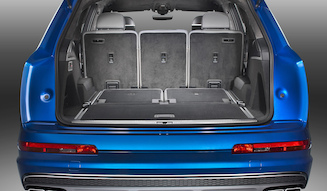
The EPC is powered by a dedicated 48V electrical system. To support this, a lithium-ion battery with a capacity of 470Wh, generating up to 13kW, is installed beneath the luggage compartment floor. This battery powers the EPC and also supports the conventional 12V battery's electrical system when needed. A new, powerful generator with a maximum output of 3kW and an efficiency exceeding 80% handles the power generation. The installation of this 48V power storage unit also reduces the load on the conventional lead-acid battery.
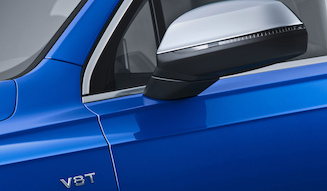
Thanks to the dual turbochargers and the EPC, the SQ7 TDI achieves a maximum output of 320kW (435ps) and a peak torque of 900Nm (91.8kgm) at 1,000-3,250rpm. It accelerates from 0 to 100km/h in 4.8 seconds and reaches a top speed of 250km/h (electronically limited).
Conversely, its fuel consumption in the New European Driving Cycle (NEDC) is 7.4 liters per 100km, translating to a fuel economy of 13.5km/liter. Carbon dioxide emissions are 194g/km, which is an unexpectedly low figure considering its near-500ps output.
Audi SQ7 TDI
The Audi SUV Flagship is the Diesel SQ7 (3)
New Possibilities Through Electrification
Another noteworthy new technology in the SQ7 TDI is its suspension and body control systems. Particularly innovative is the electromechanical active roll stabilization, which uses an electric motor generating up to 1,200Nm to control the stabilizer bars. On uneven terrain, the stabilizer bars are split to improve ride comfort, while during sporty driving, they are linked to enhance body rigidity, firming up the suspension, suppressing roll, and simultaneously eliminating understeer.
The suspension is integrated and controlled by the "Driving Dynamics package sport," which Audi refers to as a combination of three devices: the differential, electromechanical active roll stabilization, and all-wheel steering. This system coordinates functions related to the suspension, such as variable shock absorbers, air springs, sport differential, and roll force distribution, to provide exceptional handling and ride comfort regardless of road conditions or driving situations.
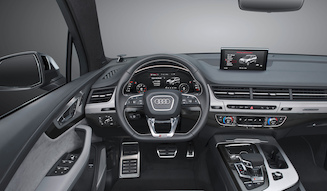
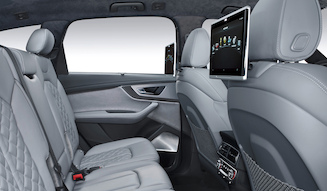
Previously, systems using electric motors to supplement engine power were generally referred to as hybrids in the automotive world. However, the SQ7 TDI demonstrates a new vision for hybrid models by employing motors and batteries not only to enhance engine power but also to control the suspension. This vehicle shows that electrification holds significant potential beyond just powertrains.
The SQ7 TDI, with order acceptance beginning this spring in Europe, will have a base price of 89,900 euros (approximately 11.5 million yen). While Audi, one of the "big three" German premium automakers, is actively pursuing electrification and is the only one without a diesel engine in its current European lineup, the question remains whether the introduction of diesel models, including the SQ7 TDI, is being considered for the Japanese market.
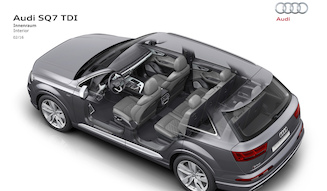
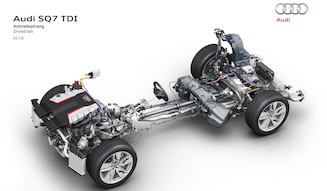
While we acknowledge the sensitive issues surrounding Volkswagen Group's diesel engines, the specifications of the SQ7 TDI, touted as the pinnacle of diesel performance, are sure to resonate with owners of high-performance cars. Furthermore, this SQ7 TDI is a necessary model for Audi's complete lineup of S models in Japan. After all, in its home market, this diesel-powered model is the only S version of the Q7. The SQ5 in Japan is also now exclusively the dieselSQ5 TDIversion. We sincerely hope Audi will make the bold decision now.