The F12 Speciale: A Legendary Name Revived | Ferrari
Ferrari F12 tdf | Ferrari F12 tdf
The F12's Speciale Revives a Legendary Name
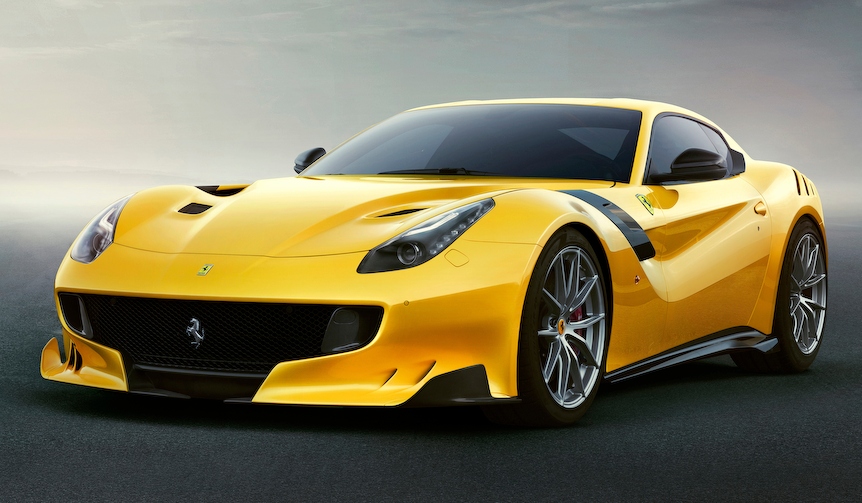
Ferrari will unveil its new Speciale, the Ferrari F12 tdf, at the annual flagship event, "Ferrari Finali Mondiali," held at Italy's Mugello Circuit on November 8. As its name suggests, this special model—a "speciale" in the Italian manufacturer's parlance—is based on the F12 Berlinetta. However, it features significant advancements, including increased maximum output and top speed. Its rarity, a tradition of special editions limited to just 799 units worldwide, is also a key talking point.
Text by SAKURAI Kenichi
A Limited Edition of 799 Units Worldwide, Coveted by Ferraristi
The "Finali Mondiali," where the new Speciale "Ferrari F12 tdf" will be unveiled, is a grand event that concludes Ferrari's year. It includes the world championship races of the "Ferrari Challenge," Ferrari's one-make racing series held worldwide, as well as owner participation events like the "XX Programme" and "F1 Clienti," organized by Ferrari's racing division and known as "Corse Clienti."
Last year, it was held in Abu Dhabi, United Arab Emirates,as reported by OPENERS.At the Yas Marina Circuit, the venue, in addition to these races and driving events, the circuit-only modelFXX Kmade its world premiere, drawing keen attention from attending Ferrari owners.
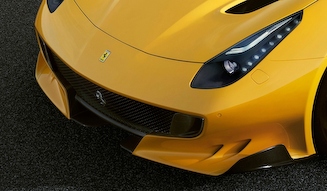
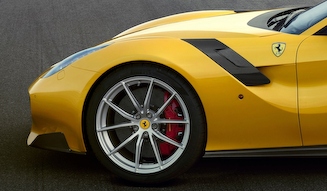
While it has become customary to announce a special model at this annual event, this year sees the debut of the most powerful front-engine, rear-drive road car, the "Ferrari F12 tdf." The F12 tdf, limited to 799 units worldwide, is developed based on the "F12 Berlinetta," the current flagship model in the company's lineup. Both the body design and the naturally aspirated V12 engine mounted in the front-mid position have been evolved to what can be called the ultimate level.F12 Berlinettahas been developed based on the "F12 Berlinetta." Both the body design and the naturally aspirated V12 engine mounted in the front-mid position have been evolved to what can be called the ultimate level.
However, the "tdf" in the car's name is intriguing. It is, in fact, an abbreviation for "Tour de France," a three-letter designation for the legendary endurance road race held from the 1950s to the 1960s. Ferrari developed the "250GT Tdf," a lightweight, high-performance model with an aluminum body, to win this race. Ferrari achieved four consecutive victories in this demanding endurance race, held on both public roads and circuits. The naming of the "F12 tdf" is thus an homage to the "Tour de France," a race that is still spoken of today.
Incidentally, the "250GT Tdf" is a rare sight; a 1958 model sold for £4.76 million (approximately 875 million yen) at a recent RM Auction in London. While original models are not easily acquired, purchasing the "F12 tdf" might not be difficult if one acts quickly. This is of course irrelevant to the common person, but it is a model that will be produced from now on. Compared to the "250GT Tdf," the hurdle to purchase is arguably much lower.
Ferrari F12 tdf | Ferrari F12 tdf
The F12's Speciale Revives a Legendary Name (2)
Bold Design Aimed at Aerodynamic Improvement
As its name originates from the "Tour de France," which was held on public roads, the "F12 tdf" is designed as a vehicle legally drivable on public roads, aiming for the highest specifications. For example, while the engine is the same 6,262cc, 65-degree V12 naturally aspirated engine as the F12 Berlinetta, the maximum output has been increased from 740 ps at 8,250 rpm to 780 ps at 8,500 rpm. The maximum torque has also been increased from 70.3 kgm at 6,000 rpm to 71.8 kgm at 6,750 rpm. However, its most notable feature is that 80 percent of the maximum torque is generated at a mere 2,500 rpm.
Unlike high-performance machines that can be difficult to handle or require special skills, anyone can experience the performance of over 340 km/h, as announced by Ferrari, provided the conditions allow. The transmission is a dedicated F1 DCT (7-speed DCT) with a 6 percent closer gear ratio, and both upshifts and downshifts are 30 percent and 40 percent faster, respectively.
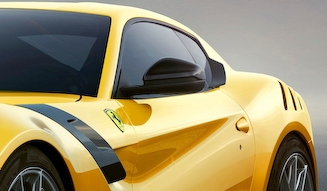
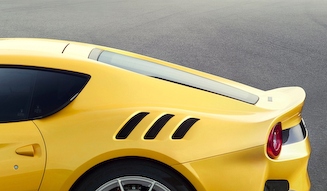
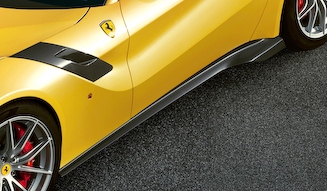
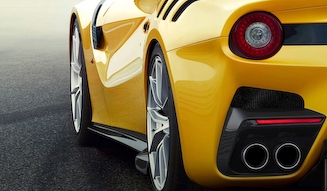
More noteworthy than the tuned engine is the body design. The front section has evolved into a shape that generates overwhelming downforce, and the underside of the body features a more aggressive design. It incorporates aggressive splitters, dive planes, floor wings, and louvers, making it almost indistinguishable from a racing machine. It is easily distinguishable from the stock F12 Berlinetta.
These radical changes to the body shape are not merely for a sporty appearance. The adoption of the aerodynamic underbody, featuring an aero bridge on the front sides, louvers in the wheel arches, a rear spoiler that is 60mm longer and 30mm higher, and strakes derived from GT racing cars, results in a 30 percent increase in downforce compared to the F12 Berlinetta.
As a result, the aerodynamic efficiency figure for the F12 tdf announced by Ferrari is 1.6, approximately double that of the F12 Berlinetta. The downforce at 200 km/h has also significantly increased from 107 kg for the F12 Berlinetta to 230 kg.
Ferrari F12 tdf | Ferrari F12 tdf
The F12's Speciale Revives a Legendary Name (3)
A Rare Large-Displacement Naturally Aspirated Engine
In addition to the aggressive body design, the interior also utilizes lightweight carbon fiber wherever possible. Inner door panels, the instrument panel, and the center bridge are all made of carbon fiber, and the floor is covered with aluminum instead of carpet, shaving off weight gram by gram. Furthermore, through redesigns of the engine, transmission, and running gear, as well as a review of parts used, a total weight reduction of 110 kg has been achieved.
These weight reductions, combined with the engine power increase and the introduction of an active rear axle system called "Virtual Short Wheelbase System," where the rear wheels steer around a vertical axis, result in chassis technology that provides instantaneous turn-in response on winding roads and challenging technical circuits. These comprehensive performance enhancements enable the F12 tdf to achieve astonishing figures of 0-100 km/h in 2.9 seconds and 0-200 km/h in 7.9 seconds.
The F12 tdf's lap time at Ferrari's benchmark Fiorano Circuit is a flat 1 minute 21 seconds. Considering that the FXX K, a pure circuit-only machine with slick tires, completed the lap in 1 minute 14 seconds, the F12 tdf's time, equipped with road-legal tires, is truly among the top class for road-legal production cars.
Porsche Advances Turbocharging for the "911"Porsche has advanced turbocharging for the "911," and Ferrari has also quickly adopted turbocharging for the488 GTBandCaliforniaT. It is undeniable that the wave of downsizing turbocharging is also reaching sports cars and supercars, but the limited-production Speciale "F12 tdf," with its 799 units, has demonstrated that there is still room for growth in the potential of large-displacement naturally aspirated engines.
But what about the future? While it's an unpleasant thought, the F12 tdf might represent the last great flourish of the large-displacement naturally aspirated V12 engine. If so, its lucky 799 owners may be the final witnesses to the pinnacle of large-displacement naturally aspirated V12 engines, the mechanical apex of automotive performance.

Ferrari F12 tdf | Ferrari F12 tdf
Body Dimensions | Length 4,656 × Width 1,961 × Height 1,273 mm
Weight | 1,415 kg (including optional lightweight features)
Engine | 6,262 cc V12 Cylinder
Maximum Output | 574 kW (780 ps) / 8,500 rpm
Maximum Torque | 705 Nm / 6,750 rpm
Transmission | 7-speed Dual-Clutch (F1 DCT)
Drivetrain | FR
Top Speed | Over 340 km/h
0-100 km/h Acceleration | 2.9 seconds
0-200 km/h Acceleration | 7.9 seconds
Tires Front/Rear | 275/35R20 / 315/35R20
Fuel Consumption | 15.4 L/100km (approx. 6.5 km/L)
CO2 Emissions | 360 g/km