Nissan Unveils New Generation Vehicle Design Technology | Nissan
Nissan CMF | Nissan Common Module Family
Announcing New Generation Vehicle Design Technology: Nissan CMF
Nissan has announced a new modular vehicle design technology.
Text by HORIGUCHI Yoshihiro (OPENERS)
Achieving Shorter Development Cycles and Lower Costs
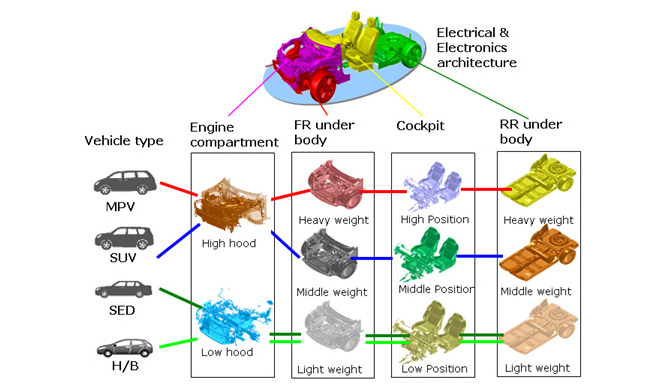
Nissan CMF (4+1 Big module concept) takes the conventional idea of "sharing a platform to develop multiple car models" a step further. It is a technology that divides the platform itself and combines parts (modules) suitable for the desired vehicle type. As the "4+1" designation suggests, Nissan CMF broadly divides the vehicle into four main parts: the "engine compartment," "front underbody," "cockpit," and "rear underbody," plus one "electronic system," totaling five components.
This technology allows for simultaneous achievement of seemingly conflicting goals: reducing development time and costs through parts sharing, while also enhancing vehicle individuality. Furthermore, it offers significant advantages such as the ability to quickly integrate cutting-edge electronic devices, including advanced electronic systems and safety features, thanks to modularization.
Theoretically, this modularization can be applied to all vehicle types, including EVs, FF, FR, and 4WD. However, its benefits are only realized with mass production. Therefore, while initially planned for about 12% of models in 2013, the aim is to apply it to approximately 60% of models by 2016.
Nissan has declared the launch of 51 new models during its six-year mid-term plan, "Power 88," spanning from 2011 to 2016. This new technology is positioned as a crucial factor in achieving that ambitious goal.
Similar to this modularization by CMF,Volkswagen recently announced its MQB technologyas well. Traditionally, car manufacturers have shifted from a "one-size-fits-all" approach for global models to producing multiple vehicle types by sharing platforms while adapting to specific needs. The modularization of platforms can be seen as a further advancement of this strategy.