Volkswagen Unveils Modular Platform MQB | Volkswagen
Volkswagen
Introduces Modular Platform "MQB"
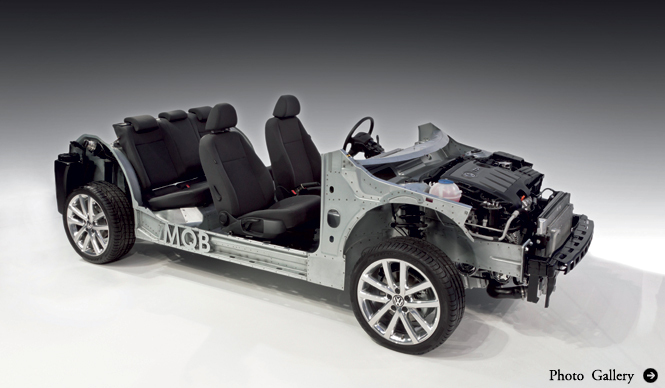
Volkswagen has announced its modular platform, "MQB" (Modular Transverse Matrix). It will first be adopted by the next-generation Golf and Audi A3.
Text by SUZUKI Fumihiko (OPENERS)
A Super-Brand Shared Platform Leveraging Group Strengths
The "MQB" announced this time can be described as a base that can be shared across a wide range of vehicle types, created as an architecture capable of long-term use. It is premised on sharing across an ultra-brand scale within the group, not only for the Volkswagen brand but also for Audi, SEAT, and Škoda. While it has already been decided that it will be first adopted in the next-generation Golf and Audi A3, its adoption is expected in a very wide range of Volkswagen brand models, including the Polo, Beetle, Golf, Scirocco, Jetta, Tiguan, Touran, Sharan, Passat, and CC. Although the distance from the pedals to the wheel center remains constant, it is a highly flexible platform that allows for changes in wheelbase, tread width, wheel size, and seat position according to the vehicle type.
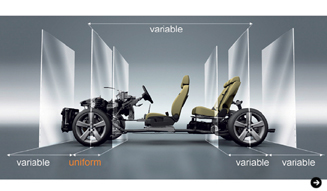
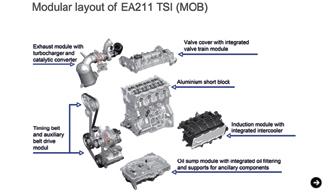
According to Volkswagen, this MQB will enable vehicles with different wheelbases and tread widths to be placed on the same production line. Simultaneously, the powertrains to be installed are also modularized. The new four-cylinder "EA211" engine (40 kW / 60 ps to 110 kW / 150 ps) with cylinder deactivation is the gasoline engine kit for MQB. For diesel engines, the "EA288" (66 kW / 90 ps to 140 kW / 190 ps) will be available. This system allows for a 90% reduction in the variation of conventional engines and gearboxes, and it can also accommodate natural gas engine models, hybrid models, and electric vehicles. Volkswagen has already announced the adoption of MQB for the electric vehicle "Golf Blue-e-Motion."
Precise Model Lineups Tailored to Needs Become Possible
In introducing MQB, Volkswagen states that it has thoroughly reviewed its parts. While the degree of weight reduction depends on the model and equipment, approximately 18 kg has been reduced by managing high-tensile steel panels in five different thicknesses in the underbody and using aluminum where appropriate. Furthermore, for engines combined with the MQB standard, weight reductions of over 21 kg are expected due to the aluminum crankshaft, 6 kg for the gearbox, over 10 kg for the interior components such as seats, dashboard beams, and air conditioning, and 3 kg for wiring. Overall, a weight reduction of 40-60 kg for the entire vehicle is anticipated. Volkswagen calculates that a reduction in vehicle weight, which influences 40% of fuel efficiency, means improved fuel economy for all MQB-utilized vehicles.
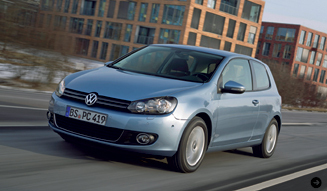
Plug-in hybrid version of the Golf
In addition, 20 safety and infotainment features, previously mainly equipped in luxury models, will now be uniformly available in MQB-equipped vehicles. For example, the next-generation Audi A3 and Golf are expected to utilize this advantage to improve collision safety with a system that prevents secondary impacts after the initial collision.
What will be most interesting to users is that high-quality cars will be sold at affordable prices, and that precise variations can be expected to meet market needs by leveraging the flexibility of the platform. Volkswagen is considering model development tailored to emerging countries like India, as well as in markets where it already holds a significant share, such as Europe, China, and the United States.
For vehicle types that MQB cannot cover, another plan based on a similar concept is underway. Audi is expected to adopt the modular platform "MLB," and Porsche will adopt "MSB." The "MSB" will be adopted by the next-generation Panamera, and it is anticipated that sharing with Bentley and Lamborghini will be considered in the future.