Toray: The Next-Generation Electric Vehicle Made with Advanced Materials
TORAY
Prototype Next-Generation EV Made with Advanced Materials
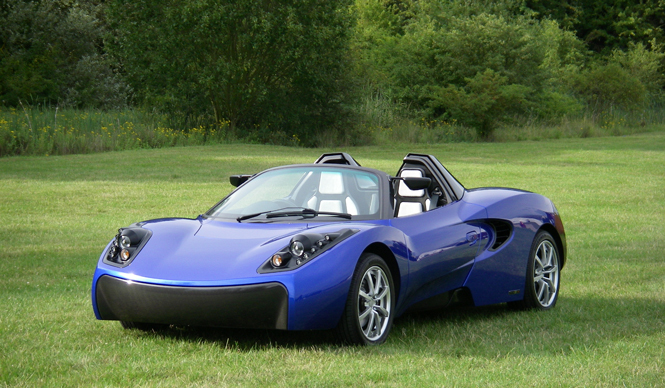
Toray has unveiled a next-generation EV (electric vehicle) concept car, the “TEEWAVE”AR1 (Toray Eco Efficient Wave Advanced Roadster 1), developed using its advanced materials and technologies, including carbon fiber composites.
Text by OPENERS
Achieving Both Significant Weight Reduction and High Safety
This concept car is a pillar of the Toray Group's green innovation strategy for automotive applications. By leveraging the company's cutting-edge material technologies in electric vehicles, which are expected to become the standard for automobiles, Toray aims to contribute to a low-carbon society.
The basic structure of the vehicle body employs a one-piece monocoque made from carbon fiber composites, offering both lightweight construction and high rigidity. Its key feature is the simultaneous achievement of weight reduction and excellent body rigidity (and high collision safety), which are typically conflicting requirements for automobiles.
Toray has invested 300 million yen in this project and commissioned Gordon Murray Design Ltd., a company led by Gordon Murray that handles the planning and design of environmentally friendly town cars in the UK, for the vehicle's styling, structural design, and production. Gordon Murray is renowned as a genius engineer who designed numerous successful F1 machines and is a specialist in carbon monocoques, underscoring Toray's commitment to this project. Incidentally, Toray states that the project's objective is to experimentally demonstrate how excellent a car can be realized in terms of weight reduction and safety using carbon fiber composites.
Vehicle Weight Reduced by Approx. 1/3, CO2 Emissions Cut by Approx. 9%
Based on this two-seater open model, calculations for a four-seater passenger car indicate that compared to a four-seater EV currently on the market made with conventional materials and structures, the body weight could be reduced from 1520kg to 975kg (approximately two-thirds), and CO2 emissions could be lowered from 14.9t to 13.6t (approximately 9 percent).
The monocoque produced with carbon fiber composites for this project ensures the necessary rigidity as a body structure on its own, and with only minor dimensional changes, it can be applied to other models such as four-seater hatchbacks. This suggests that Toray is considering its deployment in general passenger cars. If carbon fiber composites, previously used only in racing cars and some supercars, become widespread, it could bring revolutionary advancements in automotive environmental performance and safety. While the cost of carbon fiber composites remains higher than that of conventional steel, the potential for mass production and production efficiencies through integrated molding are also anticipated.
In the automotive industry, where increasing energy efficiency is paramount, the demand for advanced material technologies is growing. Toray aims to begin full-scale supply to the automotive industry around 2015.

“TEEWAVE”AR1
Body Size | 3975 x 1766 x 1154mm
Body Weight | 846kg
Range | 185km
Max Speed | 147km/h