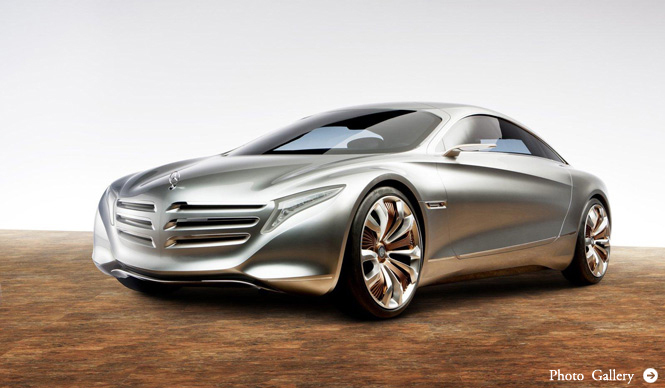
Mercedes-Benz F125! | A Revolutionary Hydrogen Fuel PHV Hinting at the Future S-Class (?)
Mercedes-Benz F125! | The Mercedes-Benz F125!
A Groundbreaking Hydrogen Fuel PHV Hinting at the Future S-Class (?)
At the Frankfurt Motor Show, DaimlerMercedes-Benzunveiled the F125!, a concept car that is a fuel-cell plug-in hybrid.
By Dai Matsuo
Technology Aimed for Introduction in 2025
The F125!, as the "F" prefix suggests, was unveiled as a Mercedes concept model. The number 125 signifies 125 years of the automobile, marking 125 years since Daimler and Benz invented it. It is a fuel-cell vehicle that uses hydrogen, which Daimler sees as the next-generation fuel, to power its motors.
Looking at its dimensions, the F125! can be said to be a model that hints at the future of the S-Class. According to Daimler, the technology is aimed for introduction in 2025, suggesting that the S-Class two generations from now might take this form.
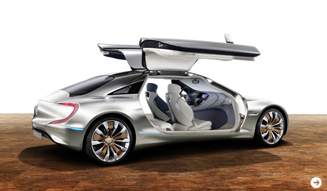
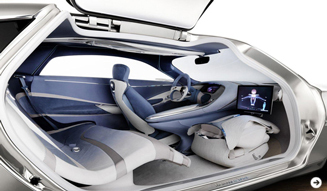
The notable fuel-cell technology generates electricity from hydrogen, driving four motors located near each wheel. The peak output from all motors is 230 kW, and with its plug-in hybrid system, the maximum cruising range is announced to be approximately 1,000 km. Naturally, CO2 emissions are zero. The exterior, befitting a concept car, features a striking design with gullwing doors. The body and chassis are a combination of FRP, carbon fiber, aluminum, and high-tensile steel, achieving a lightweight yet robust construction.
Hydrogen Storage Possible at Low Pressure of 30 atm?
A key challenge for fuel cells is how to store hydrogen. Normally, hydrogen needs to be stored at ultra-high pressures of around 700 atm. Furthermore, to withstand such pressure, tanks must be cylindrical, posing issues with space efficiency. The risk of explosion also raises concerns about using hydrogen in automobiles. The F125! addresses this by incorporating a storage alloy in an underfloor assembly, enabling it to store approximately 7.5 kg of hydrogen. Remarkably, it can store hydrogen at a low pressure of 30 atm, a seemingly dream-like technology. However, it turns out this is still theoretical. It will likely take some time before it becomes a reality.
However, Daimler Chairman Dieter Zetsche has explicitly stated that hydrogen fuel cells are the solution for when gasoline runs out. Therefore, if this hydrogen storage technology advances, the performance of the F125! will undoubtedly become a reality.
Mercedes-Benz F125
Body Dimensions | Length 4,998 x Width 1,980 x Height 1,430 mm
Wheelbase | 3,333 mm
Max Output (Front Motor) | 50 kW (68 hp)
Max Torque (Front Motor) | 75 Nm (7.6 kgm)
Max Output (Rear Motor) | 100 kW (136 hp)
Max Torque (Rear Motor) | 200 Nm (20.4 kgm)
Max Output (Total) | 230 kW (313 hp)
Max Torque | 3440 Nm (350.8 kgm)
Hydrogen Consumption | 0.79 kg/100 km (126.5 km/kg)
CO2 Emissions | 0 g/km
Cruising Range | Over 1,000 km
Drivetrain | All-wheel drive