Range Rover Sport Operable via Smartphone | Jaguar Land Rover
Jaguar Land Rover
Range Rover Sport Operable by Smartphone
Jaguar Land Rover has announced several prototype technologies from its research into future autonomous driving.
Text by HORIGUCHI Yoshihiro (OPENERS)
Technology for Automatic U-Turns
Autonomous driving technology is being rapidly developed, involving not only car manufacturers but also IT companies, driven by advancements in camera imaging and sensor analysis. Jaguar Land Rover is also developing cutting-edge technology at its research institute, and several of its achievements have now been announced.
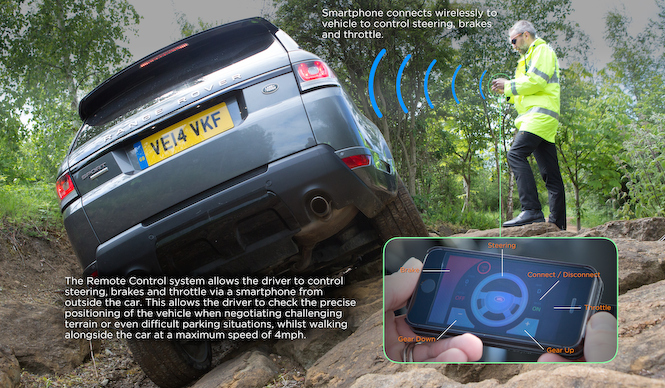
The first is a function that allows the car to be operated from outside via smartphone. Steering, acceleration, and braking can be controlled on the screen, with a maximum speed of 4 mph (approximately 6 km/h) and high/low gears available.
This function enables the driver to safely move the vehicle from outside, even on extremely rough terrain, while visually confirming obstacles and approach angles. The effective range for remote control is about 10 meters; operations are not accepted if the user is further away or too close, such as when inside the vehicle.
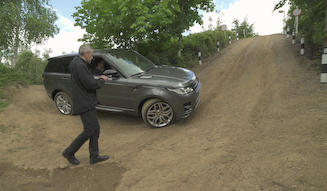
An experimental vehicle controlled by smartphone from outside the car
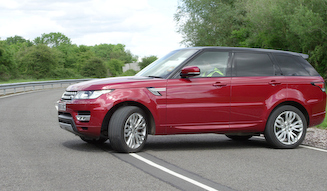
Demonstration of a full-auto U-turn
Furthermore, in urban areas, this function can be used to move the vehicle without the driver needing to get in, for situations where there isn't enough space to open the door on the driver's side. This usage is similar to the remote control function featured in BMW's latest "7 Series."
Another feature is the automatic U-turn function. In dead ends or tight parking spaces, the car uses camera and sensor information to fully automate braking, acceleration, and shifting, making steering adjustments until the vehicle completes a 180-degree turn. Of course, it constantly ensures safety by monitoring for other vehicles and pedestrians via sensors and cameras.
In addition, research is underway to improve the accuracy of sensors, which form the basis of autonomous driving, so they are not affected by the environment or weather conditions.