BMW's 7-Seater Minivan, the 2 Series Gran Tourer: A Closer Look | BMW
BMW 2 Series Gran Tourer
Optional Three-Row Seating is a Key Feature
BMW's 7-Seater Minivan, the 2 Series Gran Tourer: A Closer Look
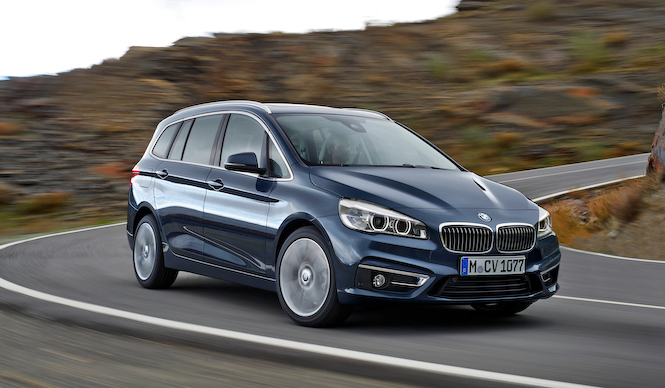
BMW has unveiled its premium minivan, a long-wheelbase version of its first C-segment front-wheel-drive model, the2 Series Active Tourer2 Series Gran Tourer, at its world premiere at the Geneva Motor Show. This family-oriented model, a first for a premium brand, has garnered significant market attention.
Text by SAKURAI Kenichi
BMW Takes on a New Challenge
The "2 Series Gran Tourer," announced by BMW at the Geneva Motor Show, is a truly challenging model. While it may not have garnered immense attention from the press, being a long-wheelbase variant of the earlier "2 Series Active Tourer," its character as BMW's first C-segment front-wheel-drive model with three rows of seating is certainly impactful in the market. It's undeniable that rival premium brands are closely observing BMW's unprecedented approach.
Historically, three-row minivans in the C-segment have been mainstream models from manufacturers like Volkswagen, Ford, Renault, and Peugeot. Premium brands, however, have entirely lacked such family-oriented minivan lineups. The reality of three-row seating being confined to larger minivans or SUVs even suggested that luxury cars had no place for the practicalities of family life.


While it might seem contradictory at first glance to call a large vehicle a minivan, the category is still defined as a "people mover." Even a full-size, seven- or eight-seater is still called a minivan. However, the unwritten rule seemed to be that compact minivans focused on families were the exclusive domain of mass-market manufacturers aiming for volume. This, to put it bluntly, also implies that the concept of "premium" was thought to be incompatible with the lifestyle-centric user base of families.
However, BMW, expanding its model range, has boldly challenged this category, taking a step ahead of rivals Mercedes and Audi. Audi, with Volkswagen in its group, faces challenges in easily introducing a three-row minivan. Meanwhile, Mercedes' attempt to enter the minivan stronghold of the North American market with theR-Classfailed to achieve expected results, effectively freezing the development of successor models for premium minivans.
BMW 2 Series Gran Tourer
Optional Three-Row Seating is a Key Feature
BMW's 7-Seater Minivan, the 2 Series Gran Tourer: A Closer Look (2)
Appealing to Families
The "2 Series Gran Tourer" emerges to fill that void. Depending on the reception and sales of this model, the minivan segment could once again become a hot market, particularly in Europe.
While the boom has subsided in North America and Japan, forming established categories, minivans are not yet as popular in European and emerging markets. It is in this context of various manufacturers' strategies that the "2 Series Gran Tourer" is attracting attention.
Conversely, from a user's perspective, the demand for such premium brand minivans is considerable, making their previous absence almost surprising.
In the Japanese market, even Volkswagen is differentiated as a premium brand simply by being an import. However, there is undoubtedly a significant demand for compact minivans with excellent usability from more luxurious brands. Ample interior and cargo space, even with a stroller, would be welcomed by parents, and the convenience of three-row seating is indispensable for families with young children.


While it may be a specific example, even in Japan, which faces declining birthrates, areas like Toyosu in Tokyo, with its numerous high-rise condominiums, have seen population growth, necessitating the construction of new elementary schools. Although declining birthrates are an undeniable fact, in certain locations, there are households with substantial incomes. It's easy to imagine a scenario where users who previously opted for premium cars based on "differentiation" or "lifestyle" are now transitioning to family life and feel some resistance to choosing conventional family cars.
While BMW didn't specifically develop this car to target the "Canary" demographic of Toyosu, it exemplifies that individuals with young children are not necessarily drawn to mass-market family car brands.
There has been a notable absence in the market of versatile vehicles chosen by users with considerable disposable income. In this regard, the significance of this model extends beyond simply being a long-wheelbase version of the "2 Series Active Tourer."
BMW 2 Series Gran Tourer
Optional Three-Row Seating is a Key Feature
BMW's 7-Seater Minivan, the 2 Series Gran Tourer: A Closer Look (3)
Ample Interior Space and Cargo Capacity
While the preamble has been somewhat lengthy, let's move on to introducing the "2 Series Gran Tourer." With dimensions of 4,556mm (length) x 1,800mm (width) x 1,641mm (height), its body is 214mm longer than the "2 Series Active Tourer" (4,342mm x 1,800mm x 1,586mm). The "2 Series Gran Tourer's" wheelbase of 2,780mm is 110mm longer than that of the "2 Series Active Tourer." This added length is entirely dedicated to interior space.
The optional two-seat third row can be folded flat into the luggage floor when not in use, meaning it doesn't compromise cargo capacity. The 5-seater model offers a luggage capacity of 645-805 liters, expanding to a maximum of 1,905 liters with the rear seats (electrically foldable) folded down in a 40:20:40 split. The three-row model provides a capacity of 560-1,820 liters. In both configurations, the floor becomes nearly flat when seats are stowed, easily accommodating large items.
The third-row seats have thin cushions, and the space underneath can be used for small items when occupied. The height from the seat to the ceiling is 900mm. While it might be a bit tight for adults, it offers sufficient headroom for children.


For reference, the headroom in the first row is 1,078mm, and in the second row, it's 1,003mm. The stadium-style seating, rising towards the rear, is designed to improve forward visibility for rear passengers. The second-row seats can also slide fore and aft, allowing for adjustments to optimize third-row legroom. Additionally, a fold-down table is integrated into the second-row seats (mounted on the back of the first-row seats).
To facilitate entry and exit to the third row, the D-pillar of the rear door is designed to be more vertical than in the "2 Series Active Tourer." While such unique exterior parts increase costs, prioritizing convenience and not using shared components is a commendable aspect.
The rear quarter windows are larger than those on the "2 Series Active Tourer." The presence of the C-pillar integrated into the body and the more rearward D-pillar allows for easy visual distinction between the two models from the side. This more upright D-pillar design contributes to a calmer appearance, differentiating it from the sportier "2 Series Active Tourer."
BMW 2 Series Gran Tourer
Optional Three-Row Seating is a Key Feature
BMW's 7-Seater Minivan, the 2 Series Gran Tourer: A Closer Look (4)
Latest Powertrains
The front face, with its characteristic BMW design and elongated headlights, is largely the same as the "2 Series Active Tourer," with a slight difference in the design of the lower air intake below the kidney grille. LED daytime running lights are standard, and like the significantly updated "1 Series", bi-LED headlights (full LED lights) are available as an option.
The L-shaped LED taillights, a signature BMW design, are shared with the "2 Series Active Tourer." The tailgate and bumper designs are also identical, meaning the only way to distinguish the two models from directly behind is by the emblem.


The engine lineup consists entirely of the latest generation of gasoline and diesel engines. The gasoline models include the "220i," powered by a 2.0-liter four-cylinder turbo engine producing 141kW (192ps) and 280Nm (28.6kgm) of torque, and the "218i," equipped with a 1.5-liter three-cylinder turbo engine delivering 100kW (136ps) and 220Nm (22.5kgm) of torque.
The diesel models feature a 1.5-liter inline three-cylinder turbo diesel engine in the "116d" producing 85kW (116ps) and 270Nm (27.5kgm) of torque. Additionally, there's a 2.0-liter inline four-cylinder turbo diesel engine in the "220d xDrive" with 110kW (150ps) and 330Nm (33.6kgm) of torque, and an enhanced version of the same 2.0-liter inline four-cylinder turbo diesel engine with 140kW (190ps) and 400Nm (40.8kgm) of torque. As the model names suggest, front-wheel drive is standard for most, with all-wheel drive exclusively available on the diesel-powered "220d xDrive."
Except for the "220d xDrive," which is exclusively paired with the latest 8-speed automatic transmission, all models come standard with a 6-speed manual transmission. A 4-cylinder gasoline or diesel engine can be optionally equipped with an 8-speed automatic transmission. The 3-cylinder engines, both gasoline and diesel, are paired with a 6-speed automatic transmission.
These latest powertrains, combined with excellent aerodynamics yielding a Cd value of 0.28, contribute to the "2 Series Gran Tourer's" impressive fuel efficiency of 16.1-16.9 km/liter (220i) in European testing. All models feature "Eco Pro Mode," which reportedly improves fuel economy by 20% compared to previous models. For reference, the most fuel-efficient "216d" diesel model with a 6-speed manual transmission achieves a remarkable 23.8-25.6 km/liter in European tests.
BMW 2 Series Gran Tourer
Optional Three-Row Seating is a Key Feature
BMW's 7-Seater Minivan, the 2 Series Gran Tourer: A Closer Look (5)
Abundant Features to Keep Children Entertained
The wealth of interior features is another essential aspect of the 2 Series Gran Tourer. BMW ConnectedDrive offers the latest entertainment functions and advanced driving assistance systems. Furthermore, the "2 Series Gran Tourer" introduces "myKIDIO," a new entertainment system app for rear-seat passengers, currently available only in Germany, which provides video and music content.
The "myKIDIO" app seamlessly connects with mobile devices, allowing playback of feature films, TV series, and audiobooks. This system, which links with Apple iPads and other tablets via the iDrive controller, can be viewed through the "2 Series Gran Tourer's" Control Display.
The app connects easily to mobile devices, and importantly, it allows for continuous playback from where you left off even after restarting the engine, making it highly practical and convenient. It's an ideal feature for keeping children entertained during long journeys.
In addition to the standard model, the 2 Series Gran Tourer is available in four trim levels: "Advantage," which includes dual-zone automatic climate control, Park Distance Control, cruise control with automatic braking, and a multifunction steering wheel; "Luxury," featuring exclusive exterior chrome accents, lightweight alloy wheels, and leather trim; "Sport Line," which builds upon the "Luxury" trim with dedicated alloy wheels and sport seats for a sportier interior and exterior; and "M Sport," equipped with an M leather steering wheel, M sport seats, and an M aerodynamics package.


Will a Minivan Boom Arrive in Europe?
It's easy to view the 2 Series Gran Tourer simply as a long-wheelbase version of the 2 Series Active Tourer with added third-row seating, but its practical advantages are immeasurable. While one might question, "Will I really use the third row?", the point is likely elsewhere.
The appeal of a car often lies in its "unnecessary" potential, such as off-road capability that may never be used or performance exceeding 300 km/h that might never be unleashed. The "2 Series Gran Tourer" is made more attractive by the imagined "just in case" or "in the event of" reserve it offers.
The updated Volkswagen "Sharan", also unveiled at the Geneva Motor Show, features enhanced safety equipment and improved fuel efficiency, along with convenient sliding rear doors. In contrast, this model uses conventional hinged rear doors. Just as Honda abandoned hinged doors for its urban minivan and introduced the low-profile "Jade," the minivan segment is diversifying. Honda's "Odyssey" stubbornly maintained its hinged doors.
From this perspective, the introduction of a minivan from BMW, a brand that champions "the ultimate driving machine," is highly significant. It's no exaggeration to say that the 2 Series Gran Tourer holds the key to the full arrival of a minivan boom in Europe.