Tokyo Motor Show On-Site Report | MINI
MINI
Tokyo Motor Show: On-Site Report
All-New MINI Makes Early Japan Debut
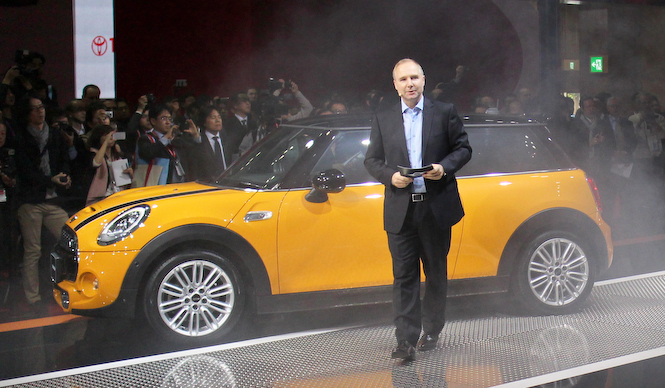
The new MINI, unveiled to the world from Oxford, UK, on November 18th, coinciding with the birthday of Sir Alec Issigonis, the father of the MINI.BMWThis third-generation model, the first to be handled by BMW, graced the MINI booth at the Tokyo Motor Show. A report from Tatsuya Otani, who attended the press conference.
Text by OTANI TatsuyaPhotographs by ARAKAWA Masayuki & OKADA Kazuyuki (OPENERS) & BMW
Retaining its Charm, with Updated Hardware
The All-New MINI Undergoes Full Model Changemade its Japan premiere at the Tokyo Motor Show. The fact that this third-generation model, since MINI came under the BMW umbrella, was unveiled in Tokyo just days after its global launch, speaks volumes about their expectations for the Japanese market.
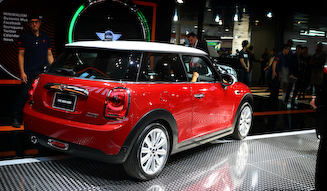
However, the styling of the third-generation MINI hasn't changed drastically from the second generation. The large, round twin headlights, the thin, flat roof, and the cabin with its large glass area – MINI's design icons – have all been carried over to the new model.
Nevertheless, the exterior dimensions have increased: 98mm in length, 44mm in width, and 7mm in height. The wheelbase has also been extended by 28mm, so the cabin space is surely more generous. Additionally, LED type headlights are now an option.
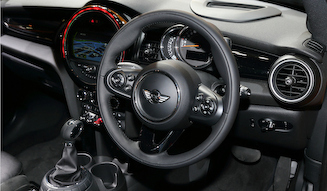
Inside, the most significant change is the installation of a large, up to 8.8-inch color display in the center of the dashboard, where the large speedometer was located in the previous model. This display can be used for climate control and audio management, and it also serves as the interface for the communication system with internet connectivity and the long-awaited built-in navigation system for the Japanese specification MINI. The infotainment controls utilize an interface fundamentally similar to BMW's iDrive. Another notable change is the relocation of the power window switches from the center console to the door panels.
On the hardware front, the platform has been completely redesigned, and it now features BMW's latest engines.
The engines include a 2.0-liter 4-cylinder turbo producing 192ps at 4,700-6,000rpm for the Cooper S, and a 1.5-liter 3-cylinder turbo producing 136ps at 4,500-6,000rpm for the Cooper. Both a 6-speed manual and a 6-speed automatic transmission are available, as before.
Some might be concerned about the 3-cylinder engine, but modern 3-cylinder units often have excellent balance, so there's little reason to shy away from the Cooper due to worries about "inherent 3-cylinder vibrations." Moreover, its performance is worthy of the Cooper name, with 0-100 km/h acceleration in 7.9 seconds (6MT; 7.8 seconds for 6AT) and a top speed of 210 km/h. On the other hand, it boasts impressive fuel efficiency, with a combined European fuel consumption of 19.2 km/ℓ (6MT; 17.8 km/ℓ for 6AT).
The third-generation MINI retains the original charm of agile handling and distinctive styling while introducing updated hardware and enhanced usability. It is expected to be introduced in Japan in the first half of next year. However, as global supply continues to struggle to meet demand, it remains uncertain whether this will be before or after the consumption tax increase.