January 26, 2015
Paris Dispatch | Volkswagen
Volkswagen
Meet the 7th Generation Golf!
2012 Paris Motor Showone of the most anticipated vehicles at the show.The 7th Generation Volkswagen Golf.Report on the Preview Announcement at Volkswagen NightFollowing this, Tatsuya Otani reports on the Golf's world premiere at the show. At first glance, the styling appears to inherit the traditional Golf aesthetic, but how does this automotive giant differ from its predecessors?
Text by OTANI TatsuyaPhotographs by MOCHIZUKI Hirohiko
Significantly Improved Sense of Quality
The 7th generation Golf has finally revealed itself to us.
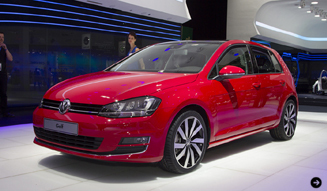
While the changes from the previous model may be subtle in photographs, seeing the car in person completely alters that impression.
Certainly, the overall proportions are unmistakably Golf. However, the finish of the body panels and the precision of the assembly make it seem like an entirely different model. It wouldn't be an exaggeration to say it looks a class, or even two classes, above previous Golfs.
First, let's focus on the sharp character lines. The lines flowing across the hood and down the sides of the body are so sharp they feel as if they could cut your finger if you touched them. Furthermore, even on the same body panel, flat surfaces are rendered perfectly flat, creating a taut, crisp impression.
Recently, at the announcement of the "up!" during his visit to Japan, Walter de Silva, Head of Design for the Volkswagen Group, stated, "Simplicity is the DNA of Volkswagen design." This sentiment is perfectly embodied here.
This approach, where design is simple yet product differentiation is achieved through the quality of materials and manufacturing techniques (a method also seen in Apple products like the iPhone), has been adopted for the Golf 7, following the up!.
Evolution Within
The Golf 7's distinctiveness isn't limited to its exterior. In fact, considering its significant impact on future Volkswagens, its interior deserves particular attention.
It is widely known that the Golf 7 was developed according to Volkswagen's new modular strategy, "MQB." This concept, which will be adopted for all future transverse-engine models from the company, aims to accelerate development and reduce costs by standardizing engine mounting angles and positions. Dr. Ulrich Hackenberg, who oversees Volkswagen Group's technical division, refers to the Golf 7, the first model under MQB, as the "master model" for this strategy. Consequently, the success of the Golf 7 is crucial for the future of Volkswagen as a whole.
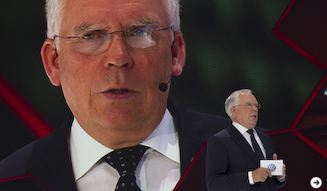
Dr. Ulrich Hackenberg
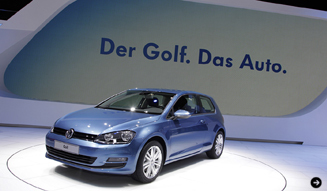
Volkswagen Golf
Another noteworthy aspect of the Golf 7 is its weight reduction technology. While there has been much discussion surrounding Volkswagen's press release claiming "up to 100kg weight reduction," Dr. Hackenberg stated, "we achieved a 27kg reduction in the white body alone, 20kg in the suspension components, and 27kg in the engine," lending support to their claims.
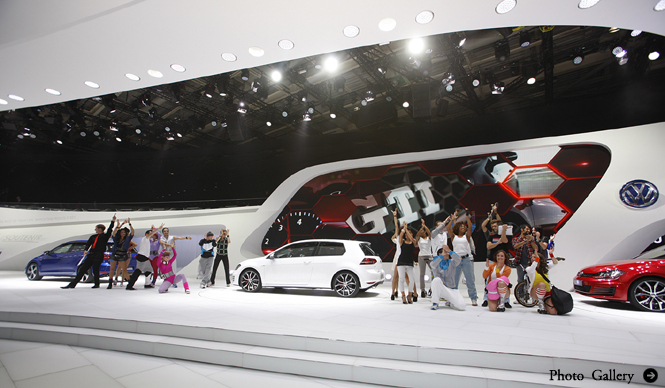
In terms of the lineup, the 1.4-liter TSI engine with cylinder deactivation technology serves as the core offering. However, the Paris Motor Show also showcased concept versions of the high-performance Golf GTI (with power outputs of 220ps and 230ps) and the Golf BlueMotion (equipped with a 1.6-liter TDI engine, achieving a fuel efficiency of 31.25 km/l).
With its advancements in design, quality, and performance, the 7th generation Golf is poised to pull ahead of its rivals. It is scheduled for release in Japan next spring.
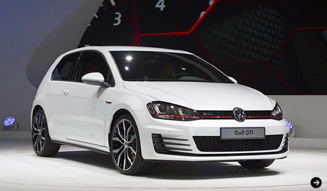
Golf GTI
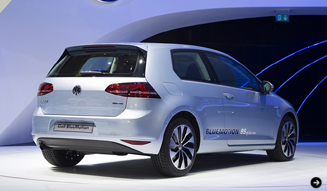
Golf Blue Motion