December 12, 2014
Beijing On-Site Report | BOSE
BOSE
BOSE, Cars, and China
BOSE, a brand that has established a strong presence in the car audio world, is exhibiting at the Beijing Motor Show and expanding its domestic sales network in China. How does Bose view the Chinese market? And how does China view Bose? Tatsuya Otani reports from both the car and home audio perspectives. This first installment introduces the little-known past and present of Bose as a car audio brand.
Text by OTANI Tatsuya
Photographs by OGAWA Yoshifumi
17 Years Ago in Boston
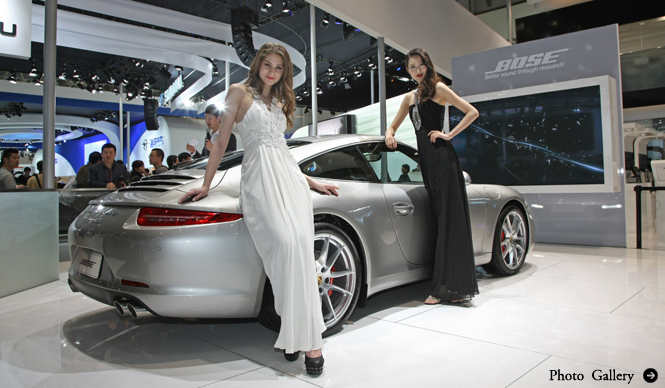
The Beijing International Motor Show featured exhibits not only from Chinese domestic automakers but also from premium car brands from Japan, the United States, and Europe. In one section, the audio brand "Bose" also had a booth. The company, which has recently become recognized as a leading brand in premium car audio, originally made its name as a home audio manufacturer with its innovative "901" speakers (released in 1968).
While Bose continues to offer a wide range of products including home theater systems, personal audio devices, and headphones, the Beijing show displayed not only the latest car audio for the Porsche "911" but also a variety of home audio equipment. Watching the Chinese visitors listen intently to the sounds emanating from these systems, the author couldn't help but recall an immersive "Bose experience" he had in Boston 17 years prior.──
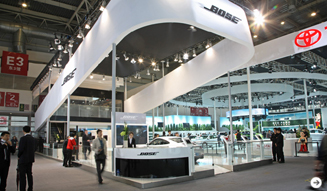
Bose, exhibiting next to the Toyota booth
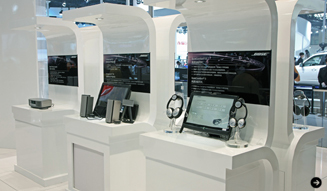
Speakers and headphones were also displayed in the booth
In 1992, Bose established Bose Automotive (then Bose International) in Japan as its base for car audio development and operations. Three years later, the author, then an automotive magazine editor, was invited to Bose's birthplace, Boston, where he had the opportunity to conduct a thorough interview with the company and its founder, Dr. Amar G. Bose.
By the 1980s, Bose had already established its reputation in the professional audio field, and its powerful sound from compact speakers suspended from ceilings was familiar to those living in Japan. The company's products were not only unique in style and sound but had also carved out a distinct niche as "high-tech audio systems" utilizing psychoacoustics and room acoustics. The journey to visit Bose's headquarters was, needless to say, both stimulating and deeply moving.
Is Car Audio a Compromise?
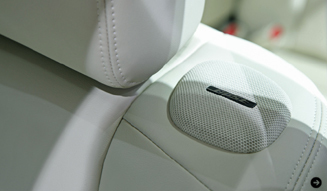
What was particularly impressive was Bose's approach and dedication to creating car audio systems. They not only designed car audio specifically for each vehicle model but also developed a method of collaborating with automakers to design speaker placement, space, and surrounding structures to achieve optimal sound.
"A car is a convenient space for enjoying audio."
Dr. Bose told the author.
"After all, the relationship between the listener and the audio system is predetermined. From the perspective of an audio engineer, this is a significant advantage not found in home audio."
To the author, who had previously considered car audio to be merely a product of compromise, Dr. Bose's philosophy was both original and, above all, inspiring. It also made perfect sense that Bose, which had been particularly focused on the relationship between direct and reflected sound (the aforementioned 901 used a 1:8 ratio of direct to reflected sound, hence one speaker in front and eight in the rear) and sound image localization, would venture into car audio, where the listener and speaker positions are fixed.
BOSE
BOSE, Cars, and China (2)
A Style of Integration with Automakers
While collaboration between automakers and audio manufacturers in developing audio systems is common today, this approach was first adopted by Bose when they developed the car audio system for Cadillac in the early 1980s. Bose was a pioneer in this field as well. Another characteristic of Bose's car audio development is its truly integrated product development with automakers.
As mentioned earlier, Bose established Bose Automotive in Japan in 1992, primarily as a "forward operating base" for developing car audio with Japanese manufacturers such as Honda, Nissan, and Mazda. Furthermore, Bose dispatched its own engineers to these locations to work alongside automotive designers in creating car audio systems.
At the time of Bose Automotive's establishment, Mike Rosen, a skilled engineer, was stationed in Japan. His successor, Richard Miller, is now based in China as the head of the technical department at Bose Automotive China.
When the author asked Miller, whom he met for the first time in Beijing, "As a native American, do you find living in China inconvenient in any way?", he received the following reply:
"Certainly, American and Chinese cultures are different. Just as American and Japanese cultures are different. However, I don't find it inconvenient. I've blended in here and am enjoying my life in China."
His unreserved expression was characteristic of an engineer with a clear conscience.
A Preference for 2 Decibels
Next, the author asked Miller about the sound preferences of Chinese consumers.
"China has a very rich musical history, and many people enjoy music here. As you pointed out, sound preferences do vary by country. For example, Americans tend to like bass, and Japanese tend to prefer treble. On the other hand, Chinese people seem to prefer a sound with a stronger mid-range. However, this difference is at most about 2 dB (decibels)..."
dB is a unit used to measure sound pressure, and a 2 dB difference is extremely small, comparable to the slight variations between individual products. The author couldn't help but feel a deep sense of awe at Bose's meticulousness in discerning such a subtle difference.
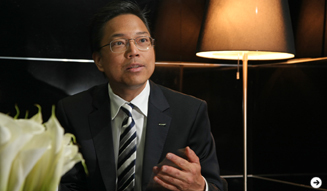
However, this does not mean that Bose's sound differs by country. John F. Moore, General Manager of Bose Automotive China, emphasized:
"The quality of Bose products is exactly the same in every country. Bose Automotive's standards are universal."
These standards are cultivated through the thorough research and investigation conducted by engineers like Miller in various regions. And one day, their efforts will surely bear fruit, and the Bose name will become widely recognized in the Chinese market, just as it did in Japan...