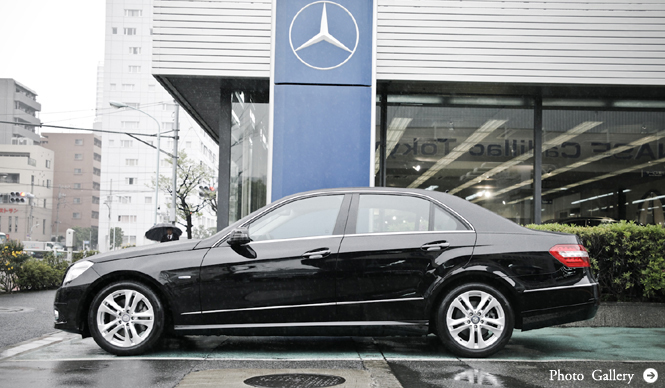
Mercedes-Benz E 350 BlueTEC Avantgarde: Long-Term Test, Part 1
Mercedes-Benz |
Mercedes-Benz E 350 BlueTEC AVANGARDE | Part 1
Reporting Begins on the Talked-About "BlueTEC" Model! (1)
What image comes to mind when you think of diesel cars? If you picture them as evil polluters spewing soot and harmful nitrogen oxides (NOx), that's likely a relic of the past.Mercedes-BenzThe "BlueTEC" purification system developed by Mercedes-Benz uses an innovative catalytic system to remove 99% of soot and injects a urea-based solution into the exhaust gas to generate ammonia. This process reduces over 80% of NOx in the exhaust to harmless nitrogen and water. It's a groundbreaking system that masterfully purifies the drawbacks of diesel cars. For our long-term report, the editorial team has chosen the E 350 BlueTEC AVANGARDE, equipped with this very BlueTEC system, as our fourth test vehicle.
Text by OPENERSPhotos by Takahiro Igarashi

Car 4
E350 BlueTEC AVANGARDE
E350 BlueTEC AVANGARDE
Part 1
Introduction Date: April 22
Purchase Price: 7.98 million yen
Europe vs. Japan: Differing Perceptions of Diesel Cars
In Europe, diesel cars are commonplace, with their high thermal efficiency and economy, even accounting for over half of new car registrations in countries like France. In recent years, technological innovations such as ultra-low particulate matter (PM) diesel vehicles, which dramatically reduce PM emissions, and super clean diesel vehicles with advanced NOx after-treatment systems that significantly lower harmful exhaust substances, have maintained their stable popularity as eco-friendly cars with a reduced environmental impact.
But what about Japan? With regulations on diesel engines that emit soot and NOx often highlighted, the image of diesel being harmful to human health and detrimental to the environment is so strong that many people harbor an excessive aversion to it.
With the pressing issue of global warming, it's a missed opportunity not to utilize diesel engines. If the harmful substances in exhaust gases can be effectively removed, they are excellent eco-cars that pollute the air less, emit less CO2 than gasoline engines, and offer better fuel economy.
In August 2006, Mercedes-Benz introduced its first clean diesel vehicle, the E 320 CDI, to Japan, a market with a strong negative perception of diesel. Approximately 4,000 units of its predecessor, the clean diesel model, were sold. This represented 20-30% of E-Class sales. While this proportion is not high compared to Europe, the expectation for a new car option presented by Mercedes, and the significance of Mercedes' bold decision, must have been considerable. The fact that several manufacturers are now moving to introduce diesel cars in Japan can also be attributed to Mercedes' success in raising awareness of clean diesel.
At the time, the common rail system garnered attention. This structure precisely injects a suitable amount of high-pressure fuel into each cylinder via injectors at the right timing. Due to the high fuel injection pressure, fuel particles become finer, eliminating incomplete combustion in the core and suppressing the generation of particulate matter. Now, let's explore the true value of Mercedes' "BlueTEC," an evolution beyond its predecessor's clean diesel technology.
How Popular is "BlueTEC" for Neutralizing Harmful Substances?
Mercedes' "BlueTEC" system virtually eliminates soot and reduces 80% of NOx to harmless nitrogen and water. The editorial department has welcomed the Mercedes-Benz E350 BlueTEC AVANGARDE, equipped with this innovative system that overcomes the drawbacks of diesel cars, as a long-term test vehicle. Focusing on clean diesel as one of the cutting-edge eco-car technologies alongside hybrid cars and pure EVs, we intend to comprehensively evaluate its fuel economy, ride comfort, and other aspects in various daily scenarios, alongside the hybrid Prius already under our review.

So, what are users' reactions to "BlueTEC"? Tetsuharu Shike, who assisted with the delivery at Yanase Tokyo Branch, shares his insights.
"Many customers are showing significant interest. While this particular customer chose the sedan, the vast majority of E-Class buyers opt for the wagon, and 80% of those are diesel models. Perhaps it's the synergistic effect of the new wagon's release coinciding with the buzz around BlueTEC. Furthermore, the fact that it's eligible for tax reductions might be encouraging purchases of BlueTEC-equipped vehicles."


Mercedes-Benz |
Mercedes-Benz E 350 BlueTEC AVANGARDE | Part 1
Reporting Begins on the Talked-About "BlueTEC" Model! (2)
Has the Japanese Resistance to "Diesel" Been Overcome?
Nevertheless, the perception of "diesel equals bad" is still stronger in Japan than in Europe. Do you anticipate that many people still feel resistance?
"Indeed, it's difficult to change the negative views on diesel held by older generations. Younger people, who don't have preconceived notions, tend to show more active interest. Those who have lived in Europe, in particular, accept it more readily. However, the quietness has improved significantly, so those familiar with older diesel cars do comment, 'It's changed,' or 'Today's diesel cars are amazing.' Beyond awareness, our biggest challenge right now is the price. The catalytic converters and common rail systems are still expensive components, making the engine itself inherently costly. If sales volume increases, we could potentially lower the price... Perhaps, rather than focusing on fuel efficiency or cost, many people are choosing vehicles with environmental features as a way to signal their commitment to environmental responsibility."
It's likely that many who purchase the Mercedes brand hold a certain social standing. In that context, Mr. Shike's point about signaling environmental consciousness is understandable.


It Seems Buying BlueTEC Now is Advantageous
Now, regarding the price, which is a point of concern. How much does it actually cost? First, the E350 BlueTEC AVANGARDE has a base price of 7.98 million yen. Additionally, through the eco-car tax reduction program, a subsidy of 402,000 yen is available, offering a 100% tax exemption.

A "New Car Purchase Subsidy Program" is in effect until the end of September 2010. For new cars that meet the Heisei 17 (2005) emission standards of 75% reduction and the Heisei 22 (2010) fuel economy standards of +15% or more, a subsidy of 100,000 yen is provided without requiring the scrapping of an older vehicle. If an older vehicle is scrapped, the subsidy increases to 250,000 yen.
Therefore, for a new car purchase without scrapping an old vehicle, the total incentive amounts to 502,000 yen, and with the scrapping of a vehicle over 13 years old, it reaches 652,000 yen. In monetary terms, these subsidies are quite substantial and reassuring when considering a purchase.
Various Approaches to Environmental Performance: What's Next?
The E350 BlueTEC AVANGARDE was delivered today and will now begin its role as a long-term test vehicle. So, what does the future hold for Mercedes-Benz's environmentally conscious vehicles?Mercedes-BenzMr. Shike explains, "BlueTEC models will continue to be introduced in the E-Class and M-Class, among others. Clean diesel vehicles offer a particularly smooth driving experience on highways. Those who test drive them are invariably impressed and clearly recognize their benefits. While there are various environmental technologies, some face challenges with infrastructure development or excessive costs. I don't believe a single system, whether hybrid, diesel, electric, or hydrogen, will dominate. Mercedes, and indeed the Japanese automotive scene, will likely pursue a multi-faceted approach."
"The E-Class, M-Class, and others will continue to see BlueTEC introductions. Clean diesel cars offer a noticeably smoother ride on highways. Test drivers are always surprised and clearly feel the advantages. While there are various environmental technologies, some still face issues with infrastructure or excessive costs, and I don't think one system will prevail over others – be it hybrid, diesel, electric, or hydrogen. Mercedes, and the Japanese automotive industry as a whole, will likely continue to develop across all fronts."
In today's era of diverse environmental technologies, we have arrived at a time where we can compare the pros and cons – design, price, fuel economy – and choose the best option. The editorial department plans to conduct comparative tests on fuel economy and ride comfort with the Prius, another environmentally conscious vehicle currently undergoing a long-term report.
Detailed Initial Costs for the E 350 BlueTEC AVANGARDE
|
 E350 BlueTEC AVANGARDE | E 350 BlueTEC AVANGARDE Body | Length 4,870 x Width 1,855 x Height 1,455mm Wheelbase | 2,875mm Engine | 2,986cc DOHC V6 Max Output | 155kW [211ps] / 3,400rpm Max Torque | 540Nm [55.1kgm] / 1,600–2,400rpm Transmission | Electronically Controlled 7-Speed AT Price | 7.98 million yen |
*Registration and related fees may vary by dealership.