NISSAN GT-R Spec V | NISSAN GT-R SPEC V | LONG TERM TEST Vol. 5 01
NISSAN GT-R Spec V | LONG TERM TEST Vol. 5
First Time on the Circuit 01
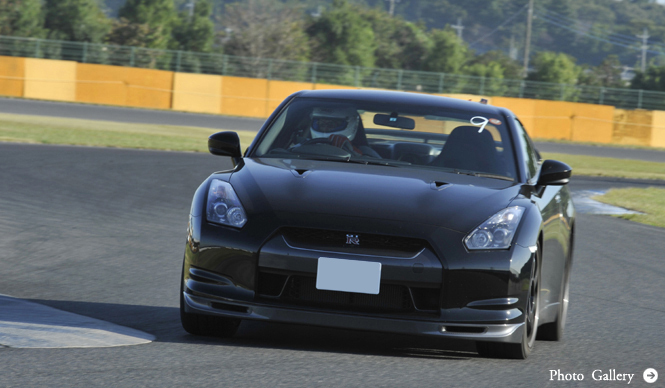
This is the fifth installment in our long-term report series, where we've explored the allure of the Nissan GT-R under the theme of "Life with the GT-R Spec V." For this fifth installment, we brought the Spec V to Tsukuba Circuit Course 1000 to participate in a driving lesson hosted by Engine magazine. The two OPENERS automotive journalists who experienced driving the GT-R on what can be considered its natural home ground, the circuit, discuss the charms of the Spec V.
Text by OPENERSPhotos by Satoshi Kaminaga
Heading to the Circuit
—First, what was the program for today?
Reporter A—We drove on Course 1000, a 1000-meter mini-circuit within Tsukuba Circuit in Shimotsuma City, Ibaraki Prefecture. While 1000 meters isn't a long circuit, the program involved 12 laps of the course, with breaks, repeated for four sets.
Comparison with the First-Generation GT-R
—Reporter B, you've experienced circuit driving with the GT-R shortly after its debut, haven't you? How did the new Spec V compare to the original?
Reporter B—The first thing I noticed was that while previously it was difficult to follow the intended line, and understeer tended to occur easily without careful throttle control, the Spec V had none of that. The vehicle's stability was exceptionally improved.
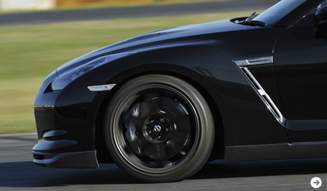
Reporter A—Yes, I believe this was achieved through improved suspension performance due to suspension tuned for the circuit, weight reduction, reduced unsprung weight thanks to the carbon-ceramic brakes, and the adoption of higher-performance tires. This was particularly evident in the final corner, wasn't it?
—The brakes seem to have changed significantly.
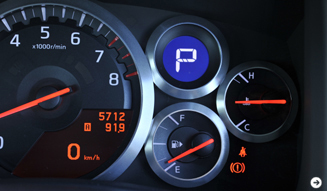
Reporter B—That's right. The disc material is now carbon-ceramic, which is lightweight, highly durable, and heat-resistant. This is a major difference compared to the previous GT-R, but unfortunately, on Course 1000, where we only reached about 120 km/h at the end of the straight, we couldn't really feel the difference in braking power. Also, on a mini-circuit with many corners and short straights, frequent shifting is necessary, which can raise oil temperatures. There were times we had to drive slowly for cool-down. Moreover, the ambient temperature was quite high that day, and under such conditions, a protective function automatically engages, preventing gear shifts. This is a safety feature.
Reporter A—Regarding the engine, I don't think we were able to fully utilize its power on the 1000-meter course. We'll have to test that at the Fuji Speedway Grand Prix Circuit, which is planned for the future.
NISSAN GT-R Spec V
NISSAN GT-R Spec V
—I see, so it's a car designed for serious circuit driving.
Reporter B—Kazutoshi Mizuno of Nissan Motor Co., Ltd., who led the development, was once a "race engineer" who developed Le Mans racing cars. In a sense, the Spec V was created to break lap records; it is truly a "car for driving on the circuit." Therefore, the excitement level on the circuit is extremely high.
Reporter A—Exactly. So, conversely, it's certainly not suited for public roads. While it glides over the flat surface of a circuit, it transmits even the smallest road imperfections directly to the occupants on public roads, making only its negative aspects stand out. Of course, it can be used for daily driving, but this experience has reaffirmed that the Spec V's true home ground is the circuit.