NISSAN GT-R Spec V | The 4th Installment of the Long-Term Test
NISSAN GT-R Spec V | 4th Installment
The 2,000km Service
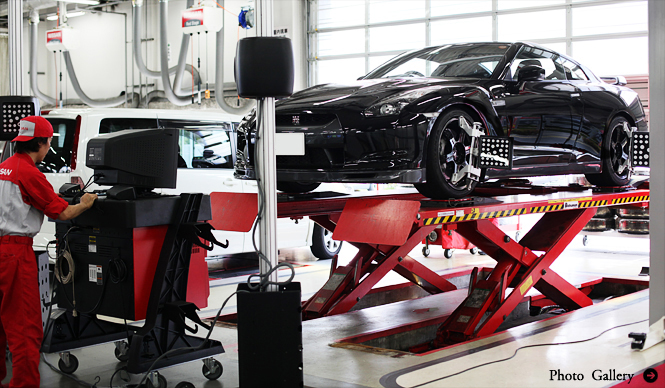
This is the fourth installment of our "LONG TERM TEST" of the Nissan GT-R Spec V. This time, we focus on the first after-sales service: the "2,000km inspection." We report on the details of this service, conducted at the High Performance Center, "Nissan Prince Tokyo Sales, Kameido Store," staffed by technical experts specially trained for the Spec V.
text by OPENERSphoto by Jamandfix
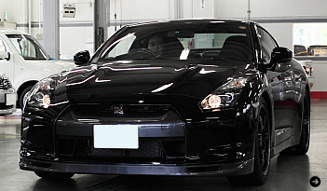
Car 1
Nissan GT-R Spec V
NISSAN GT-R Spec V
4th Installment
Delivery Date: February 13
Purchase Price: ¥15,750,000
Mileage: 5,041km
This Period's Fuel Economy: 4.79km/ℓ
Overall Average Fuel Economy: 5.00km/ℓ
A Specialist's Inspection, Tailored for the Spec V
The Spec V, already exceptional from its purchase with its limited sales channels at just seven dealerships nationwide, continues to impress with its unique "2,000km inspection." First, let's look at the inspection items. Common to the standard GT-R, the "base model," are wheel alignment measurement and adjustment, and engine and transmission settings. To this are added the Spec V's specific inspection items.
These include measurement of the brake rotors, visual inspection of the brake pads, checks for coolant leaks, and inspection of the titanium muffler's mounting. The primary reason for these additional checks is the use of dedicated parts like the carbon-ceramic brakes and titanium muffler. However, even for the shared inspection criteria with the standard GT-R, stricter judgment standards are applied. Furthermore, only specialists who have undergone special training are permitted to handle Spec V inspections. At the Kameido store, Mr. Hiroaki Yamada, a Spec V certified technical staff member with racing mechanic experience and a deep understanding of circuit driving, performed the approximately eight-hour inspection. Let's delve into the details.
Service Log
Nissan's First Carbon-Ceramic Brake Inspection
The inspection began with a visual check after removing the underbody panels. After confirming the absence of water leaks, oil leaks, or loose parts, the process moved to the next stage.
Next was the inspection of the carbon-ceramic brakes, a key feature of the Spec V. After removing the tires, the rotors were checked for cracks on the surface and inner surfaces, as well as rust on the bolts. First, a specially made cover for the Spec V was attached to avoid impacting the carbon material. This is because carbon is particularly sensitive to external impacts. Once the tires were safely removed, the frequency measurement of the carbon-ceramic brakes commenced. A specialized tool was inserted between the brake pads and rotors, and with the pads set to a free state, an accelerometer was attached to the rotor, which was then tapped with a hammer to measure its frequency.
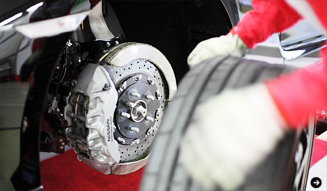
A cover is attached to protect the carbon before removing the tire.
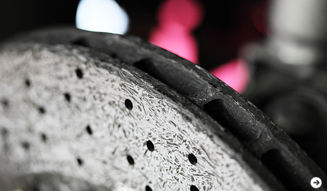
The Spec V's signature feature: carbon-ceramic brakes.
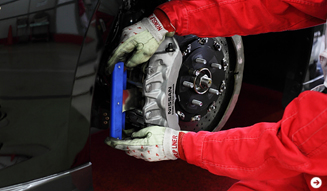
A specialized tool is inserted between the brake pads and rotor.
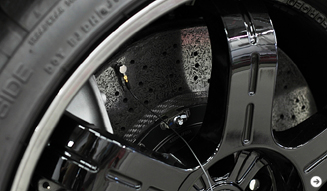
An accelerometer is attached to measure frequency.
This frequency value changes with the driver's patterns and habits. However, using the new rotor's frequency as a reference, a deviation within 100 is considered acceptable. Furthermore, the sound produced during the frequency measurement was monitored via headphones. Even if the frequency is within the acceptable range, a dull thudding sound indicates a potential issue, possibly due to cracks. Ultimately, the specialist's eyes and ears are the most reliable tools. Finally, the remaining thickness of the brake pads was measured (a warning light illuminates when the remaining thickness drops below 3.5mm). This was done for all four wheels.
This process alone took about three hours, illustrating the meticulous nature of this inspection. Before proceeding to the wheel alignment measurement and adjustment, Mr. Yamada took the car for a short drive to return the suspension to its normal state after being lifted.
Wheel Alignment Adjusted to Your Preference
After its drive, the Spec V was ready for wheel alignment checks, performed using an alignment tester that employs laser beams. Each wheel was placed on a turntable, and reflective markers were attached to each wheel to measure the pre-adjustment values. Then, while ensuring zero deviation between the left and right sides, the camber angle and toe angle were adjusted to the owner's preferred settings. For example, for "primarily circuit driving," the camber would be set more aggressively (increased angle) with toe-out (negative), while for "primarily city driving," the camber would be more upright (closer to vertical) with toe-in (positive).
As a side note, circuit-oriented settings enhance cornering agility, while city-driving settings improve straight-line stability. In the former case, increased camber can lead to more pronounced uneven tire wear compared to the city-driving setup. As the OPENERS Spec V is primarily used as a daily driver, we opted for the "city driving" specification this time, with a reduced camber angle and a positive toe angle.
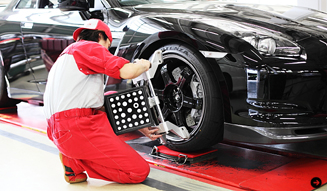
Reflective markers are attached to each wheel.
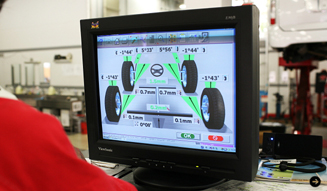
Camber and toe angles are adjusted while viewing the monitor.
Camber Angle (Eliminating left-right variance, bringing it closer to vertical)
Front (Right) | Before: -1°56’ / After: -1°44’
Front (Left) | Before: -1°49’ / After: -1°44’
Rear (Right) | Before: -1°42’ / After: -1°43’
Rear (Left) | Before: -1°49’ / After: -1°43’
Toe Angle (Eliminating left-right variance, setting to positive)
Front (Right) | Before: 0.1mm / After: 0.7mm
Front (Left) | Before: 0.4mm / After: 0.7mm
Rear (Right) | Before: 1.6mm / After: 0.2mm
Rear (Left) | Before: -1.1mm / After: 0.2mm
As you can see from the table, the values, which showed considerable variation between the left and right wheels before adjustment, are now perfectly aligned. After the adjustment, driving the car revealed a noticeable improvement: the steering felt more stable around the neutral position and straight-line stability seemed enhanced, possibly due to the increased contact patch of the front tires with the reduced camber angle. The steering feel also became slightly more refined, with a pleasant, appropriate weight. It was a welcome change.
Next was the transmission setting. This process is fully automated via computer. Essentially, the car selects each gear one by one and adjusts it to its optimal value based on instructions sent from the computer. It's truly a cutting-edge high-tech car! While we were marveling at this, the transmission inspection was completed. Finally, checks for coolant leaks, titanium muffler heat deformation and sagging, and light illumination were performed, concluding all tasks.
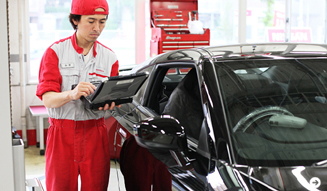
Transmission Setting
Incidentally, unlike with some other models, this 2,000km inspection is complimentary. Witnessing such thorough work makes one feel like they've truly gotten their money's worth. As I drove back to the office on the metropolitan expressway after leaving the dealership, I noticed that the car felt smoother and more composed overall, from the shift feel to the steering response, as if any rough edges had been polished away. This feeling of having received excellent value only grew stronger.
