April 15, 2015
Long-Term Test | Is the “Spec-V” a “Circuit Car,” or Not!?
NISSAN GT-R Spec V The 2nd Installment
“Spec-V”: A Circuit Car, or Not!?
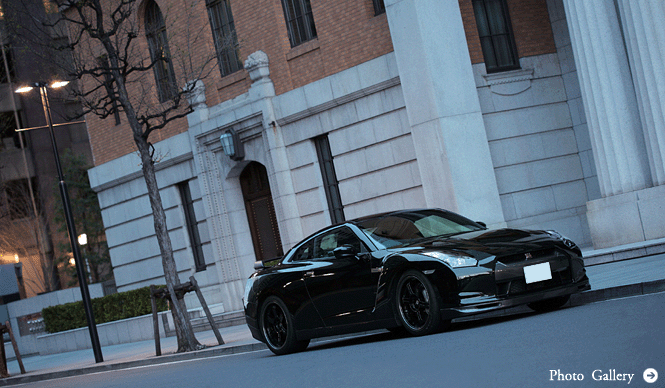
It’s been three months since the "Nissan GT-R Spec-V" arrived at our office on February 13th. In that time, the odometer has easily surpassed 2,000km, meaning the "running-in period" is well and truly complete.
This second installment will cover the running-in period and the differences between the "Nissan GT-R Spec-V" and the standard "Nissan R35 GT-R," as experienced during the car's initial phase.
Text by OPENERSPhoto by JamandfixSpecial Thanks to PF LINK SYSTEMS
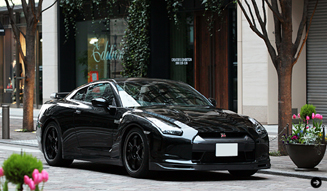
The very first car
The Nissan GT-R Spec V
NISSAN GT-R Spec V
The 2nd installment
Date of introduction: Feb. 13, 2009
Purchase price: ¥15.75 million
Running distance: 2,057km
Fuel consumption this time: 5.12km/ℓ
Total fuel consumption: 5.02km/ℓ
The "Running-In" Period
When you get a new car, the first thing you'll likely do is "run it in."
It must be noted that the GT-R's "VR38DETT" engine is assembled by hand, piece by piece, by technicians with "hands of God" in a clean room. This means its engine is produced with the same meticulous care as a racing engine, making it far more sensitive than most robot-produced engines.
Therefore, a "running-in" period isn't always strictly necessary for a car with such a sensitively produced engine. However, this 3.8-liter engine produces an immense 485ps. The "Spec-V" in particular is equipped with a "High-geared boost" system. This feature temporarily increases supercharging pressure, generating greater torque in the 3,500-5,000rpm range. Consequently, extra attention is required during the running-in process.
There are various opinions on "running-in." It's no exaggeration to say that for every ten drivers, there are ten different methods.
So, what approach did we take? We sought advice from Mr. Kazuaki Mizuno, the lead Nissan developer most experienced with the "GT-R Spec V." Following his guidance, we kept the engine rotation below 3,000rpm until the odometer reached 2,000km.
Below 3,000rpm, the "GT-R Spec V" accelerates with a calm demeanor, so much so that you might forget it houses a potent 485ps engine.
That said, its extraordinary engine, capable of generating a tremendous 60kgm of torque at 3,200rpm, avoids any uncomfortable dynamic sensations within Japan's traffic conditions, where the maximum permitted speed is 100km/h.
Having experienced the "running-in" of new cars several times, I must say this was the most stress-free.
Naturally, I avoided any sudden inputs during the "running-in" period. I also made a point to actively engage the gears within a tolerable RPM range, ensuring the transmission operated smoothly.
The most striking aspect regarding the transmission is the complete absence of the actuator noise previously heard from the rear transaxle. This observation applies not only to the "Spec-V" but also to the base "09 model" I test-drove.
Even more remarkable is the dramatic improvement in body rigidity.
With the "Spec-V's" specific tuning, the suspension is notably firmer. Specifically, the increased spring rates of the dampers and springs, combined with the enhanced body rigidity, allow the suspension's full potential to be realized.
Spec V.
Of course, this impression was formed while driving medium-speed corners on the metropolitan expressway at a "daily" pace. I intend to explore this further in the near future, perhaps on Hakone's roads or a circuit.

Unexpectedly Comfortable Ride Quality
While we're on the subject of suspension, let's discuss the ride quality, which I imagine many of you are curious about.
In 2007, at the debut of the new "GT-R" model, Mr. Kazutoshi Mizuno (mentioned earlier) spoke of the "yet-to-be-announced" "Spec-V" as follows: "This is a special model that would be stored near the circuit for weekend drives." Honestly, I had no expectations for a comfortable ride; in fact, I had resigned myself to its absence. However, upon driving it the day it was delivered, I found that the comfort was surprisingly acceptable for town driving at a reasonable speed.
Certainly, the "full-bucket-shaped" Recaro seats are somewhat firm with noticeably thinner cushioning. However, the highly sensitive suspension allows for supple leg movements, which is likely a contributing factor.
Furthermore, the reduction in unsprung weight should significantly enhance ride comfort. This 7kg weight saving per wheel is achieved through the custom-made Rays wheels and carbon-ceramic brakes.
Notably, the electronically controlled dampers found in the base model are omitted in the "Spec-V." You can imagine the ride comfort by comparing it to the "R" mode—the firmest setting—on the base car.
In terms of comfort, it's highly appreciated that the grating noise heard in the first model has been completely eliminated. Along with the improved body rigidity, the sensitivity of the internal equipment should also be upgraded.
Finally, I'd like to mention a few points observed during daily driving. First, regarding tire pressure. The "GT-R" constantly monitors tire pressure, which can be viewed on the multi-monitor inside the car while driving. I noticed that the air pressure in the left front tire was set slightly lower than the other three, but for the "Spec-V," the right front was set lower.
Additionally, in the first model, the water and transmission temperatures rose gradually, requiring some time to reach their defined values. In contrast, the "Spec-V" reaches its defined temperature of 80 degrees much more quickly.
It makes little difference whether it's the basic model or the "Spec-V" in the fact thatthe GT-R advances each year, without altering the engineers or test drivers involved in its development.
This fact alone conveys Nissan's incredible passion for the "GT-R."
Related articles: NISSAN GT-R Spec V The 2nd Installment (Japanese version)