April 15, 2015
NISSAN GT-R Spec V | The Nissan GT-R Spec V | 2nd Long-Term Test | Not a Circuit Special!?
NISSAN GT-R Spec V | The Second Installment
Not a Circuit Special!?
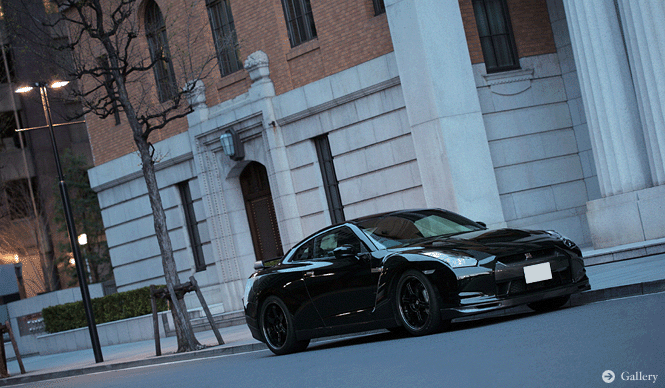
Three months have passed since the Nissan GT-R Spec V arrived at our editorial department on February 13th. During that time, the odometer has easily surpassed 2,000 km, and the break-in period has been successfully completed. In this second installment, I'd like to discuss the break-in process and the differences between this car and the very first R35 GT-R I drove, based on that experience.
Text by OPENERSPhoto by JamandfixSpecial Thanks to PF LINK SYSTEMS
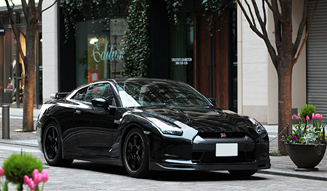
Car 1
Nissan GT-R Spec V
NISSAN GT-R Spec V
Part 2
Delivery Date: February 13
Purchase Price: ¥15,750,000
Mileage: 2,057 km
Fuel Economy This Time: 5.12 km/ℓ
Overall Average Fuel Economy: 5.02 km/ℓ
Regarding the Break-in Period
When you get a new car, the first thing everyone does is the "break-in." By the way, as you may know, the VR38DETT engine that powers the GT-R is assembled by hand, one by one, by master craftsmen in a clean room, a process that requires almost the same care as building a racing engine. This means its manufacturing precision is overwhelmingly higher than that of most engines produced on an assembly line by robots.
However, this power unit is an engine that squeezes out an astonishing 485 ps from 3.8 liters. The Spec V, in particular, is equipped with a special "high-geared boost" feature that temporarily increases turbocharger boost pressure to generate greater torque in the mid-range, between 3,500 and 5,000 rpm. Therefore, one should exercise considerable caution during the break-in period.
Generally, there are various theories about break-in procedures. It's no exaggeration to say that there are as many ways to break in a car as there are drivers.
So, how did I actually go about it? I decided to follow the advice of the person most knowledgeable about the GT-R Spec V in the world: Kazutoshi Mizuno, the overall development leader at Nissan Motor Corporation. Specifically, I limited the engine speed to 3,000 rpm until the odometer reached 2,000 km.
Indeed, below 3,000 rpm, even the GT-R Spec V's 485 ps power unit delivers such calm acceleration that you almost forget its capabilities. That said, with a unit that produces a staggering 60 kgm of torque at 3,200 rpm, and considering that Japanese traffic laws limit speeds to 100 km/h, I honestly felt no frustration whatsoever regarding its performance. In all my years of breaking in new cars, this has been the most stress-free experience.
Needless to say, I avoided any abrupt maneuvers during the break-in. I also made a point of shifting gears frequently within the allowable RPM range to help things settle in. What was particularly impressive regarding the transmission was that the rattling noise from the actuator around the rear transaxle, which had been a minor concern in the early models, was completely eliminated. This was true not only for the Spec V but also for the standard 2009 model I test-drove previously.
Furthermore, the body rigidity has been significantly enhanced. Given the specific nature of the Spec V model, the suspension is quite firmly tuned. Specifically, the damper and spring rates have been increased, but thanks to the improved body rigidity, the suspension's potential feels fully utilized. Of course, this is my impression from driving at everyday speeds through medium-speed corners on expressways like the Shuto Expressway. I plan to take it to Hakone and the circuit for further, more detailed evaluation.
Surprisingly Comfortable Ride
While we're on the subject of the suspension, I'd like to touch upon the ride comfort, which I'm sure many of you are curious about. When the new GT-R debuted in 2007, Mr. Mizuno mentioned regarding the Spec V, which was expected to be released later, that it would be a "special model to be kept near a circuit and driven on weekends." With that in mind, I had no expectations for comfort before taking delivery. Or rather, I had resigned myself to its absence. However, on the day of delivery, as I braced myself and started driving, I was surprisingly pleased to find that the ride comfort at town speeds wasn't bad at all.
Admittedly, the dedicated full bucket Recaro seats have noticeably thinner cushions compared to the standard model, making for a harder seating experience. However, perhaps due to the high precision of the suspension itself, it moves supplely, which I believe is one of the reasons for this.
Additionally, the Spec V features exclusive Rays wheels and carbon-ceramic brakes, resulting in a reduction of 7 kg in unsprung weight per wheel. This reduction in unsprung weight likely contributes significantly to the improved ride comfort.
Incidentally, the Spec V omits the electronically controlled dampers with three adjustable settings found in the standard model. However, its ride comfort is reminiscent of the firmest setting, 'R mode,' on the standard car.
In terms of comfort, I'm also pleased that the creaking noises, which were a minor issue in the early models, have been completely eliminated. This is likely due to the improved body rigidity and the enhanced precision of the interior fittings.
I'd like to mention a few points I've noticed during daily use. Firstly, the GT-R constantly monitors tire pressure, which can be checked on the multi-monitor display inside the car while driving. In the early standard model, the front left tire had slightly lower pressure than the others, but in the Spec V, the front right tire has been set to a lower pressure.
Also, in the early model, the water temperature of the engine and transmission rose gradually after starting to drive, taking time to reach the specified level. In contrast, the Spec V reaches the specified 80 degrees Celsius much more quickly. Both the tire pressure and water temperature adjustments appear to be the result of setting changes made by the manufacturer, and I intend to investigate these points further through interviews with the company.
Whether it's the standard model or the Spec V, the fact that the development engineers and test drivers remain the same team even after the car's release,The GT-R, which evolves year by year with the introduction of the year model system.This fact alone speaks volumes about Nissan Motor Corporation's passion for this car.