April 15, 2015
NISSAN LEAF | Part 5
NISSAN LEAF
Introducing the Nissan Leaf! Special Edition
Okinawa's Present and Future with Electric Vehicles
Okinawa is advancing towards becoming a smart island, aiming to promote the adoption of EVs and realize a smart grid society by developing private charging infrastructure. To publicize the current situation, Nissan held a Leaf test drive event there. This report, a special edition of our long-term Leaf review, covers Okinawa's present and future with electric vehicles.
Text by YAMAGUCHI Koichi (OPENERS)
Photographs by KAWANO Atsuki
A Land Suited for EV Adoption
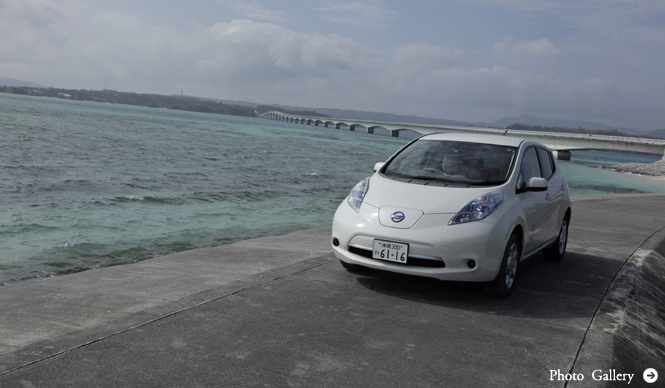
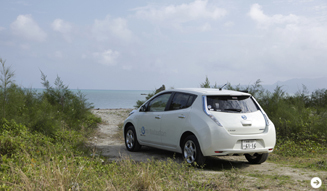
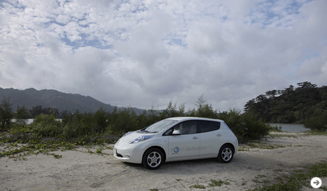
With the deep blue sea as a backdrop and a gentle sea breeze, I began photographing the Nissan Leaf, feeling a bead of sweat trickle down my forehead. Glancing at the instrument panel, the outside temperature read 25°C. It was mid-February, a time when Tokyo was shivering under a cold snap, yet here I was, participating in a Leaf test drive event hosted by Nissan in Okinawa.
"Look, an electric car is charging!" After finishing the photoshoot, as I plugged the Leaf into a rapid charger at a convenience store, three young boys passing by excitedly ran over. While children are naturally drawn to novelty, the Leaf, with its faint whirring motor sound as it glides away, seemed to capture their boundless curiosity, sparking images of a future world.
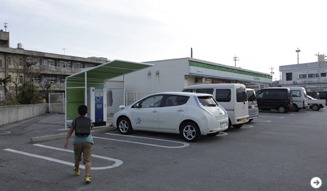
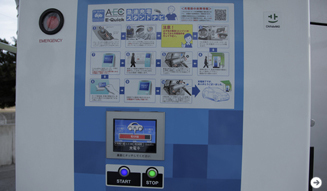
The day when the Leaf and other EVs become common transportation for Okinawans is fast approaching. In fact, a project is currently underway to make that day a reality as soon as possible: the Okinawa EV Town Concept.
"Okinawa is inherently a suitable place for EV adoption," a Nissan public relations representative stated during the presentation prior to the test drive. Why is that?—The geographical factors—approximately 130 km north to south and 30 km east to west—play a significant role. This means the range limitations, a weak point for EVs, are not a critical issue, and infrastructure development can be achieved with minimal investment. Furthermore, charging facilities can be efficiently placed along the main arterial roads running north and south. Indeed, Okinawa already has 27 rapid chargers installed at 18 key locations, including highway service areas (SA), roadside stations, and convenience stores, with a balanced distribution of standard charging facilities at hotels and tourist spots.
NISSAN LEAF
Introducing the Nissan Leaf! Special Edition
Okinawa's Present and Future with Electric Vehicles (2)
Rental Cars: The Vanguard of EV Adoption
In this setting, rental cars are poised to become the vanguard of EV adoption. Okinawa is, without a doubt, one of Japan's premier resort destinations, attracting 6 million tourists annually, half of whom utilize rental cars. Consequently, introducing the Leaf into rental fleets presents an excellent opportunity for users to experience EVs, thereby contributing to a nationwide ripple effect. With this in mind, Nissan has actively supported the introduction of EV rental cars in the prefecture, delivering 220 Leafs, approximately 1% of the total rental car fleet in Okinawa.
However, even with the widespread adoption of EVs in Okinawa, if they remain primarily rental cars, it cannot be considered true "adoption." The challenge lies in how to gain acceptance as everyday transportation for local residents.—.
"Typically, rental cars are replaced on a three-year cycle. This means that EVs that have completed their service as rental cars will be continuously supplied to the used car market at reasonable prices each year. Given that the Okinawa used car market handles 900,000 vehicles, the scheme for EV adoption involves creating demand for EVs by developing charging infrastructure."
These are the words of Mr. Munenori Matsumoto of AEC (Advanced Energy Company), a company responsible for installing and operating charging facilities in Okinawa. Established in 2010, AEC is backed by capital from 10 related companies within the prefecture, as well as 26 companies ranging from automakers to IT solution providers and trading firms. It is, in essence, the driving force behind the Okinawa EV Town Concept.
According to Mr. Matsumoto, the company's business plan, titled the "Okinawan EV Adoption Model," outlines a first phase of installing approximately 50 rapid charging stations, primarily at highway SAs and tourist spots, to support infrastructure for tourists using EV rentals. The second phase, aiming for three to four years from now, plans to increase the total number of stations to around 100, considering the usability for local residents who will purchase used EVs.
NISSAN LEAF
Introducing the Nissan Leaf! Special Edition
Okinawa's Present and Future with Electric Vehicles (3)
Making Use of Charging Time
The venue for this test drive was "Kanucha Bay Resort," a resort hotel located on the east coast of Nago City. The parking lot, lined with palm trees, is equipped with 16 standard charging ports. While most other resort hotels typically offer only about two, this facility is exceptionally well-prepared to welcome EV rental cars.
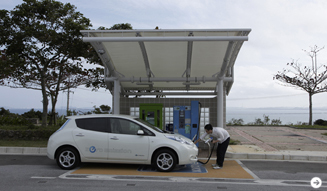
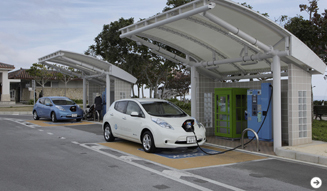
During the test drive, based at Kanucha Bay Resort, we covered 254.9 km over two days. This involved standard charging while at the hotel and two rapid charging sessions. On the first day, we used a convenience store's rapid charger, and on the second, the one at the Igi SA on the Okinawa Expressway. At the convenience store, the charging was completed while I picked up drinks and snacks and browsed magazines. At the service area, it was done while I captured memories of the trip with my iPhone, focusing on the stunning view before me. By integrating the 30 minutes of rapid charging time into other activities rather than simply waiting, the usability of an EV can be significantly enhanced. This was something I reaffirmed during my test drive in Okinawa.
While charging at Igi SA, I encountered a young family who appeared to be tourists. The father was entertaining a small child, while the mother handled the Leaf's charging. This was a sight I hadn't seen at self-service gas stations. There was a palpable sense of happiness in the air. Meanwhile, it was just me and photographer K (a man in his 40s), dressed in shorts and a bandana, on what was strictly a work trip, not a vacation.—As our eyes met the moment the mother finished charging, I couldn't help but think, "We're on a business trip, not a vacation," with a wry smile.
What left the most lasting impression over the two days was the sense of security that rapid chargers were always within reach. When I searched for rapid charging facilities on the instrument panel's monitor, I found they were generally within the vehicle's cruising range. On the way back to the hotel on the first day, the distance to the destination displayed by the car navigation exceeded the remaining range, but I wasn't worried. I knew there was a charging station nearby if needed.
NISSAN LEAF
Introducing the Nissan Leaf! Special Edition
Okinawa's Present and Future with Electric Vehicles (4)
Smart Island Okinawa
Although it was a short test drive, I noticed several things that made Okinawa seem EV-user-friendly. For instance, the charging facilities at the Okinawa Expressway SAs are equipped with two charging spots each, and even have waiting areas for vehicles needing to queue. They are also covered, protecting users from rain during charging. The charging spots are conveniently located near shops and restaurants, allowing for smooth transitions to shopping or grabbing a coffee while charging. Signage guiding users to the charging spaces is also excellent. I sincerely hope NEXCO West Japan takes note.
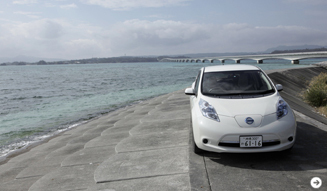
On the morning of the second day, I drove across a long bridge spanning the crystal-clear sea in search of a photo opportunity. It was the Kouri Bridge, Okinawa's longest bridge, connecting Kouri Island and Yagaji Island in the northern part of the main island. As we reached the apex of the bridge, a breathtaking panorama unfolded outside the car window, where the blue sky melted into the clear sea. I couldn't resist opening the Leaf's windows fully, allowing the dry air to carry the gentle sound of the waves into the cabin. For a moment, I listened to the pleasant melody composed by the wind and waves. It was a cliché, but I felt gently embraced by nature. This was a sensation I never experienced when driving with the roar of an engine. Setting aside the question of how the electricity for charging is generated, I felt that the EV was perfectly suited to Okinawa's magnificent environment.
"We are promoting EV adoption not solely for environmental reasons. EVs are essentially mobile batteries, and by increasing their numbers, we can build a smart grid society at a lower cost."
Mr. Munenori Matsumoto of AEC emphasized this to us during the press conference. The goal is to boost the regional economy while preserving the natural environment, with an eye on energy issues. This is a commonly cited benefit of a smart grid society. Whether this wonderful scheme remains a pipe dream or becomes a reality depends significantly not only on government and corporate efforts but also on the awareness of each individual resident. It would be wonderful if, by the time the elementary school children I met at the convenience store grow up and get behind the wheel of an EV, Okinawa has become a smart island that the world looks to as a model. With such thoughts, I began my journey back to the frigid climate of Tokyo from this earthly paradise.