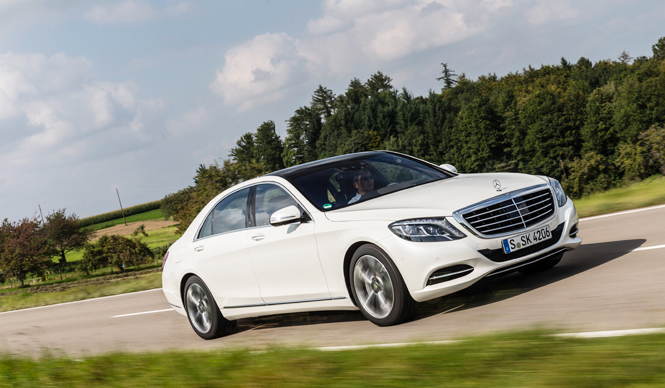
Test drive of the Mercedes-Benz S 500 Plug-in Hybrid in Germany | Mercedes-Benz
Mercedes-Benz S 500 PLUG-IN HYBRID
Mercedes-Benz S 500 Plug-in Hybrid
First Drive of Mercedes-Benz's Plug-in Hybrid in Germany
We test drove the Mercedes-Benz S 500 Plug-in Hybrid, the brand's first plug-in hybrid model, in Stuttgart, Germany. This report is by Tatsuya Otani.
Text by OTANI Tatsuya
The Changes Plug-in Hybrids Bring to Our Lives
I believe plug-in hybrid cars, which are currently a hot topic, are vehicles that possess two distinct talents.
One is the talent of an EV (electric vehicle) that produces zero emissions while driving. The other is the talent of a hybrid car, now synonymous with fuel efficiency. In other words, a plug-in hybrid car is one that combines the advantages of both EVs and hybrid cars into a single vehicle.
The S 500 Plug-in Hybrid, announced as Mercedes-Benz's first plug-in hybrid car (Mercedes calls them PIH, but we will use the more common Japanese abbreviation PHV below), is no different from conventional PHVs in that it combines the strengths of EVs and hybrid cars. However, its commitment to "thoroughly refining automotive efficiency to further reduce CO2 emissions" represents an unprecedented endeavor that truly impressed me.
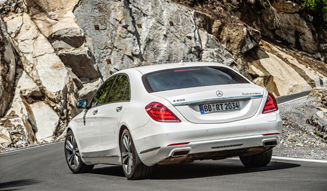
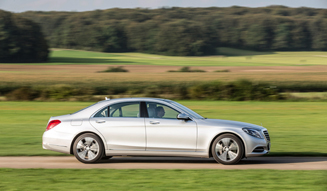
Before I delve into its "groundbreaking philosophy" later, let me first explain how owning the S 500 Plug-in Hybrid will change our lives.
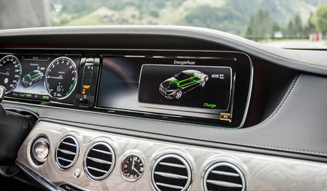
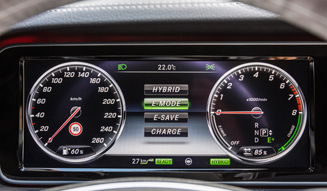
When fully charged, the S 500 Plug-in Hybrid's onboard lithium-ion battery allows for an EV driving range of up to 33 km. While a range of 33 km per charge might seem too short to be practical, according to Ministry of Land, Infrastructure, Transport and Tourism statistics, approximately 70% of all passenger cars in Japan have a daily driving distance of less than 30 km. This means that about 70% of Japanese users can drive the S 500 Plug-in Hybrid without consuming a single drop of gasoline by charging the battery at home every night.
Mercedes-Benz S 500 PLUG-IN HYBRID
Mercedes-Benz S 500 Plug-in Hybrid
First Drive of Mercedes-Benz's Plug-in Hybrid in Germany (2)
Environmental Benefits, Running Costs, and Power: All Enhanced by Electricity
Speaking of the benefits of running a car on electricity, the first thing that comes to mind is reduced CO2 emissions (while the car itself emits zero CO2 during operation, CO2 is still emitted during power generation). But did you also know that the running costs, in this case electricity costs, are lower?
For example, the cost to fully charge the S 500 Plug-in Hybrid's battery is estimated to be between 200-300 yen. In contrast, driving the same 33 km on gasoline would cost about 530 yen at a fuel efficiency of 10 km/l, and even at 15 km/l, it would cost around 350 yen (calculated with gasoline at 160 yen per liter). Therefore, at present, PHVs are not only environmentally friendly but also kind to your wallet.
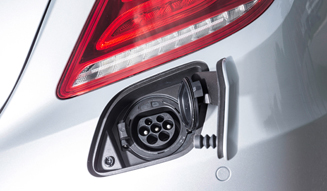
However, on weekends, you might go out with family or head to the golf course with friends. In such cases, a 33 km range would be insufficient. That's when the PHV's other talent comes into play: you can drive the S 500 Plug-in Hybrid as a hybrid car.
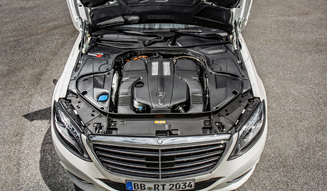
The newly developed 3.0-liter V6 engine delivers a maximum output of 333 ps and a peak torque of 480 Nm. Furthermore, when needed, the power of the electric motor joins in, boosting the maximum output to 442 ps and the peak torque to 650 Nm.
These specifications rival those of the existing S 550. As a result, the S 500 Plug-in Hybrid offers an exhilarating drive. During the international test drive event in Germany, we navigated extensively around Stuttgart, the home of Mercedes, experiencing powerful torque in the city and smooth acceleration on the Autobahn.
Mercedes-Benz S 500 PLUG-IN HYBRID
Mercedes-Benz S 500 Plug-in Hybrid
First Drive of Mercedes-Benz's Plug-in Hybrid in Germany (3)
Japanese Name: "S 550 Plug-in Hybrid Long"
While it will be sold as the "S 500 Plug-in Hybrid" in Europe, the Japanese version will be renamed the "S 550 Plug-in Hybrid Long."
As you know, Mercedes model names combine a letter indicating the class with a three-digit number representing engine performance. In reality, the "S 500 Plug-in Hybrid" has performance equivalent to a "550." However, in Europe, where many fans are familiar with the number 500, it seems to have been deliberately named the "S 500 Plug-in Hybrid."
However, given that its performance is indeed equivalent to a "550" and it is a long-wheelbase model, it will be sold under a different name in Japan (and North America) as mentioned earlier. Of course, there is no practical difference, but I wonder if I'm the only one who feels a bit more fortunate when told it's the "S 550 Plug-in Hybrid Long."
Now, let me explain the "groundbreaking philosophy" mentioned at the beginning.
PHVs, when charged daily and used solely for short trips, are virtually indistinguishable from EVs. Since this greatly contributes to CO2 reduction, they receive special preferential treatment in officially announced data.
This means that a certain proportion of the driving is assumed to be powered by electricity charged into the battery, and fuel consumption is calculated as if this portion did not consume fuel.
As a result, the S 500 Plug-in Hybrid boasts a published fuel economy of nearly 36 km/l (converted to Japanese standards) per 100 km. However, this is a calculation that combines the EV and hybrid car capabilities. It doesn't tell us the fuel economy when driven solely on gasoline. In other words, this figure can serve as a "cloak" to conceal the fuel economy when used primarily as a hybrid car.
Mercedes-Benz S 500 PLUG-IN HYBRID
Mercedes-Benz S 500 Plug-in Hybrid
First Drive of Mercedes-Benz's Plug-in Hybrid in Germany (4)
The Flagship Closest to the Future
However, if the "actual fuel economy" as a hybrid car is not disclosed, it could foster an environment where automakers have no incentive to strive for improved efficiency. This could create a trend where they feel no pressure to make improvements.
Yet, Mercedes remains steadfast in its pursuit of genuine automotive efficiency and has decided to independently publish its "fuel economy data when driven without charging the battery." This can be considered a bold decision.
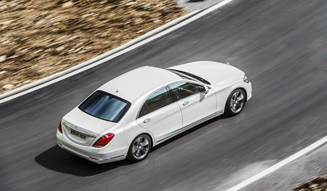
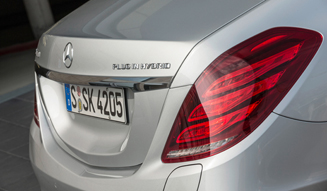
The figure is 15.6 km/l in Japanese notation. Furthermore, this data was obtained using the European measurement method, which is considered much stricter than Japan's JC08 mode and closer to real-world fuel economy. Therefore, it would be no surprise if you achieved similar fuel economy when driving the "S 550 Plug-in Hybrid" in Japan.
Mercedes has not only focused on apparent fuel economy figures but also diligently pursued the fundamental efficiency of the vehicle. Their philosophy is remarkably advanced. In that sense, the S 500 Plug-in Hybrid can rightly be called "the most futuristic flagship model from Mercedes-Benz."

Mercedes-Benz S 500 PLUG-IN HYBRID
Mercedes-Benz S 500 Plug-in Hybrid
Body Dimensions | Length 5,246 x Width 1,899 x Height 1,494 mm
Wheelbase | 3,165 mm
Tread Front/Rear | 1,624 / 1,632 mm
Minimum Ground Clearance | 130 mm
Weight | 2,215 kg
Engine | 2,996cc V6 DOHC Twin-Turbo
Bore x Stroke | 88.0 x 82.1 mm
Compression Ratio | 10.5
Engine Max Output | 245 kW (333 ps) / 5,250-6,000 rpm
Engine Max Torque | 480 Nm (48.9 kgm) / 1,600-4,000 rpm
Motor | AC Synchronous Motor
Motor Output | 85 kW (115 ps)
Motor Torque | 340 Nm (34.7 kgm)
System Max Output | 325 kW (442 ps)
System Max Torque | 650 Nm (66.3 kgm)
Transmission | 7-speed AT (7G-TRONIC)
Drivetrain | FR
Tires Front/Rear | 245/50R18 / 275/45R18
Brakes Front/Rear | Ventilated Discs / Ventilated Discs
Fuel Economy (NEDC) | 2.8 ℓ/ 100 km
Minimum Turning Radius | 6.15 m
Trunk Capacity | 365 Liters